📘 AP Calculus BC · 考试介绍📘 AP Calculus BC · Exam Overview
新生先看:AP Calculus BC 考试结构、时长、计算器政策、1-5 分评分标准一页看懂。New here? A one-glance overview of AP Calculus BC — format, timing, calculator policy, and the 1–5 score scale.
得分政策 · 1-5 分标准Score Policy · 1–5 Scale
最终成绩按 Raw Score 折算,从 1 到 5。多数美国大学 4-5 可换学分,部分接受 3。Raw scores convert to a 1–5 scaled score. Most US colleges grant credit for 4–5; some accept 3.
| AP 分数AP Score | 原始分区间Raw Score Range | 说明Description |
|---|---|---|
| 5 | 72 – 110 | Extremely Well Qualified(相当于大学 A)Extremely Well Qualified (college A) |
| 4 | 60 – 71 | Well Qualified(A- / B+ / B)Well Qualified (A- / B+ / B) |
| 3 | 43 – 59 | Qualified — 通常视作「通过」Qualified — widely considered passing |
满分 ≈ 110 分(45 MCQ × 1.25 + 6 FRQ × 9)。Max ≈ 110 (45 MCQ × 1.25 + 6 FRQ × 9).
Part I · FRQ 押题分析Part I · FRQ Prediction Analysis
11 年槽位热力图11-Year Slot Heatmap
横轴是年份,纵轴是 FRQ 位置。同色块 = 同类考点。X-axis: year. Y-axis: FRQ slot. Same color = same topic archetype.
| 2014 | 2015 | 2016 | 2017 | 2018 | 2019 | 2021 | 2022 | 2023 | 2024 | 2025 | |
|---|---|---|---|---|---|---|---|---|---|---|---|
| FRQ1 Calc | 流入流出率Rate In/Out | 流入流出率Rate In/Out | 流入流出率Rate In/Out | 流入流出率Rate In/Out | 流入流出率Rate In/Out | 流入流出率Rate In/Out | 表格 / MVT / 近似Table · MVT | 流入流出率Rate In/Out | 表格 / MVT / 近似Table · MVT | 表格 / MVT / 近似Table · MVT | 流入流出率Rate In/Out |
| FRQ2 Calc | 极坐标面积Polar Area | 极坐标面积Polar Area | 参数 / 向量运动Parametric · Vector | 极坐标面积Polar Area | 流入流出率Rate In/Out | 参数 / 向量运动Parametric · Vector | 参数 / 向量运动Parametric · Vector | 参数 / 向量运动Parametric · Vector | 参数 / 向量运动Parametric · Vector | 参数 / 向量运动Parametric · Vector | 极坐标面积Polar Area |
| FRQ3 No Calc | f' 图像分析f' Graph | 表格 / MVT / 近似Table · MVT | f' 图像分析f' Graph | f' 图像分析f' Graph | f' 图像分析f' Graph | f' 图像分析f' Graph | 面积 / 体积Area · Volume | f' 图像分析f' Graph | 微分方程Diff. Eq. | 微分方程Diff. Eq. | 表格 / MVT / 近似Table · MVT |
| FRQ4 No Calc | 表格 / MVT / 近似Table · MVT | 微分方程Diff. Eq. | 微分方程Diff. Eq. | 微分方程Diff. Eq. | 表格 / MVT / 近似Table · MVT | 表格 / MVT / 近似Table · MVT | f' 图像分析f' Graph | 表格 / MVT / 近似Table · MVT | f' 图像分析f' Graph | f' 图像分析f' Graph | f' 图像分析f' Graph |
| FRQ5 No Calc | 面积 / 体积Area · Volume | 微分方程Diff. Eq. | 面积 / 体积Area · Volume | 微分方程Diff. Eq. | 微分方程Diff. Eq. | 微分方程Diff. Eq. | 微分方程Diff. Eq. | 面积 / 体积Area · Volume | 面积 / 体积Area · Volume | 表格 / MVT / 近似Table · MVT | 微分方程Diff. Eq. |
| FRQ6 No Calc | Taylor 级数Taylor Series | Taylor 级数Taylor Series | Taylor 级数Taylor Series | Taylor 级数Taylor Series | Taylor 级数Taylor Series | 幂级数Power Series | 幂级数Power Series | 幂级数Power Series | Taylor 级数Taylor Series | 幂级数Power Series | 幂级数Power Series |
- FRQ5 微分方程 89% 必考 — 斜率场 + 可分离 + Euler 三件套
- FRQ6 级数 100% 必考 — Taylor/Maclaurin、收敛判定、Lagrange error
- FRQ1 流入流出率 78% — 5 年内每年都考,公式套路固定
- FRQ2 参数 67% vs 极坐标 33%,近 5 年参数为主,今年参数占优
- FRQ3/4 都是 f' 图像 或 表格 分析,套路相似,一起背
- FRQ5 Differential Equations 89% Must-Know — slope field + separable + Euler trio
- FRQ6 Series 100% Must-Know — Taylor/Maclaurin, convergence tests, Lagrange error
- FRQ1 Rate In/Out 78% — tested every year in the past 5 years, fixed formula patterns
- FRQ2 Parametric 67% vs Polar 33%, parametric dominant in the past 5 years, parametric favored this year
- FRQ3/4 both are f' graph or table analysis, similar patterns, study them together
2026 每个槽位的押题概率2026 Prediction Probability per Slot
概率 = 该题型在 2014-2025 的出现频率。Probability = historical frequency of this topic on 2014-2025 exams.
| 槽位Slot | 最可能Top pick | 备选Backup |
|---|---|---|
| FRQ1 (Calc) | 流入流出率Rate In/Out 73% | 表格 / MVT / 近似Table · MVT 27% |
| FRQ2 (Calc) | 参数 / 向量运动Parametric · Vector 55% | 极坐标面积Polar Area 36% |
| FRQ3 (No Calc) | f' 图像分析f' Graph 55% | 表格 / MVT / 近似Table · MVT 18% / 微分方程Diff. Eq. 18% |
| FRQ4 (No Calc) | 表格 / MVT / 近似Table · MVT 36% / f' 图像分析f' Graph 36% | 微分方程Diff. Eq. 27% |
| FRQ5 (No Calc) | 微分方程Diff. Eq. 55% | 面积 / 体积Area · Volume 36% |
| FRQ6 (No Calc) | Taylor 级数Taylor Series 55% | 幂级数Power Series 45% |
📱 如何用 iPad / Mac 对着网页做题?
本手册三处都有「导出练习卷」功能 —— MCQ(下方)、FRQ 槽位真题(Part II 每个槽位右上)、2026 模拟卷(Part III 顶部):
- MCQ 库:筛选想做的题 → 点 导出当前筛选为练习卷 → 每题下带横线笔记格子 + 末尾答题卡 Ⓐ Ⓑ Ⓒ Ⓓ Ⓔ
- FRQ 真题:在 Part II 每个槽位(FRQ1-6),点槽位内的 📱 导出 iPad 练习卷 → 自动导出该槽位 9-11 道历年真题,每题预留 2 页解题笔记空间
- 2026 模拟卷:Part III 顶部 📱 导出整套模拟卷(无答案) → 6 道原创 FRQ 打印成一份完整卷,每题 2 页笔记空间
iPad 工作流:点导出按钮 → Safari 分享(⬆️)→「打印」→ 双指撑开预览 → 右下分享 → 存入 GoodNotes / Notability → 用 Apple Pencil 在横线格子上写解题过程。做完回网页点「答案 / 解答」对照。
📱 How to practice on iPad / Mac against this page?
Three places support "Export as practice sheet" — MCQ (below), FRQ past questions (Part II, each slot), 2026 mock (Part III top):
- MCQ bank: filter → click Export Current Filter as Practice Sheet → each question has writing lines + bubble sheet Ⓐ Ⓑ Ⓒ Ⓓ Ⓔ
- FRQ past: in Part II, click 📱 Export Practice Sheet inside a slot → 9-11 past FRQs with 2 pages of writing space per problem
- 2026 Mock: Part III top 📱 Export Full Mock (no answers) → 6 original FRQs as one booklet, 2 pages per problem
iPad workflow: click Export → Safari Share (⬆️) → "Print" → pinch preview open → Share bottom-right → save to GoodNotes / Notability → work with Apple Pencil on the lines. Come back to the web page to check answers.
Part II · FRQ 六大槽位 · 模板 + 真题Part II · FRQ Six Slots · Templates + Past Questions
每个 FRQ 槽位:怎么识别 → 解题模板 → 踩分点 → 历年真题(点击展开)。For each FRQ slot: how to identify → solution template → pitfalls → past FRQs (click to expand).
FRQ1 · 流入流出率 / 累积量FRQ1 · Rate In/Out · Accumulation
考 Unit 6(积分与累积变化)。给你两个 rate(流入 + 流出),让你求累积量、变化率、最大/最小时刻。Tests Unit 6 (Integration and Accumulation of Change). Given two rates (in + out), find accumulated amount, rate of change, and max/min times.
🔍 怎么一眼认出🔍 How to Identify
- 有 rate(t) 函数或表格,单位是「per hour / per minute / per second」
- 问题涉及「total amount」「accumulated」「net change」「when is it max/min」
- Calculator allowed(FRQ1 永远 Part A)
- A rate(t) function or table with units 'per hour / per minute / per second'
- Question involves 'total amount', 'accumulated', 'net change', 'when is it max/min'
- Calculator allowed (FRQ1 is always Part A)
📐 解题模板📐 Solution Template
- Step 1:识别累积公式。净量 \(= \int_a^b (E(t) - L(t))\,dt\)。若问 \(t=b\) 时总量,加初始值 \(A(0)\)。
- Step 2:rate of change 就是 rate 本身。求 \(E(5)\)(或 \(E'(5)\))时直接代入 / 求导即可。用 calculator 求积分时别手算!
- Step 3:求「when is amount max」→ 解 \(A'(t)=0\),即 \(E(t)-L(t)=0\),sign chart 判断。
- Step 4:若 \(L(t)\) 给的是表格 → 用 trapezoidal sum 近似 \(\int L\,dt = \sum \frac{b-a}{2}(L(a)+L(b))\)。
- Step 5:单位!每道 sub-part 都写单位(cars, gallons, dollars)——没单位就丢分。
- Step 1: Identify the accumulation formula. Net amount \(= \int_a^b (E(t) - L(t))\,dt\). If asking for total amount at \(t=b\), add the initial value \(A(0)\).
- Step 2: Rate of change IS the rate itself. For \(E(5)\) (or \(E'(5)\)) just plug in / differentiate. Don't compute integrals by hand when calculator is allowed!
- Step 3: 'When is amount max' → solve \(A'(t)=0\), i.e., \(E(t)-L(t)=0\), then use a sign chart.
- Step 4: If \(L(t)\) is given as a table → use trapezoidal sum to approximate \(\int L\,dt = \sum \frac{b-a}{2}(L(a)+L(b))\).
- Step 5: Units! Write units on every sub-part (cars, gallons, dollars) — missing units = lost points.
⚠️ 踩分点与易错⚠️ Pitfalls & Common Errors
- ⚠️ 积分符号下限漏掉初始量 \(A(0)\)(第 3 题最常见)
- ⚠️ trapezoidal 公式 \((b-a)/2\) 写成 \((b-a)\)
- ⚠️ Calc-allowed 的题用手算积分浪费时间又容易错
- ⚠️ 「rate of change」和「amount」概念混
- ⚠️ 最后一问通常问「meaning of expression in context」——必须写单位 + 时间区间
- ⚠️ Forgetting the initial amount \(A(0)\) under the integral (most common error on Q3)
- ⚠️ Writing the trapezoidal coefficient as \((b-a)\) instead of \((b-a)/2\)
- ⚠️ Manual integration on calculator-allowed problems wastes time and invites errors
- ⚠️ Confusing 'rate of change' with 'amount'
- ⚠️ The last part often asks 'meaning of expression in context' — must write units + time interval
历年真题(9 道 · 点击展开)Past FRQs (9 · Click to Expand)
2014 FRQ1 · Grass clippings A(t)=6.687(0.931)^t; 平均变化率 + 线性近似Grass clippings A(t)=6.687(0.931)^t; avg rate of change + linear approx Calculator Allowed
Grass clippings are placed in a bin, where they decompose. For \(0 \le t \le 30\), the amount of grass clippings remaining in the bin is modeled by \(A(t) = 6.687(0.931)^{t}\), where \(A(t)\) is measured in pounds and \(t\) is measured in days.
- (A) Find the average rate of change of \(A(t)\) over the interval \(0 \le t \le 30\). Indicate units of measure.
- (B) Find the value of \(A'(15)\). Using correct units, interpret the meaning of the value in the context of the problem.
- (C) Find the time \(t\) for which the amount of grass clippings in the bin is equal to the average amount of grass clippings in the bin over the interval \(0 \le t \le 30\).
- (D) For \(t > 30\), \(L(t)\), the linear approximation to \(A\) at \(t = 30\), is a better model for the amount of grass clippings remaining in the bin. Use \(L(t)\) to predict the time at which there will be 0.5 pound of grass clippings remaining in the bin. Show the work that leads to your answer.
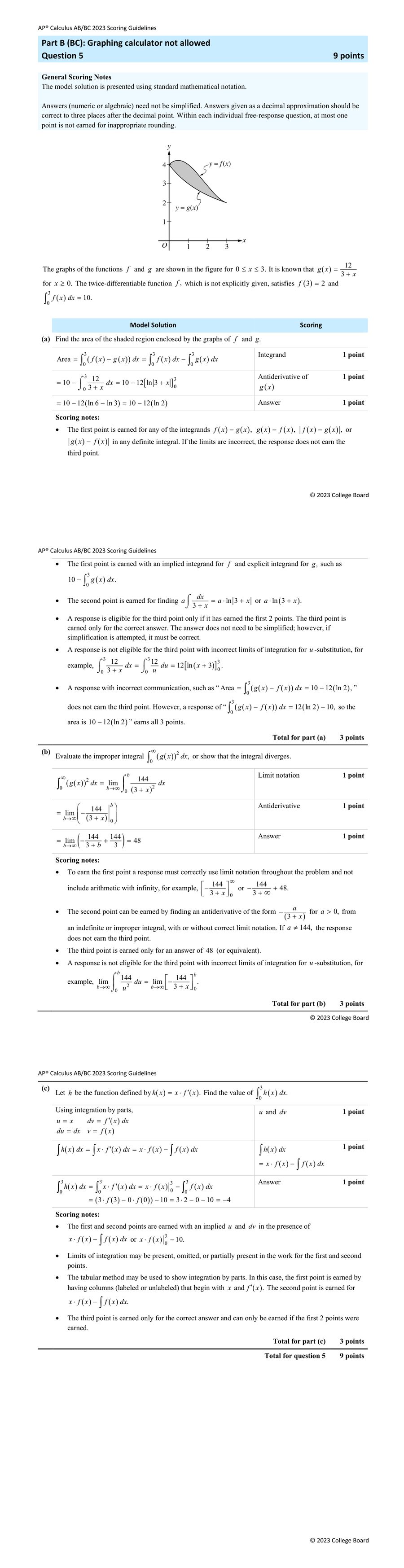
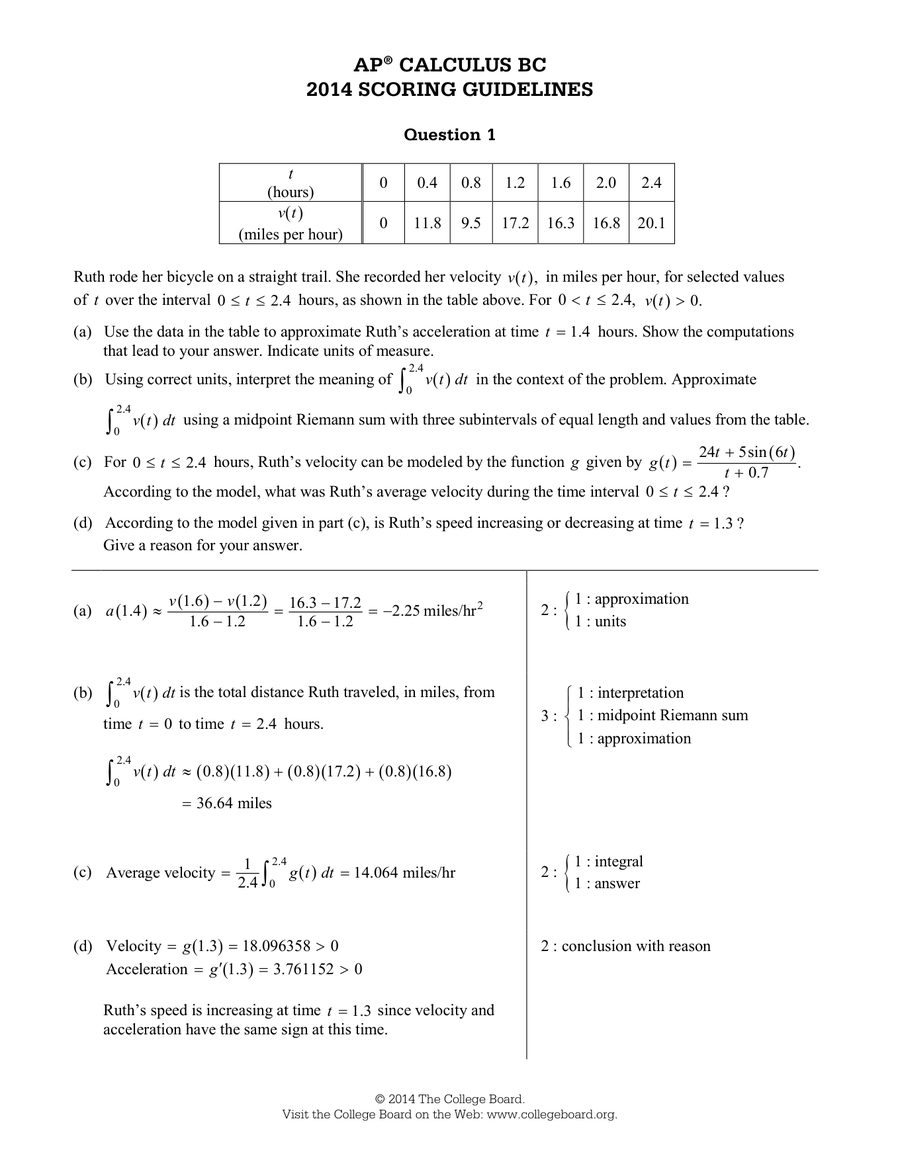
📝 点击展开评分标准(Scoring Guideline)📝 Expand Scoring Guideline
2015 FRQ1 · Rainwater 罐进水 R(t) 排水 D(t)Rainwater tank inflow R(t), drain D(t) Calculator Allowed
At time \(t = 0\) minutes, a tank contains 100 liters of water. The piecewise-linear graph above shows the rate \(R(t)\), in liters per minute, at which water is pumped into the tank during a 55-minute period.
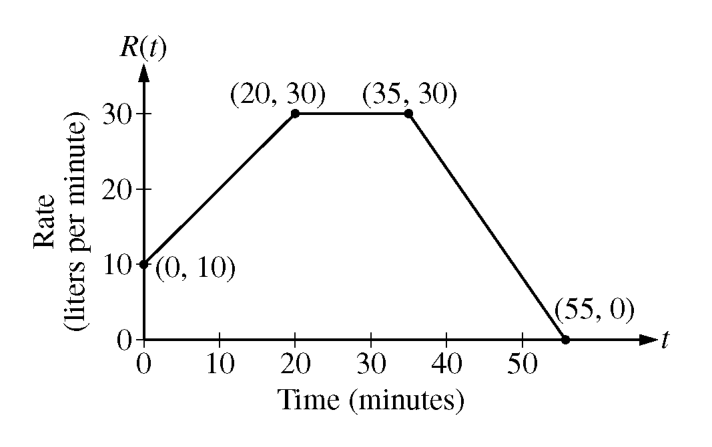
- (A) Find \(R'(45)\). Using appropriate units, explain the meaning of your answer in the context of this problem.
- (B) How many liters of water have been pumped into the tank from time \(t = 0\) to time \(t = 55\) minutes? Show the work that leads to your answer.
- (C) At time \(t = 10\) minutes, water begins draining from the tank at a rate modeled by the function \(D\), where \(D(t) = 10\,e^{(\sin t)/10}\) liters per minute. Water continues to drain at this rate until time \(t = 55\) minutes. How many liters of water are in the tank at time \(t = 55\) minutes?
- (D) Using the functions \(R\) and \(D\), determine whether the amount of water in the tank is increasing or decreasing at time \(t = 45\) minutes. Justify your answer.
📝 点击展开评分标准(Scoring Guideline)📝 Expand Scoring Guideline
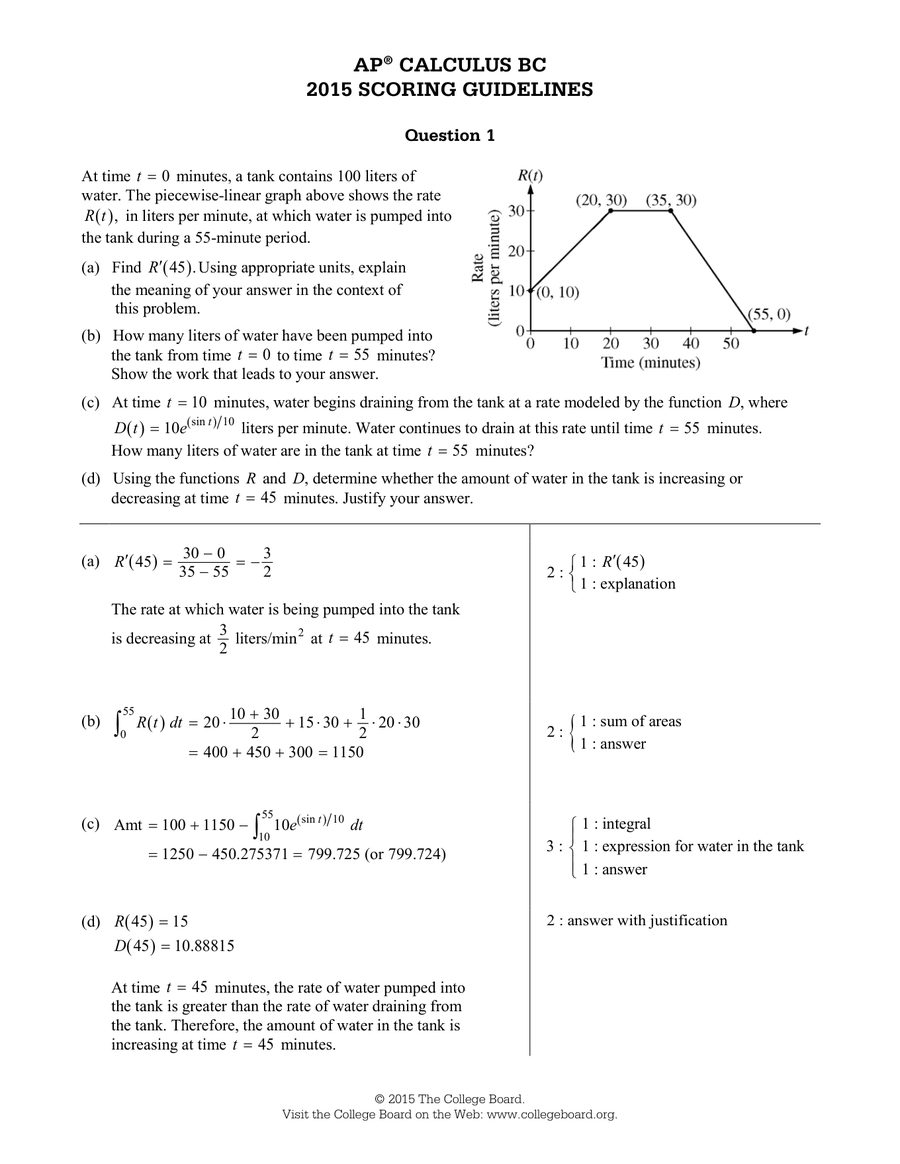
2016 FRQ1 · 水泵入 W(t)=2000e^(-t²/20) + 表格移除率 RWater pump in W(t)=2000e^(-t²/20) + tabular removal rate R Calculator Allowed
Water is pumped into a tank at a rate modeled by \(W(t) = 2000\,e^{-t^{2}/20}\) liters per hour for \(0 \le t \le 8\), where \(t\) is measured in hours. Water is removed from the tank at a rate modeled by \(R(t)\) liters per hour, where \(R\) is differentiable and decreasing on \(0 \le t \le 8\). Selected values of \(R(t)\) are shown in the table above. At time \(t = 0\), there are 50,000 liters of water in the tank.
| t (hours) | R(t) (liters per hour) |
|---|---|
| 0 | 1340 |
| 1 | 1190 |
| 3 | 950 |
| 6 | 740 |
| 8 | 700 |
- (A) Estimate \(R'(2)\). Show the work that leads to your answer. Indicate units of measure.
- (B) Use a left Riemann sum with the four subintervals indicated by the table to estimate the total amount of water removed from the tank during the 8 hours. Is this an overestimate or an underestimate of the total amount of water removed? Give a reason for your answer.
- (C) Use your answer from part (b) to find an estimate of the total amount of water in the tank, to the nearest liter, at the end of 8 hours.
- (D) For \(0 \le t \le 8\), is there a time \(t\) when the rate at which water is pumped into the tank is the same as the rate at which water is removed from the tank? Explain why or why not.
📝 点击展开评分标准(Scoring Guideline)📝 Expand Scoring Guideline
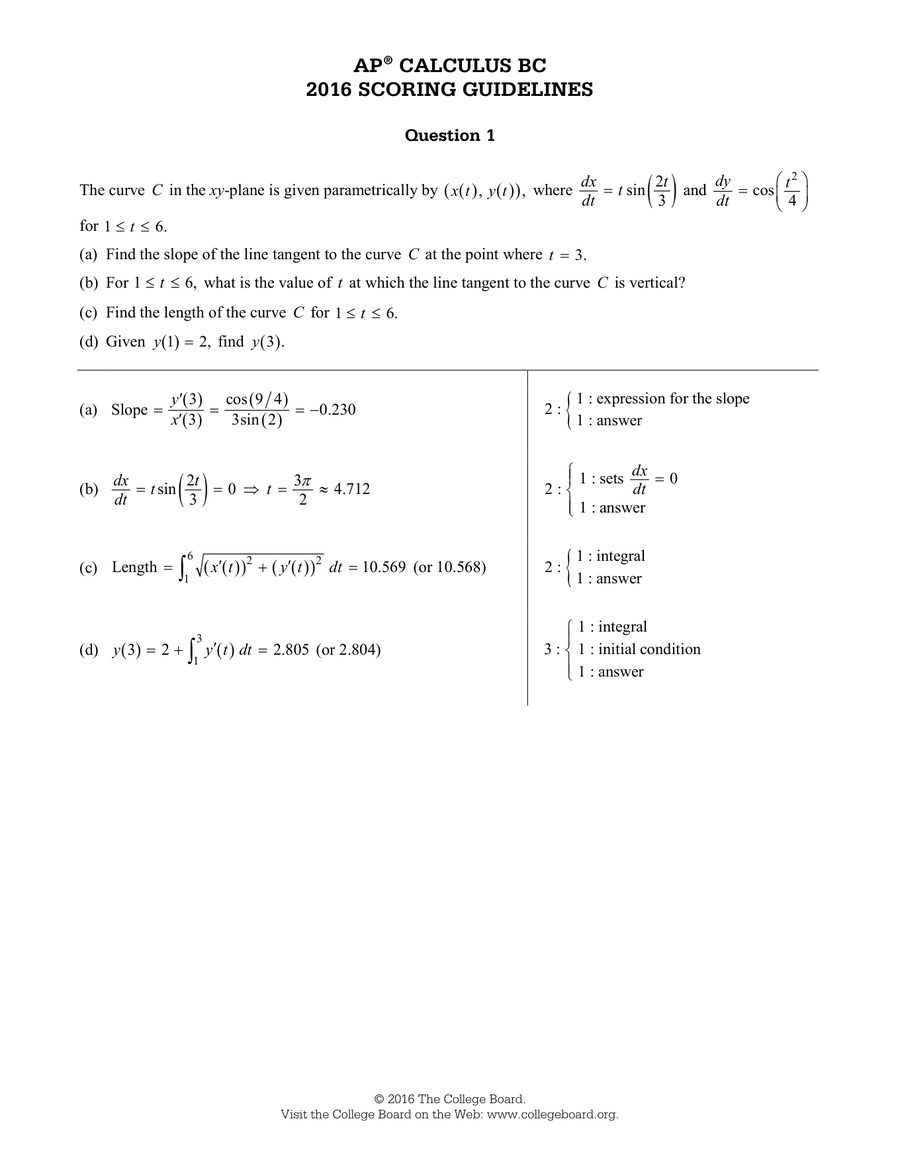
2017 FRQ1 · 水罐 cross section A(h) 高 10ft; filling + drainingTank cross section A(h), height 10ft; filling + draining Calculator Allowed
A tank has a height of 10 feet. The area of the horizontal cross section of the tank at height \(h\) feet is given by the function \(A\), where \(A(h)\) is measured in square feet. The function \(A\) is continuous and decreases as \(h\) increases. Selected values for \(A(h)\) are given in the table above.
| \(h\) (feet) | 0 | 2 | 5 | 10 |
|---|---|---|---|---|
| \(A(h)\) (square feet) | 50.3 | 14.4 | 6.5 | 2.9 |
- (A) Use a left Riemann sum with the three subintervals indicated by the data in the table to approximate the volume of the tank. Indicate units of measure.
- (B) Does the approximation in part (a) overestimate or underestimate the volume of the tank? Explain your reasoning.
- (C) The area, in square feet, of the horizontal cross section at height \(h\) feet is modeled by the function \(f\) given by \(f(h) = \dfrac{50.3}{e^{0.2h} + h}\). Based on this model, find the volume of the tank. Indicate units of measure.
- (D) Water is pumped into the tank. When the height of the water is 5 feet, the height is increasing at the rate of 0.26 foot per minute. Using the model from part (c), find the rate at which the volume of water is changing with respect to time when the height of the water is 5 feet. Indicate units of measure.
📝 点击展开评分标准(Scoring Guideline)📝 Expand Scoring Guideline
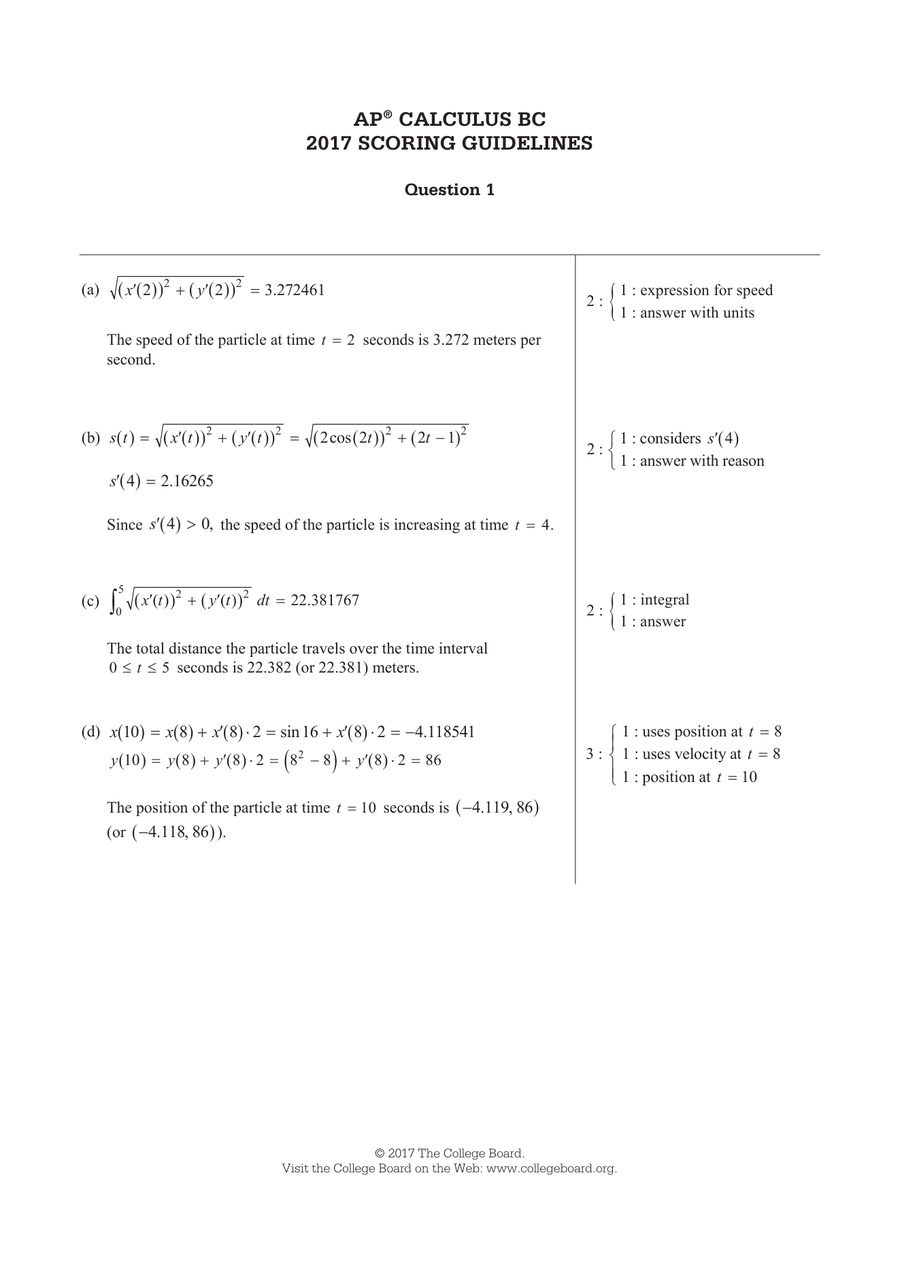
2018 FRQ1 · 人排队上扶梯 r(t)=44(t/100)³(1-t/300)People on escalator r(t)=44(t/100)³(1-t/300) Calculator Allowed
People enter a line for an escalator at a rate modeled by the function \(r\) given by \[r(t) = \begin{cases} 44\left(\dfrac{t}{100}\right)^3 \left(1 - \dfrac{t}{300}\right)^7 & \text{for } 0 \le t \le 300 \\ 0 & \text{for } t > 300 \end{cases}\] where \(r(t)\) is measured in people per second and \(t\) is measured in seconds. As people get on the escalator, they exit the line at a constant rate of 0.7 person per second. There are 20 people in line at time \(t = 0\).
- (A) How many people enter the line for the escalator during the time interval \(0 \le t \le 300\)?
- (B) During the time interval \(0 \le t \le 300\), there are always people in line for the escalator. How many people are in line at time \(t = 300\)?
- (C) For \(t > 300\), what is the first time \(t\) that there are no people in line for the escalator?
- (D) For \(0 \le t \le 300\), at what time \(t\) is the number of people in line a minimum? To the nearest whole number, find the number of people in line at this time. Justify your answer.
📝 点击展开评分标准(Scoring Guideline)📝 Expand Scoring Guideline
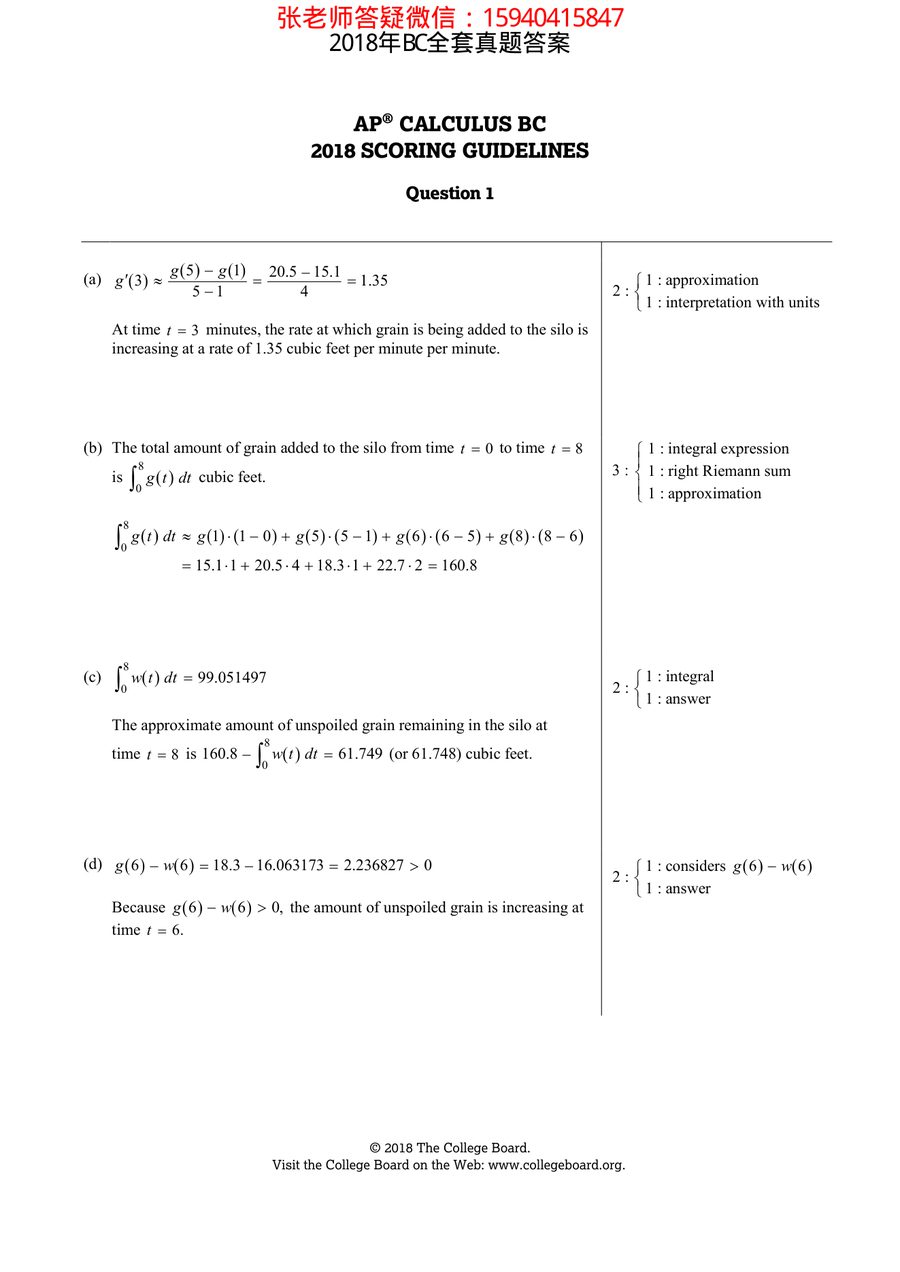
2018 FRQ2 · Plankton 细胞密度 p(h)=0.2h²e^(-0.0025h²); 深度积分Plankton cell density p(h)=0.2h²e^(-0.0025h²); depth integral Calculator Allowed
Researchers on a boat are investigating plankton cells in a sea. At a depth of \(h\) meters, the density of plankton cells, in millions of cells per cubic meter, is modeled by \(p(h) = 0.2 h^2 e^{-0.0025 h^2}\) for \(0 \le h \le 30\) and is modeled by \(f(h)\) for \(h > 30\). The continuous function \(f\) is not explicitly given.
- (A) Find \(p'(25)\). Using correct units, interpret the meaning of \(p'(25)\) in the context of the problem.
- (B) Consider a vertical column of water in this sea with horizontal cross sections of constant area 3 square meters. To the nearest million, how many plankton cells are in this column of water between \(h = 0\) and \(h = 30\) meters?
- (C) There is a function \(u\) such that \(0 \le f(h) \le u(h)\) for all \(h \ge 30\) and \(\int_{30}^{\infty} u(h)\,dh = 105\). The column of water in part (b) is \(K\) meters deep, where \(K > 30\). Write an expression involving one or more integrals that gives the number of plankton cells, in millions, in the entire column. Explain why the number of plankton cells in the column is less than or equal to 2000 million.
- (D) The boat is moving on the surface of the sea. At time \(t \ge 0\), the position of the boat is the point with coordinates \((x(t), y(t))\), where \(x'(t) = 662\sin(5t)\) and \(y'(t) = 880\cos(6t)\). Time \(t\) is measured in hours, and \(x(t)\) and \(y(t)\) are measured in meters. Find the total distance traveled by the boat over the time interval \(0 \le t \le 1\).
📝 点击展开评分标准(Scoring Guideline)📝 Expand Scoring Guideline
2019 FRQ1 · Parking lot 进/离车 E(t), L(t) tabularParking lot entering/leaving E(t), L(t) tabular Calculator Allowed
The rate at which cars enter a parking lot is modeled by \(E(t) = 30 + 5(t - 2)(t - 5)e^{-0.2t}\). The rate at which cars leave the parking lot is modeled by the differentiable function \(L\). Selected values of \(L(t)\) are given in the table above. Both \(E(t)\) and \(L(t)\) are measured in cars per hour, and time \(t\) is measured in hours after 5 A.M. (\(t = 0\)). Both functions are defined for \(0 \le t \le 12\).
| \(t\) (hours) | 2 | 5 | 9 | 11 | 12 |
|---|---|---|---|---|---|
| \(L(t)\) (cars per hour) | 15 | 40 | 24 | 68 | 18 |
- (A) What is the rate of change of \(E(t)\) at time \(t = 7\)? Indicate units of measure.
- (B) How many cars enter the parking lot from time \(t = 0\) to time \(t = 12\)? Give your answer to the nearest whole number.
- (C) Use a trapezoidal sum with the four subintervals indicated by the data in the table to approximate \(\displaystyle\int_2^{12} L(t)\,dt\). Using correct units, explain the meaning of \(\displaystyle\int_2^{12} L(t)\,dt\) in the context of this problem.
- (D) For \(0 \le t < 6\), 5 dollars are collected from each car entering the parking lot. For \(6 \le t \le 12\), 8 dollars are collected from each car entering the parking lot. How many dollars are collected from the cars entering the parking lot from time \(t = 0\) to time \(t = 12\)? Give your answer to the nearest whole dollar.
2022 FRQ1 · Toll plaza A(t)=450sin(0.62t); 队列累积 (AB/BC 同题)Toll plaza A(t)=450sin(0.62t); queue accumulation (AB/BC shared) Calculator Allowed
From 5 A.M. to 10 A.M., the rate at which vehicles arrive at a certain toll plaza is given by \(A(t) = 450\sqrt{\sin(0.62t)}\), where \(t\) is the number of hours after 5 A.M. and \(A(t)\) is measured in vehicles per hour. Traffic is flowing smoothly at 5 A.M. with no vehicles waiting in line.
- (A) Write, but do not evaluate, an integral expression that gives the total number of vehicles that arrive at the toll plaza from 6 A.M. \((t = 1)\) to 10 A.M. \((t = 5)\).
- (B) Find the average value of the rate, in vehicles per hour, at which vehicles arrive at the toll plaza from 6 A.M. \((t = 1)\) to 10 A.M. \((t = 5)\).
- (C) Is the rate at which vehicles arrive at the toll plaza at 6 A.M. \((t = 1)\) increasing or decreasing? Give a reason for your answer.
- (D) A line forms whenever \(A(t) \ge 400\). The number of vehicles in line at time \(t\), for \(a \le t \le 4\), is given by \(N(t) = \displaystyle\int_a^t (A(x) - 400)\,dx\), where \(a\) is the time when a line first begins to form. To the nearest whole number, find the greatest number of vehicles in line at the toll plaza in the time interval \(a \le t \le 4\). Justify your answer.
📝 点击展开评分标准(Scoring Guideline)📝 Expand Scoring Guideline

2025 FRQ1 · 🆕 入侵物种 C(t) = 7.6·arctan(0.2t), C'(t)=38/(25+t²)🆕 Invasive species C(t) = 7.6·arctan(0.2t), C'(t)=38/(25+t²) Calculator Allowed
An invasive species of plant appears in a fruit grove at time \(t = 0\) and begins to spread. The function \(C\) defined by \(C(t) = 7.6\,\arctan(0.2t)\) models the number of acres in the fruit grove affected by the species \(t\) weeks after the species appears. It can be shown that \(C'(t) = \dfrac{38}{25 + t^2}\).
Note. Your calculator should be in radian mode.
- (A) Find the average number of acres affected by the invasive species from time \(t = 0\) to time \(t = 4\) weeks. Show the setup for your calculations.
- (B) Find the time \(t\) when the instantaneous rate of change of \(C\) equals the average rate of change of \(C\) over the time interval \(0 \le t \le 4\). Show the setup for your calculations.
- (C) Assume that the invasive species continues to spread according to the given model for all times \(t > 0\). Write a limit expression that describes the end behavior of the rate of change in the number of acres affected by the species. Evaluate this limit expression.
- (D) At time \(t = 4\) weeks after the invasive species appears in the fruit grove, measures are taken to counter the spread of the species. The function \(A\), defined by \[A(t) = C(t) - \int_4^{t} 0.1 \cdot \ln(x)\,dx,\] models the number of acres affected by the species over the time interval \(4 \le t \le 36\). At what time \(t\), for \(4 \le t \le 36\), does \(A\) attain its maximum value? Justify your answer.
📝 点击展开评分标准(Scoring Guideline)📝 Expand Scoring Guideline

FRQ2 · 参数/向量运动 或 极坐标FRQ2 · Parametric/Vector Motion or Polar BC 专属BC Only
BC 专属题(Unit 9)。参数 66.7% / 极坐标 33.3%,近 5 年参数占优。BC-only question (Unit 9). Parametric 66.7% / Polar 33.3%; parametric has dominated the last 5 years.
🔍 怎么一眼认出🔍 How to Identify
- 参数型:给 x(t), y(t) 或 dx/dt, dy/dt;问 speed、acceleration、tangent、position
- 极坐标:给 r(θ) 公式;问 area、tangent line、rate of change of area
- Parametric type: given x(t), y(t) or dx/dt, dy/dt; asks about speed, acceleration, tangent, position
- Polar: given r(θ) formula; asks about area, tangent line, rate of change of area
📐 解题模板📐 Solution Template
参数运动 5 步
- Step 1:速度 \(\|v\| = \sqrt{(dx/dt)^2 + (dy/dt)^2}\)。加速度 \(\vec a = (x''(t), y''(t))\)。
- Step 2:切线斜率 \(\frac{dy}{dx} = \frac{dy/dt}{dx/dt}\)。
- Step 3:\(t=T\) 时位置:\(x(T) = x(0) + \int_0^T \frac{dx}{dt}\,dt\)(同理 y)。
- Step 4:总路程(弧长)\(= \int_0^T \|v(t)\|\,dt\)。
- Step 5:问「运动方向」→ 看 dx/dt 和 dy/dt 的正负号。
极坐标 5 步
- Step 1:面积 \(A = \frac{1}{2}\int_\alpha^\beta r^2(\theta)\,d\theta\)。
- Step 2:两曲线之间面积 \(= \frac{1}{2}\int (r_{\text{outer}}^2 - r_{\text{inner}}^2)\,d\theta\)。
- Step 3:交点 → 解 \(r_1(\theta) = r_2(\theta)\)。
- Step 4:\(x = r\cos\theta, y = r\sin\theta\),转直角坐标求切线。
- Step 5:\(dA/d\theta\) 时注意是 \(r^2/2\) 不是 \(r/2\)。
Parametric Motion · 5 Steps
- Step 1: Speed \(\|v\| = \sqrt{(dx/dt)^2 + (dy/dt)^2}\). Acceleration \(\vec a = (x''(t), y''(t))\).
- Step 2: Tangent slope \(\frac{dy}{dx} = \frac{dy/dt}{dx/dt}\).
- Step 3: Position at \(t=T\): \(x(T) = x(0) + \int_0^T \frac{dx}{dt}\,dt\) (same for y).
- Step 4: Total distance (arc length) \(= \int_0^T \|v(t)\|\,dt\).
- Step 5: For 'direction of motion' → look at signs of dx/dt and dy/dt.
Polar · 5 Steps
- Step 1: Area \(A = \frac{1}{2}\int_\alpha^\beta r^2(\theta)\,d\theta\).
- Step 2: Area between two curves \(= \frac{1}{2}\int (r_{\text{outer}}^2 - r_{\text{inner}}^2)\,d\theta\).
- Step 3: Intersections → solve \(r_1(\theta) = r_2(\theta)\).
- Step 4: \(x = r\cos\theta, y = r\sin\theta\); convert to rectangular to get tangent line.
- Step 5: When computing \(dA/d\theta\), remember it's \(r^2/2\), not \(r/2\).
⚠️ 踩分点与易错⚠️ Pitfalls & Common Errors
- ⚠️ 参数:速度是 \(\sqrt{\cdot}\) 不是 \(dx/dt + dy/dt\)
- ⚠️ 极坐标面积用 \(\frac{1}{2} r^2\) 不是 \(\frac{1}{2}r\)
- ⚠️ \(\frac{dy}{dx}\) 搞错成 \(\frac{dx}{dt}/\frac{dy}{dt}\)(分子分母颠倒)
- ⚠️ 积分区间没统一到 \(\theta\)(用 \(dt\) 而非 \(d\theta\))
- ⚠️ Parametric: speed is \(\sqrt{\cdot}\), not \(dx/dt + dy/dt\)
- ⚠️ Polar area uses \(\frac{1}{2} r^2\), not \(\frac{1}{2}r\)
- ⚠️ Mixing up \(\frac{dy}{dx}\) as \(\frac{dx}{dt}/\frac{dy}{dt}\) (numerator/denominator swapped)
- ⚠️ Integration variable not unified to \(\theta\) (using \(dt\) instead of \(d\theta\))
历年真题(10 道 · 点击展开)Past FRQs (10 · Click to Expand)
2014 FRQ2 · 极坐标 r=3 vs r=3−2sin(2θ); 面积 + dx/dθ + 距离变化Polar r=3 vs r=3−2sin(2θ); area + dx/dθ + distance rate Calculator Allowed
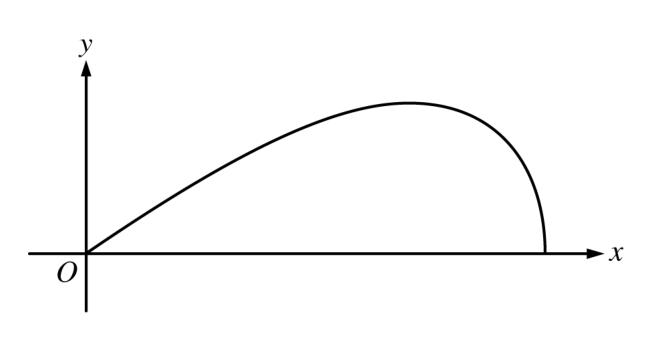
The graphs of the polar curves \(r = 3\) and \(r = 3 - 2\sin(2\theta)\) are shown in the figure above for \(0 \le \theta \le \pi\).
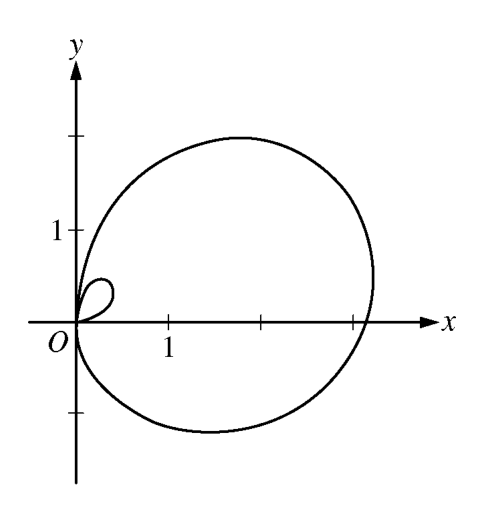
- (A) Let \(R\) be the shaded region that is inside the graph of \(r = 3\) and inside the graph of \(r = 3 - 2\sin(2\theta)\). Find the area of \(R\).
- (B) For the curve \(r = 3 - 2\sin(2\theta)\), find the value of \(\dfrac{dx}{d\theta}\) at \(\theta = \dfrac{\pi}{6}\).
- (C) The distance between the two curves changes for \(0 < \theta < \dfrac{\pi}{2}\). Find the rate at which the distance between the two curves is changing with respect to \(\theta\) when \(\theta = \dfrac{\pi}{3}\).
- (D) A particle is moving along the curve \(r = 3 - 2\sin(2\theta)\) so that \(\dfrac{d\theta}{dt} = 3\) for all times \(t \ge 0\). Find the value of \(\dfrac{dr}{dt}\) at \(\theta = \dfrac{\pi}{6}\).
📝 点击展开评分标准(Scoring Guideline)📝 Expand Scoring Guideline
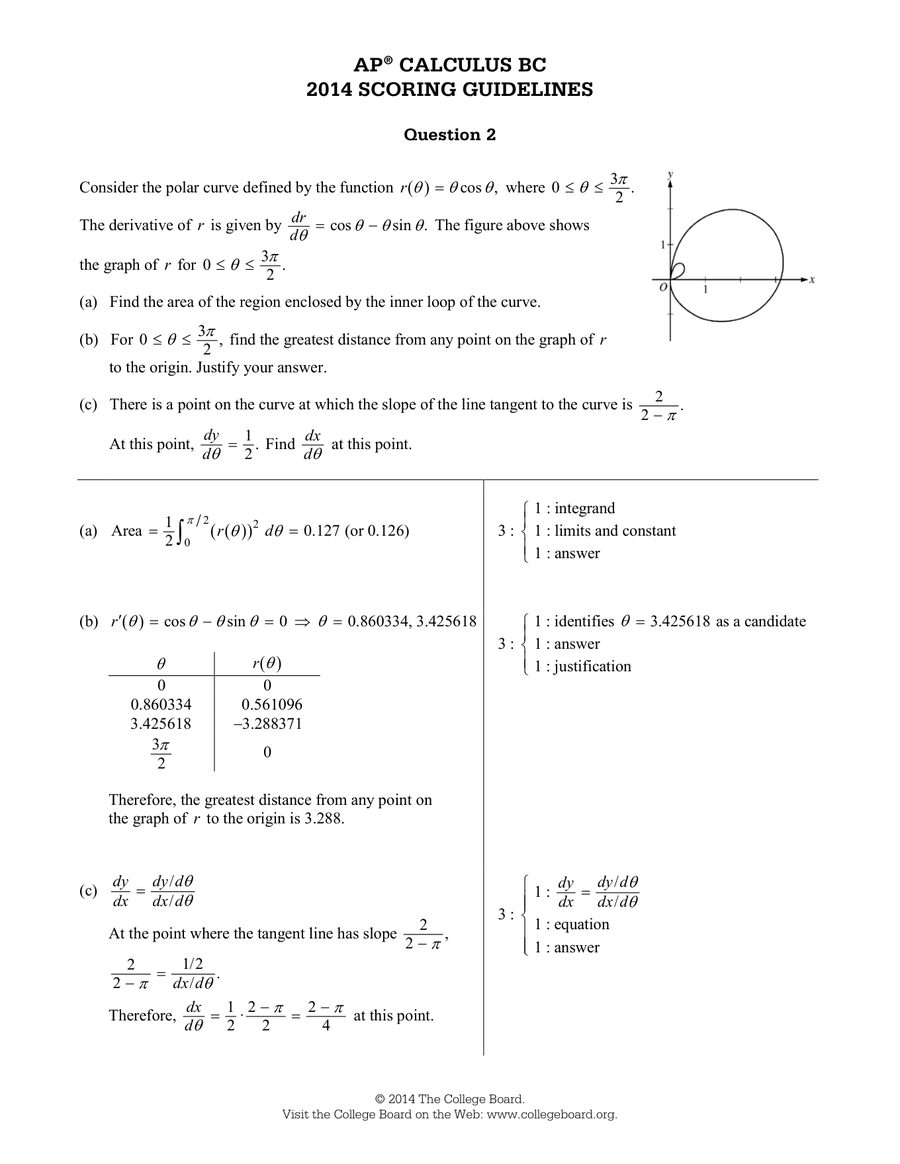
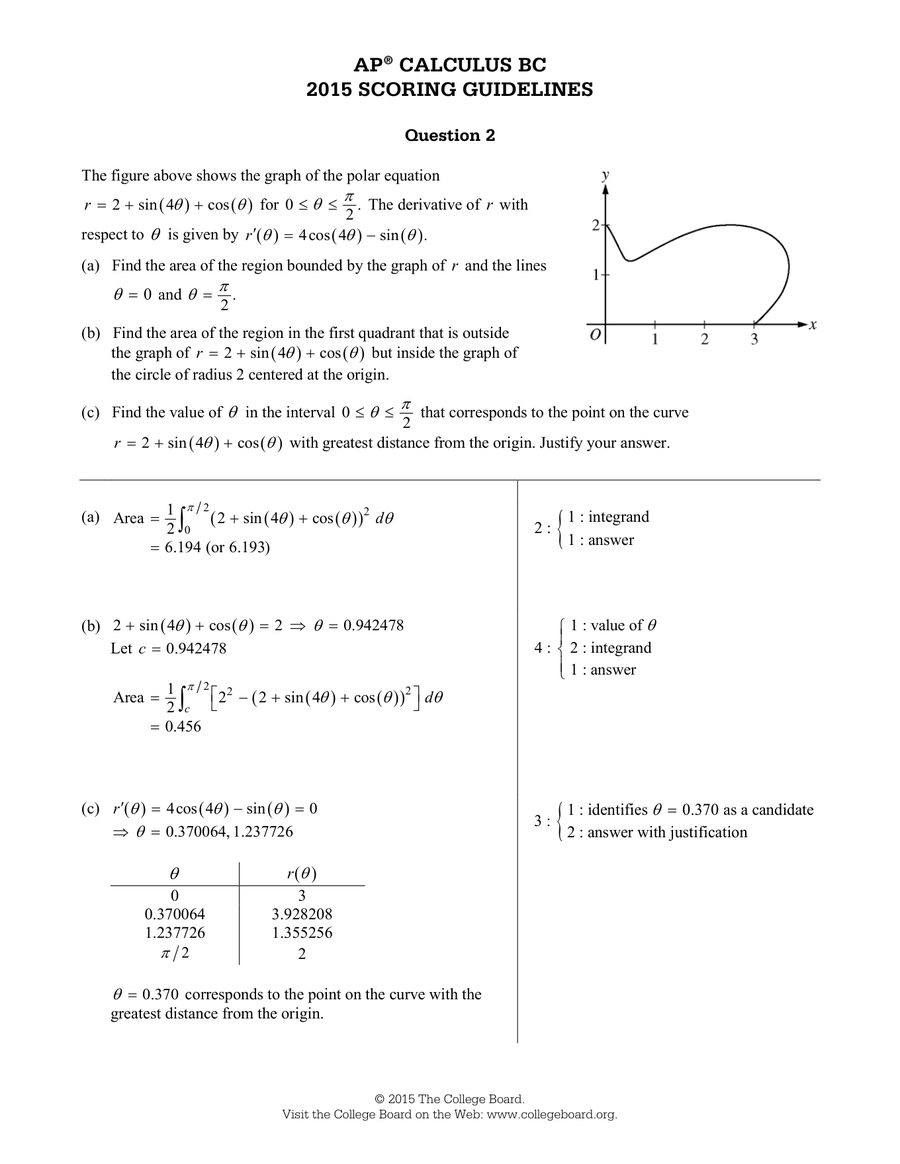
2015 FRQ2 · 极坐标 r = 2+sin(4θ)+cos(θ); 面积Polar r = 2+sin(4θ)+cos(θ); area Calculator Allowed
The figure above shows the graph of the polar equation \(r = 2 + \sin(4\theta) + \cos\theta\) for \(0 \le \theta \le \tfrac{\pi}{2}\). The derivative of \(r\) with respect to \(\theta\) is given by \(r'(\theta) = 4\cos(4\theta) - \sin\theta\).
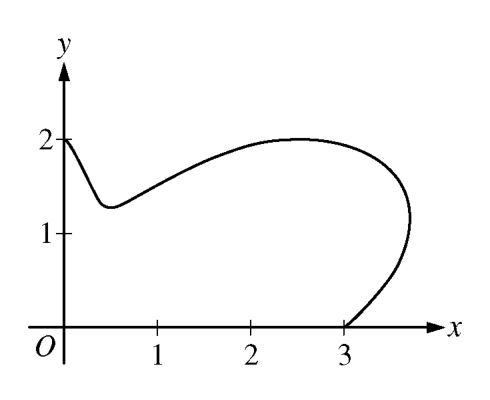
- (A) Find the area of the region bounded by the graph of \(r\) and the lines \(\theta = 0\) and \(\theta = \tfrac{\pi}{2}\).
- (B) Find the area of the region in the first quadrant that is outside the graph of \(r = 2 + \sin(4\theta) + \cos\theta\) but inside the graph of the circle of radius 2 centered at the origin.
- (C) Find the value of \(\theta\) in the interval \(0 \le \theta \le \tfrac{\pi}{2}\) that corresponds to the point on the curve \(r = 2 + \sin(4\theta) + \cos\theta\) with greatest distance from the origin. Justify your answer.
📝 点击展开评分标准(Scoring Guideline)📝 Expand Scoring Guideline
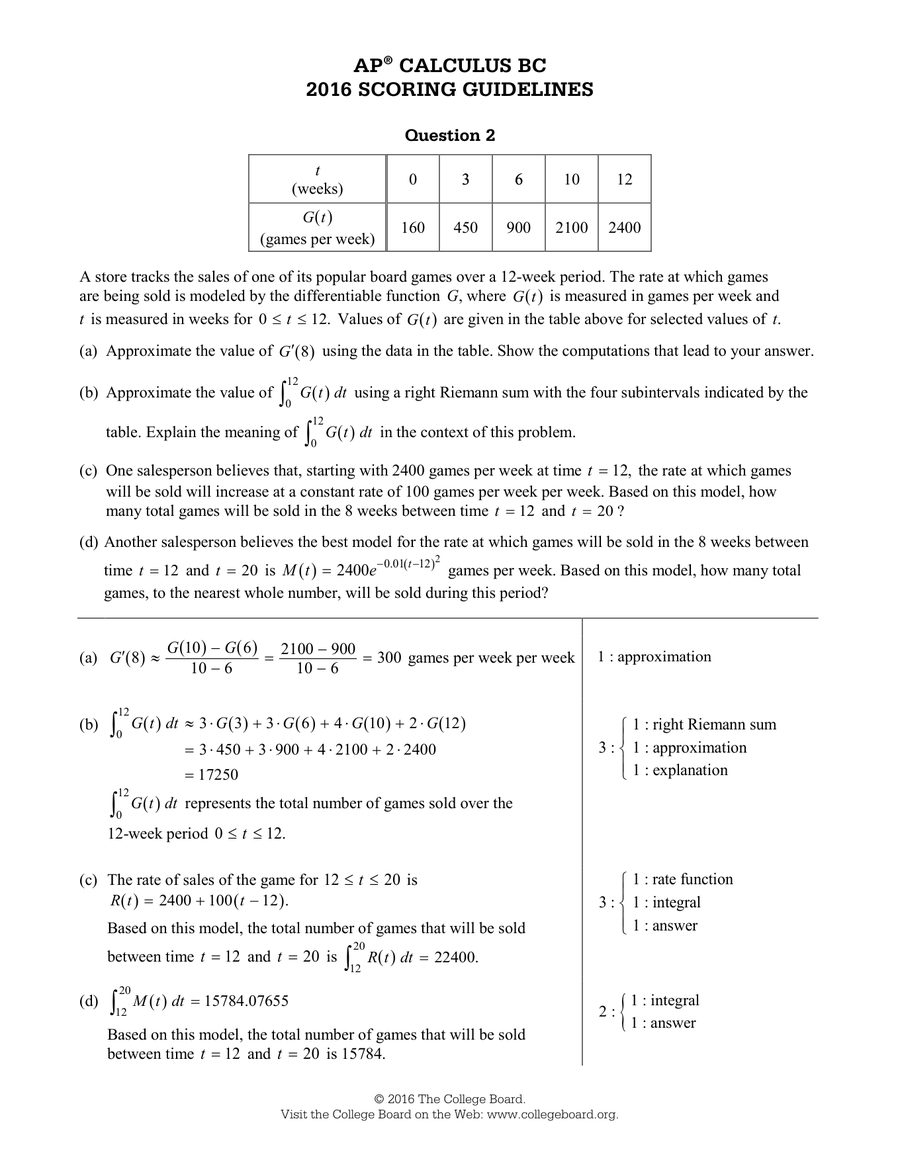
2016 FRQ2 · 参数 (x(t), y(t)); dx/dt=t²+sin(3t²), y 分段线性Parametric (x(t), y(t)); dx/dt=t²+sin(3t²), y piecewise linear Calculator Allowed
At time \(t\), the position of a particle moving in the \(xy\)-plane is given by the parametric functions \((x(t), y(t))\), where \(\dfrac{dx}{dt} = t^{2} + \sin(3t^{2})\). The graph of \(y\), consisting of three line segments, is shown in the figure above. At \(t = 0\), the particle is at position \((5, 1)\).

- (A) Find the position of the particle at \(t = 3\).
- (B) Find the slope of the line tangent to the path of the particle at \(t = 3\).
- (C) Find the speed of the particle at \(t = 3\).
- (D) Find the total distance traveled by the particle from \(t = 0\) to \(t = 2\).
📝 点击展开评分标准(Scoring Guideline)📝 Expand Scoring Guideline
2017 FRQ2 · 极坐标 r=1+sin(θ)cos(2θ) vs r=2cos(θ); 面积Polar r=1+sin(θ)cos(2θ) vs r=2cos(θ); area Calculator Allowed
The figure above shows the polar curves \(r = f(\theta) = 1 + \sin\theta \cos(2\theta)\) and \(r = g(\theta) = 2\cos\theta\) for \(0 \le \theta \le \dfrac{\pi}{2}\). Let \(R\) be the region in the first quadrant bounded by the curve \(r = f(\theta)\) and the x-axis. Let \(S\) be the region in the first quadrant bounded by the curve \(r = f(\theta)\), the curve \(r = g(\theta)\), and the x-axis.
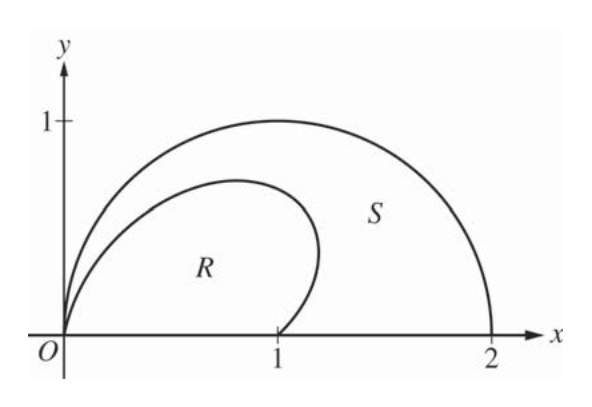
- (A) Find the area of \(R\).
- (B) The ray \(\theta = k\), where \(0 < k < \dfrac{\pi}{2}\), divides \(S\) into two regions of equal area. Write, but do not solve, an equation involving one or more integrals whose solution gives the value of \(k\).
- (C) For each \(\theta\), let \(w(\theta)\) be the distance between the points with polar coordinates \((f(\theta), \theta)\) and \((g(\theta), \theta)\). Write an expression for \(w(\theta)\). Find \(w_A\), the average value of \(w(\theta)\) over the interval \(0 \le \theta \le \dfrac{\pi}{2}\).
- (D) Using the information from part (c), find the value of \(\theta\) for which \(w(\theta) = w_A\). Is the function \(w(\theta)\) increasing or decreasing at that value of \(\theta\)? Give a reason for your answer.
📝 点击展开评分标准(Scoring Guideline)📝 Expand Scoring Guideline
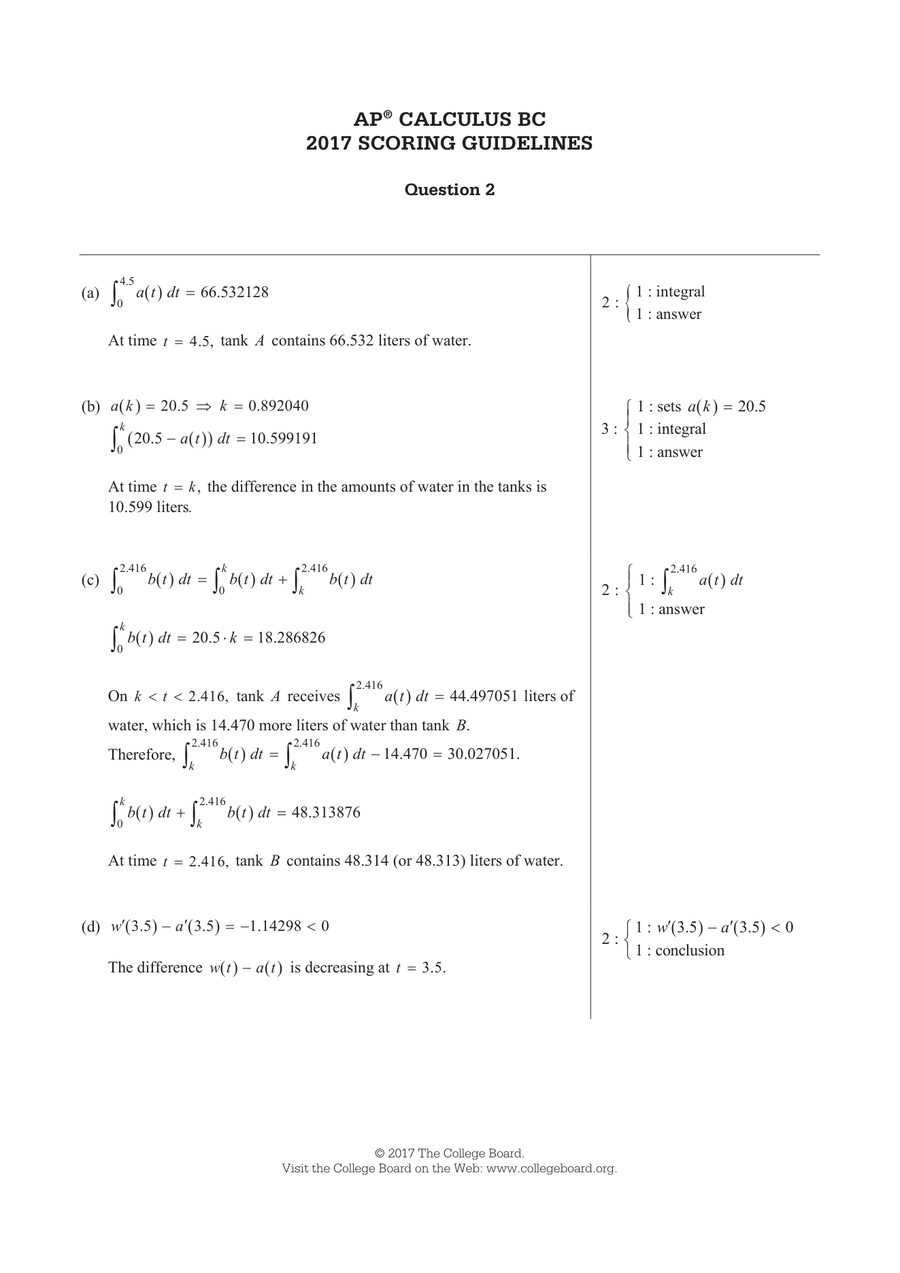
2019 FRQ2 · 激光蚀刻参数运动Laser etching parametric motion Calculator Allowed
A laser is a device that produces a beam of light. A design, shown above, is etched onto a flat piece of metal using a moving laser. The position of the laser at time \(t\) seconds is represented by \((x(t), y(t))\) in the \(xy\)-plane. Both \(x\) and \(y\) are measured in centimeters, and \(t\) is measured in seconds. The laser starts at position \((0, 0)\) at time \(t = 0\), and the design takes 3.1 seconds to complete. For \(0 \le t \le 3.1\), \(\dfrac{dx}{dt} = 3\cos(t^2)\) and \(\dfrac{dy}{dt} = 4\cos(2.5 t)\).
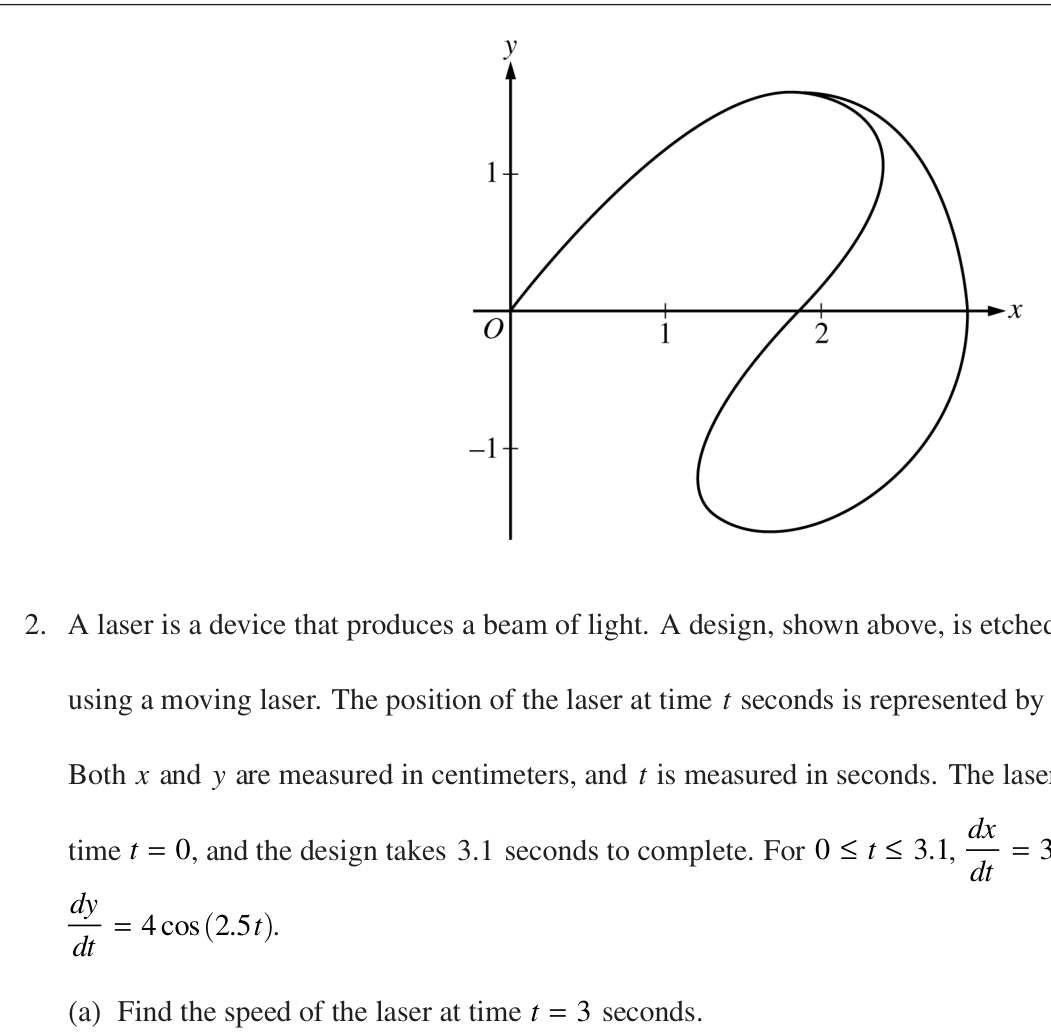
- (A) Find the speed of the laser at time \(t = 3\) seconds.
- (B) Find the total distance traveled by the laser from time \(t = 1\) to time \(t = 3\) seconds.
- (C) The laser is farthest to the right at time \(t = 1.253\) seconds. Find the \(x\)-coordinate of the laser's rightmost position.
- (D) What is the difference between the \(y\)-coordinates of the laser's highest position and lowest position for \(0 \le t \le 3.1\)? Justify your answer.
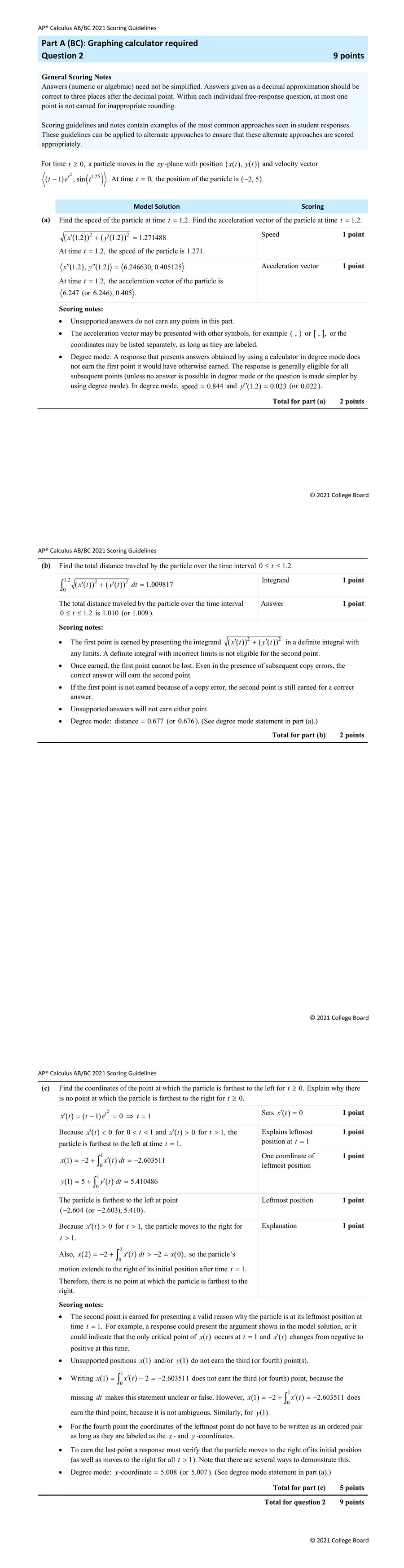
2021 FRQ2 · 参数向量运动(速度向量式)Parametric vector motion (velocity vector form) Calculator Allowed
For time \(t \ge 0\), a particle moves in the \(xy\)-plane with position \((x(t), y(t))\) and velocity vector \(\bigl\langle (t-1)e^{t^2},\ \sin(t^{1.25})\bigr\rangle\). At time \(t = 0\), the position of the particle is \((-2, 5)\).
- (A) Find the speed of the particle at time \(t = 1.2\). Find the acceleration vector of the particle at time \(t = 1.2\).
- (B) Find the total distance traveled by the particle over the time interval \(0 \le t \le 1.2\).
- (C) Find the coordinates of the point at which the particle is farthest to the left for \(t \ge 0\). Explain why there is no point at which the particle is farthest to the right for \(t \ge 0\).
📝 点击展开评分标准(Scoring Guideline)📝 Expand Scoring Guideline
2022 FRQ2 · 参数 dx/dt=√(1+t²), dy/dt=ln(2+t²)Parametric dx/dt=√(1+t²), dy/dt=ln(2+t²) Calculator Allowed
A particle moving along a curve in the \(xy\)-plane is at position \((x(t), y(t))\) at time \(t > 0\). The particle moves in such a way that \(\dfrac{dx}{dt} = \sqrt{1 + t^2}\) and \(\dfrac{dy}{dt} = \ln(2 + t^2)\). At time \(t = 4\), the particle is at the point \((1, 5)\).
- (A) Find the slope of the line tangent to the path of the particle at time \(t = 4\).
- (B) Find the speed of the particle at time \(t = 4\), and find the acceleration vector of the particle at time \(t = 4\).
- (C) Find the \(y\)-coordinate of the particle's position at time \(t = 6\).
- (D) Find the total distance the particle travels along the curve from time \(t = 4\) to time \(t = 6\).
📝 点击展开评分标准(Scoring Guideline)📝 Expand Scoring Guideline

2023 FRQ2 · 参数 y(t) = 2sin t, dx/dt = e^cos tParametric y(t) = 2sin t, dx/dt = e^cos t Calculator Allowed
For \(0 \le t \le \pi\), a particle is moving along the curve shown so that its position at time \(t\) is \((x(t), y(t))\), where \(x(t)\) is not explicitly given and \(y(t) = 2\sin t\). It is known that \(\dfrac{dx}{dt} = e^{\cos t}\). At time \(t = 0\), the particle is at position \((1, 0)\).
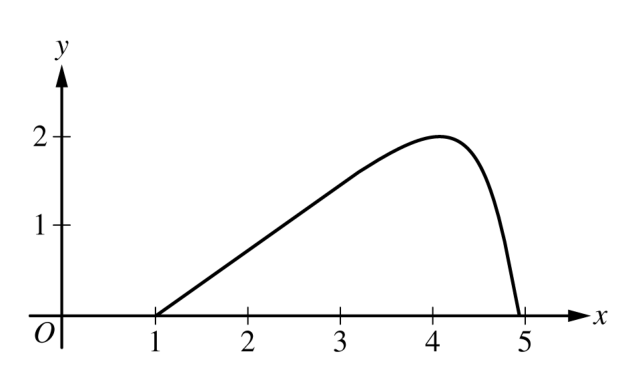
- (A) Find the acceleration vector of the particle at time \(t = 1\). Show the setup for your calculations.
- (B) For \(0 \le t \le \pi\), find the first time \(t\) at which the speed of the particle is 1.5. Show the work that leads to your answer.
- (C) Find the slope of the line tangent to the path of the particle at time \(t = 1\). Find the \(x\)-coordinate of the position of the particle at time \(t = 1\). Show the work that leads to your answers.
- (D) Find the total distance traveled by the particle over the time interval \(0 \le t \le \pi\). Show the setup for your calculations.
📝 点击展开评分标准(Scoring Guideline)📝 Expand Scoring Guideline

2024 FRQ2 · 🆕 参数 x'(t)=8-t², y'(t)=20t/(1+t^1.2)🆕 Parametric x'(t)=8-t², y'(t)=20t/(1+t^1.2) Calculator Allowed
A particle moving along a curve in the \(xy\)-plane has position \((x(t), y(t))\) at time \(t\) seconds, where \(x(t)\) and \(y(t)\) are measured in centimeters. It is known that \(x'(t) = 8t - t^2\) and \(y'(t) = -t + \sqrt{t^{1.2} + 20}\). At time \(t = 2\) seconds, the particle is at the point \((3, 6)\).
- (A) Find the speed of the particle at time \(t = 2\) seconds. Show the setup for your calculations.
- (B) Find the total distance traveled by the particle over the time interval \(0 \le t \le 2\). Show the setup for your calculations.
- (C) Find the \(y\)-coordinate of the position of the particle at the time \(t = 0\). Show the setup for your calculations.
- (D) For \(2 \le t \le 8\), the particle remains in the first quadrant. Find all times \(t\) in the interval \(2 \le t \le 8\) when the particle is moving toward the \(x\)-axis. Give a reason for your answer.
📝 点击展开评分标准(Scoring Guideline)📝 Expand Scoring Guideline

2025 FRQ2 · 🆕 极坐标 r=2sin(2θ) vs 半圆 r=1🆕 Polar r=2sin(2θ) vs semicircle r=1 Calculator Allowed
Curve \(C\) is defined by the polar equation \(r(\theta) = 2\sin^2\theta\) for \(0 \le \theta \le \pi\). Curve \(C\) and the semicircle \(r = \tfrac{1}{2}\) for \(0 \le \theta \le \pi\) are shown in the \(xy\)-plane.
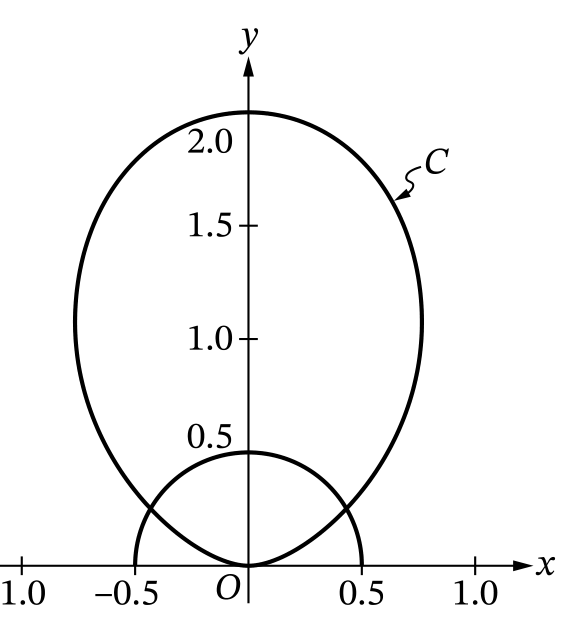
Note. Your calculator should be in radian mode.
- (A) Find the rate of change of \(r\) with respect to \(\theta\) at the point on curve \(C\) where \(\theta = 1.3\). Show the setup for your calculations.
- (B) Find the area of the region that lies inside curve \(C\) but outside the graph of the polar equation \(r = \tfrac{1}{2}\). Show the setup for your calculations.
- (C) It can be shown that \(\dfrac{dx}{d\theta} = 4\sin\theta\cos^2\theta - 2\sin^3\theta\) for curve \(C\). For \(0 \le \theta \le \tfrac{\pi}{2}\), find the value of \(\theta\) that corresponds to the point on curve \(C\) that is farthest from the \(y\)-axis. Justify your answer.
- (D) A particle travels along curve \(C\) so that \(\dfrac{d\theta}{dt} = 15\) for all times \(t\). Find the rate at which the particle's distance from the origin changes with respect to time when the particle is at the point where \(\theta = 1.3\). Show the setup for your calculations.
📝 点击展开评分标准(Scoring Guideline)📝 Expand Scoring Guideline

FRQ3 · f' 图像分析 / 多元混合槽FRQ3 · f' Graph Analysis / Mixed Slot
Unit 5/6。最常见是给你 f' 的图(半圆 + 线段),让你分析 f 本身。No calculator。Unit 5/6. Most common: given the graph of f' (semicircle + line segments), analyze f itself. No calculator.
🔍 怎么一眼认出🔍 How to Identify
- 题目配一张 f' 或 f 的分段图(半圆 + 线段组合)
- 问 f 的 increasing/decreasing、concavity、local/absolute max-min、inflection
- 通常有「evaluate f(b) given f(a) = ...」→ 用 FTC
- Problem includes a piecewise graph of f' or f (semicircle + line segment combos)
- Asks about f's increasing/decreasing, concavity, local/absolute max-min, inflection
- Usually has 'evaluate f(b) given f(a) = ...' → use FTC
📐 解题模板📐 Solution Template
- Step 1:f 单调递增 ↔ f' > 0。找 f' 的正负区间。
- Step 2:f 凹 ↔ f'' > 0 ↔ f' 递增。看 f' 图的斜率(上升段 = f''>0)。
- Step 3:Local max/min:f' 符号变号的点(从 + 到 - = max)。Absolute extrema 还要比较端点。
- Step 4:Inflection:f'' 变号 ↔ f' 有 local max/min 或拐点。
- Step 5:评估 f(b):\(f(b) = f(a) + \int_a^b f'(t)\,dt\)。积分用图形几何面积(半圆 = \(\pi r^2/2\),三角形 = \(bh/2\))。
- Step 1: f is increasing ↔ f' > 0. Find intervals where f' is positive/negative.
- Step 2: f is concave up ↔ f'' > 0 ↔ f' is increasing. Look at slope of f' graph (rising = f''>0).
- Step 3: Local max/min: points where f' changes sign (from + to - = max). For absolute extrema, also compare endpoints.
- Step 4: Inflection: f'' changes sign ↔ f' has local max/min or inflection point.
- Step 5: Evaluate f(b): \(f(b) = f(a) + \int_a^b f'(t)\,dt\). Use geometric area from the graph (semicircle = \(\pi r^2/2\), triangle = \(bh/2\)).
⚠️ 踩分点与易错⚠️ Pitfalls & Common Errors
- ⚠️ 把「f' 图」当「f 图」分析(常见低级错误)
- ⚠️ 半圆面积用 \(\pi r^2\) 不是 \(\pi r^2/2\)
- ⚠️ f'' 和 f' 搞混
- ⚠️ Abs max 只看 critical point 忘记端点
- ⚠️ Treating 'f' graph' as 'f graph' (common basic error)
- ⚠️ Using \(\pi r^2\) instead of \(\pi r^2/2\) for semicircle area
- ⚠️ Confusing f'' with f'
- ⚠️ Only checking critical points for absolute max, forgetting endpoints
历年真题(10 道 · 点击展开)Past FRQs (10 · Click to Expand)
2014 FRQ3 · f 在 [-5,4] 三条线段, g(x)=∫f; 求 h=g/(5-x), p(x²-x)f on [-5,4] three line segments, g(x)=∫f; find h=g/(5-x), p(x²-x) No Calculator
The function \(f\) is defined on the closed interval \([-5, 4]\). The graph of \(f\) consists of three line segments and is shown in the figure above. Let \(g\) be the function defined by \(g(x) = \int_{-3}^{x} f(t)\,dt\).
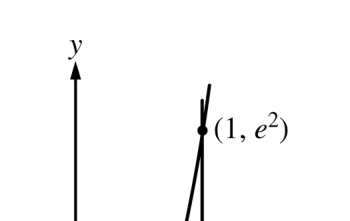
- (A) Find \(g(3)\).
- (B) On what open intervals contained in \(-5 < x < 4\) is the graph of \(g\) both increasing and concave down? Give a reason for your answer.
- (C) The function \(h\) is defined by \(h(x) = \dfrac{g(x)}{5x}\). Find \(h'(3)\).
- (D) The function \(p\) is defined by \(p(x) = f(x^2 - x)\). Find the slope of the line tangent to the graph of \(p\) at the point where \(x = -1\).
📝 点击展开评分标准(Scoring Guideline)📝 Expand Scoring Guideline
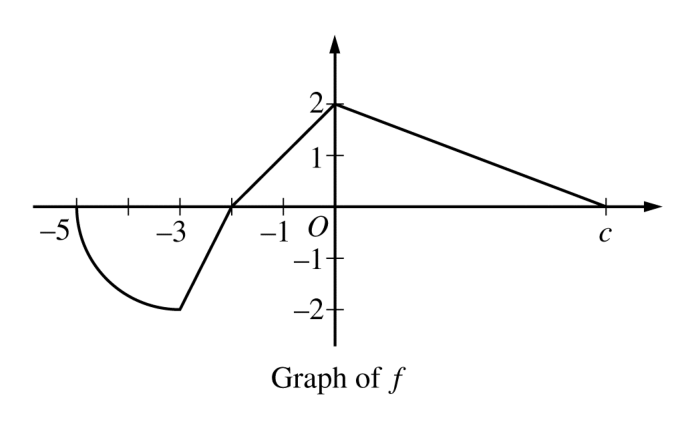
2016 FRQ3 · f 在 [-5,c] 三段线 + 四分之一圆心圆; g=∫ff on [-5,c] three line segments + quarter circle; g=∫f No Calculator
The figure above shows the graph of the piecewise-linear function \(f\). For \(-4 \le x \le 12\), the function \(g\) is defined by \(g(x) = \int_{2}^{x} f(t)\,dt\).
- (A) Does \(g\) have a relative minimum, a relative maximum, or neither at \(x = 10\)? Justify your answer.
- (B) Does the graph of \(g\) have a point of inflection at \(x = 4\)? Justify your answer.
- (C) Find the absolute minimum value and the absolute maximum value of \(g\) on the interval \(-4 \le x \le 12\). Justify your answers.
- (D) For \(-4 \le x \le 12\), find all intervals for which \(g(x) \le 0\).
📝 点击展开评分标准(Scoring Guideline)📝 Expand Scoring Guideline
2017 FRQ3 · f 在 [-6,5], f(-2)=7; f' 分段 → f 单调/极值f on [-6,5], f(-2)=7; f' piecewise → f monotonicity/extrema No Calculator
The function \(f\) is differentiable on the closed interval \([-6, 5]\) and satisfies \(f(-2) = 7\). The graph of \(f'\), the derivative of \(f\), consists of a semicircle and three line segments, as shown in the figure above.
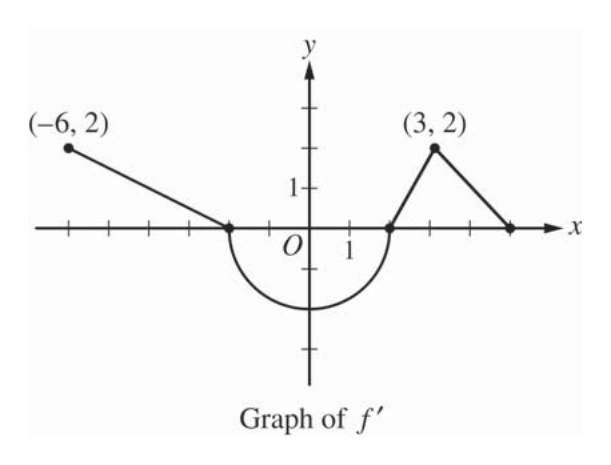
- (A) Find the values of \(f(-6)\) and \(f(5)\).
- (B) On what intervals is \(f\) increasing? Justify your answer.
- (C) Find the absolute minimum value of \(f\) on the closed interval \([-6, 5]\). Justify your answer.
- (D) For each of \(f''(-5)\) and \(f''(3)\), find the value or explain why it does not exist.
📝 点击展开评分标准(Scoring Guideline)📝 Expand Scoring Guideline
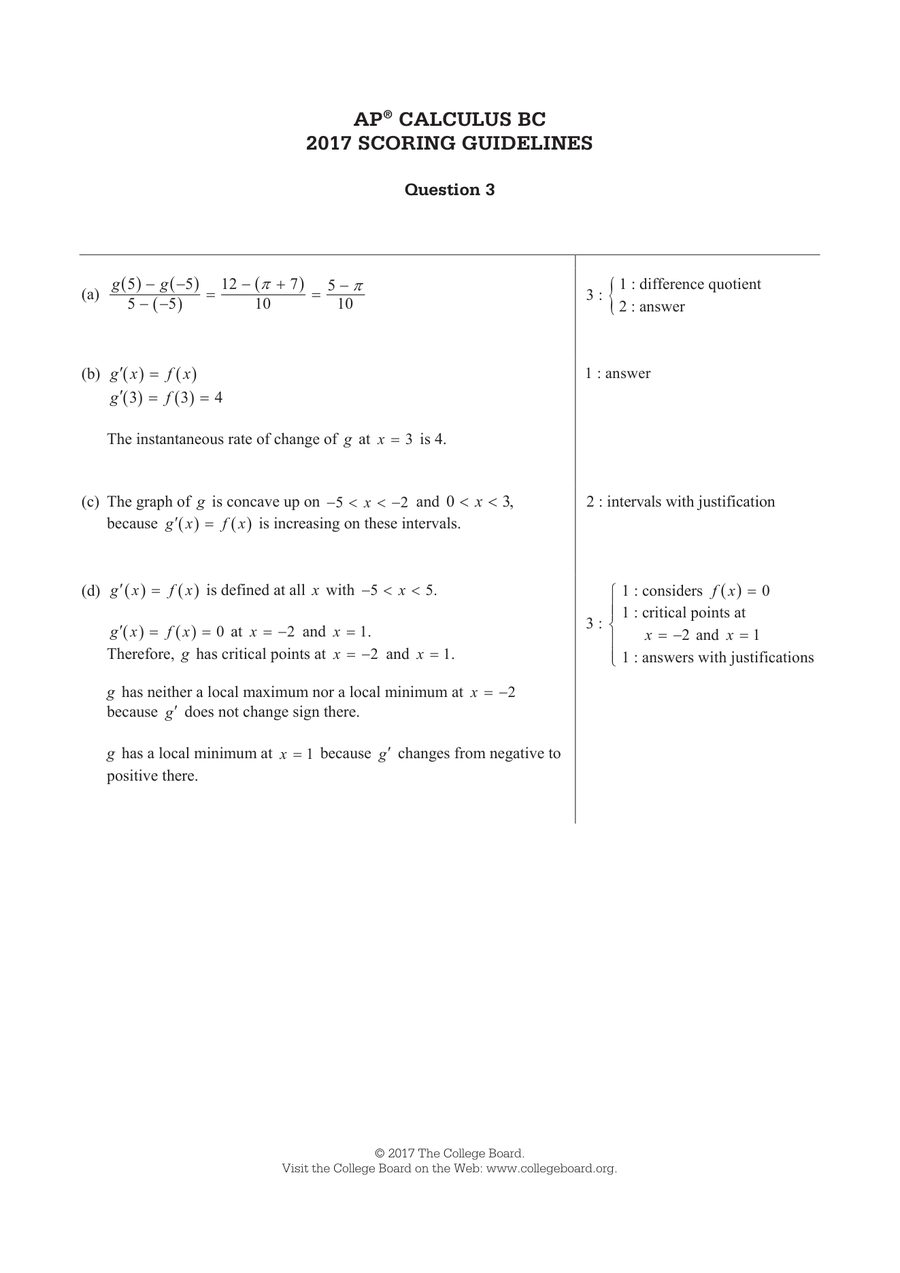
2018 FRQ3 · g = f' piecewise-linear on [-5,7] No Calculator
The graph of the continuous function \(g\), the derivative of the function \(f\), is shown above. The function \(g\) is piecewise linear for \(-5 \le x < 3\), and \(g(x) = 2(x - 4)^2\) for \(3 \le x \le 6\).
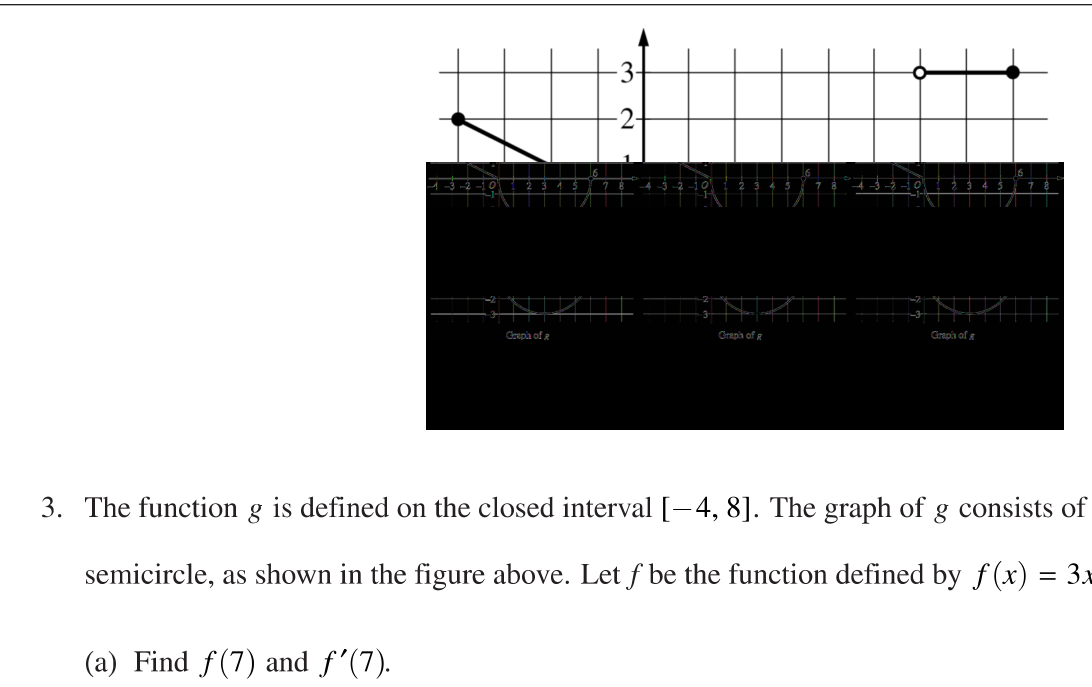
- (A) If \(f(1) = 3\), what is the value of \(f(-5)\)?
- (B) Evaluate \(\int_{1}^{6} g(x)\,dx\).
- (C) For \(-5 < x < 6\), on what open intervals, if any, is the graph of \(f\) both increasing and concave up? Give a reason for your answer.
- (D) Find the x-coordinate of each point of inflection of the graph of \(f\). Give a reason for your answer.
📝 点击展开评分标准(Scoring Guideline)📝 Expand Scoring Guideline
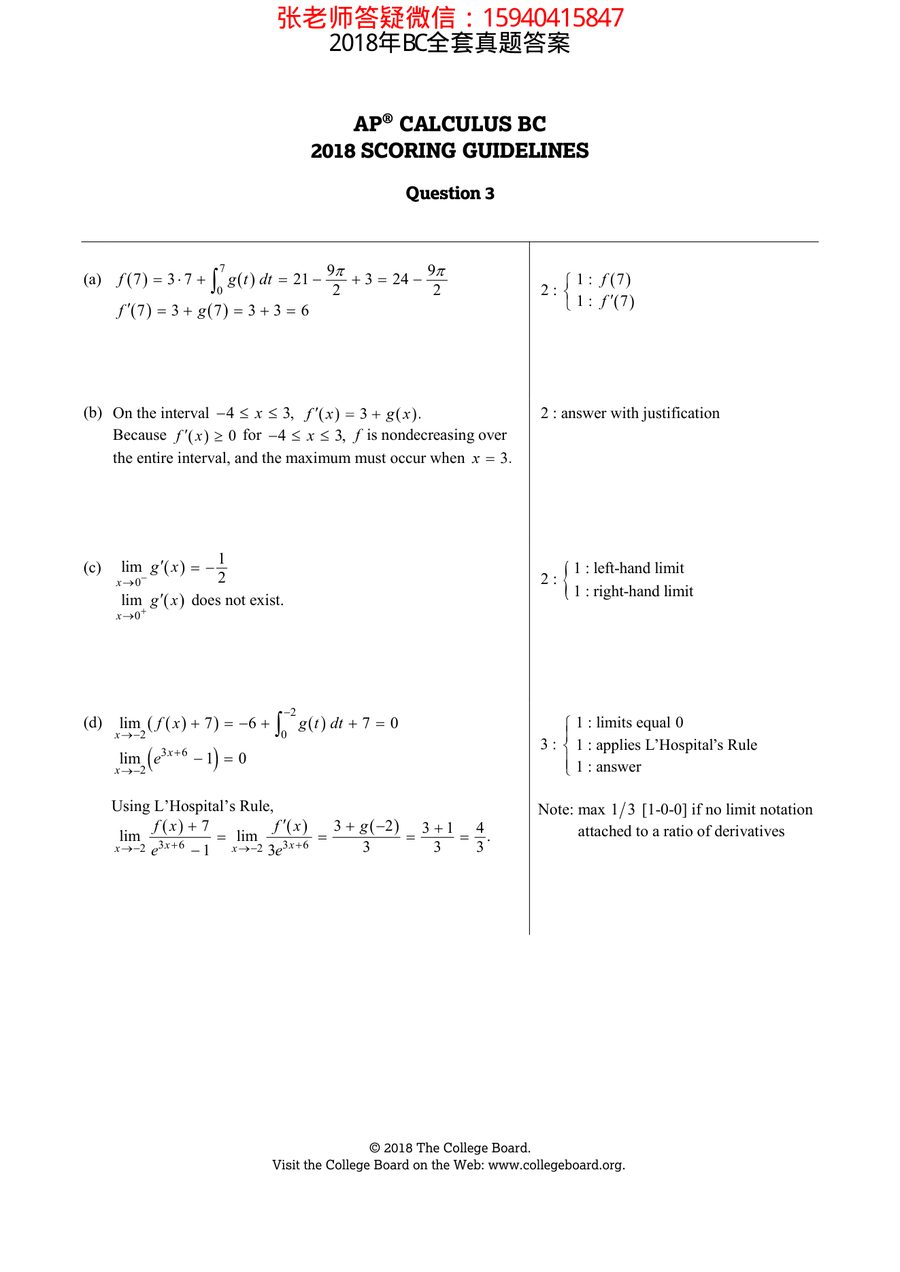
2019 FRQ3 · f 分段 √(9-x²) + (-x+3cos(πx/2))f piecewise √(9-x²) + (-x+3cos(πx/2)) No Calculator
Let \(f\) be the function defined by \[f(x) = \begin{cases} \sqrt{9 - x^2} & \text{for }-3 \le x \le 0 \\ -x + 3\cos\!\left(\dfrac{\pi x}{2}\right) & \text{for }0 < x \le 4. \end{cases}\]
- (A) Find the average rate of change of \(f\) on the interval \(-3 \le x \le 4\).
- (B) Write an equation for the line tangent to the graph of \(f\) at \(x = 3\).
- (C) Find the average value of \(f\) on the interval \(-3 \le x \le 4\).
- (D) Must there be a value of \(x\) at which \(f(x)\) attains an absolute maximum on the closed interval \(-3 \le x \le 4\)? Justify your answer.
2021 FRQ4 · f 连续 [-4,6] 分段图像 (AB/BC 同题)f continuous on [-4,6] piecewise graph (AB/BC shared) No Calculator
Let \(f\) be a continuous function defined on the closed interval \(-4 \le x \le 6\). The graph of \(f\), consisting of four line segments, is shown above. Let \(G\) be the function defined by \(G(x) = \displaystyle\int_0^x f(t)\,dt\).
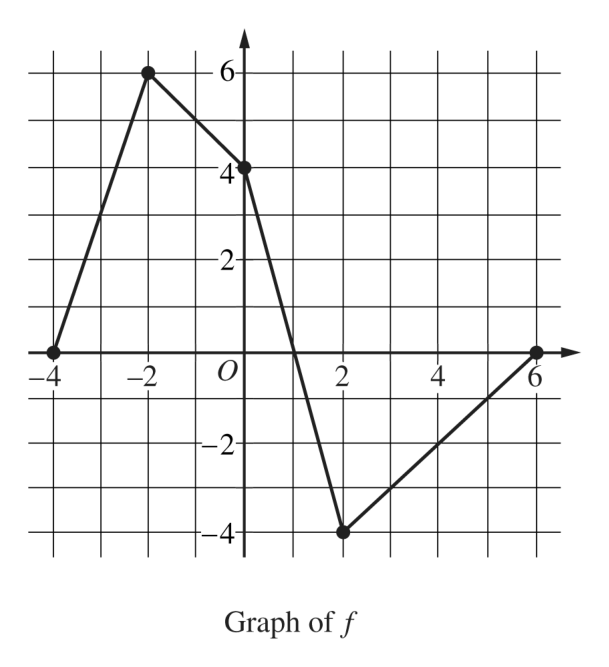
- (A) On what open intervals is the graph of \(G\) concave up? Give a reason for your answer.
- (B) Let \(P\) be the function defined by \(P(x) = G(x)\cdot f(x)\). Find \(P'(3)\).
- (C) Find \(\displaystyle\lim_{x \to 2} \dfrac{G(x)}{x^2 - 2x}\).
- (D) Find the average rate of change of \(G\) on the interval \([-4, 2]\). Does the Mean Value Theorem guarantee a value \(c\), \(-4 < c < 2\), for which \(G'(c)\) is equal to this average rate of change? Justify your answer.
📝 点击展开评分标准(Scoring Guideline)📝 Expand Scoring Guideline

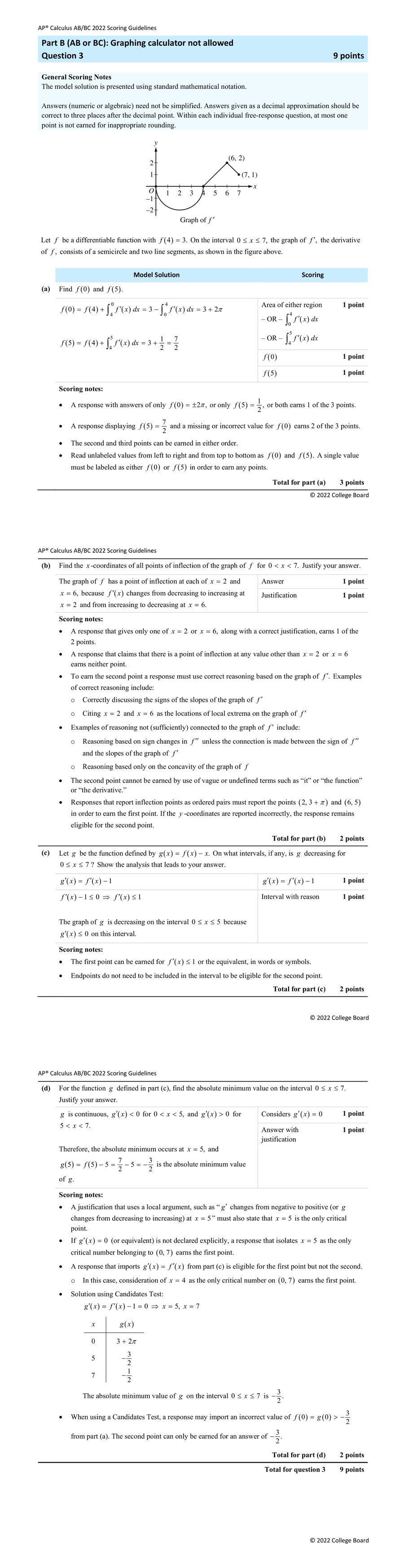
2022 FRQ3 · f 可导, f(4)=3, f' 图 on [0,7] (AB/BC 同题)f differentiable, f(4)=3, f' graph on [0,7] (AB/BC shared) No Calculator
Let \(f\) be a differentiable function with \(f(4) = 3\). On the interval \(0 \le x \le 7\), the graph of \(f'\), the derivative of \(f\), consists of a semicircle and two line segments, as shown in the figure above.
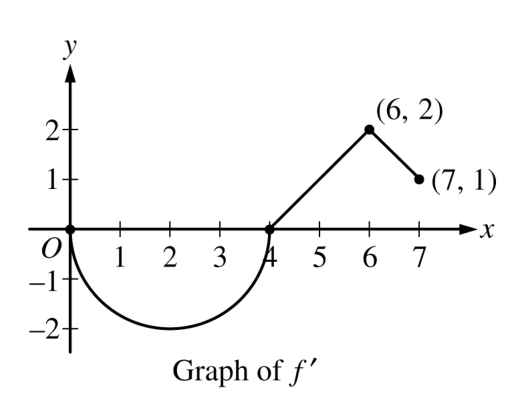
- (A) Find \(f(0)\) and \(f(5)\).
- (B) Find the \(x\)-coordinates of all points of inflection of the graph of \(f\) for \(0 < x < 7\). Justify your answer.
- (C) Let \(g\) be the function defined by \(g(x) = f(x) - x\). On what intervals, if any, is \(g\) decreasing for \(0 \le x \le 7\)? Show the analysis that leads to your answer.
- (D) For the function \(g\) defined in part (c), find the absolute minimum value on the interval \(0 \le x \le 7\). Justify your answer.
📝 点击展开评分标准(Scoring Guideline)📝 Expand Scoring Guideline
2023 FRQ4 · f 在 [-2,8], f(2)=1; f' 图 (AB/BC 同题)f on [-2,8], f(2)=1; f' graph (AB/BC shared) No Calculator
The function \(f\) is defined on the closed interval \([-2, 8]\) and satisfies \(f(2) = 1\). The graph of \(f'\), the derivative of \(f\), consists of two line segments and a semicircle, as shown in the figure.
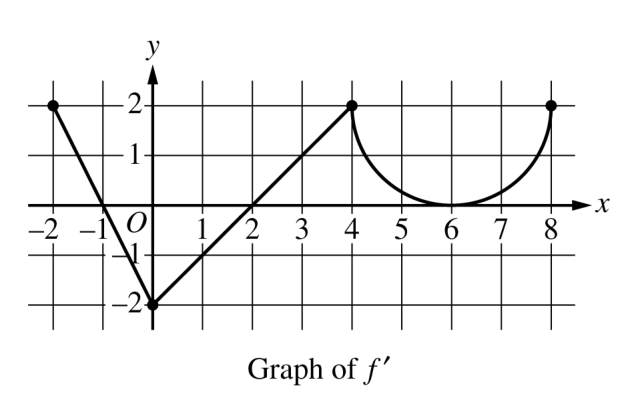
- (A) Does \(f\) have a relative minimum, a relative maximum, or neither at \(x = 6\)? Give a reason for your answer.
- (B) On what open intervals, if any, is the graph of \(f\) concave down? Give a reason for your answer.
- (C) Find the value of \(\displaystyle\lim_{x \to 2} \dfrac{6f(x) - 3x}{x^2 - 5x + 6}\), or show that it does not exist. Justify your answer.
- (D) Find the absolute minimum value of \(f\) on the closed interval \([-2, 8]\). Justify your answer.
📝 点击展开评分标准(Scoring Guideline)📝 Expand Scoring Guideline
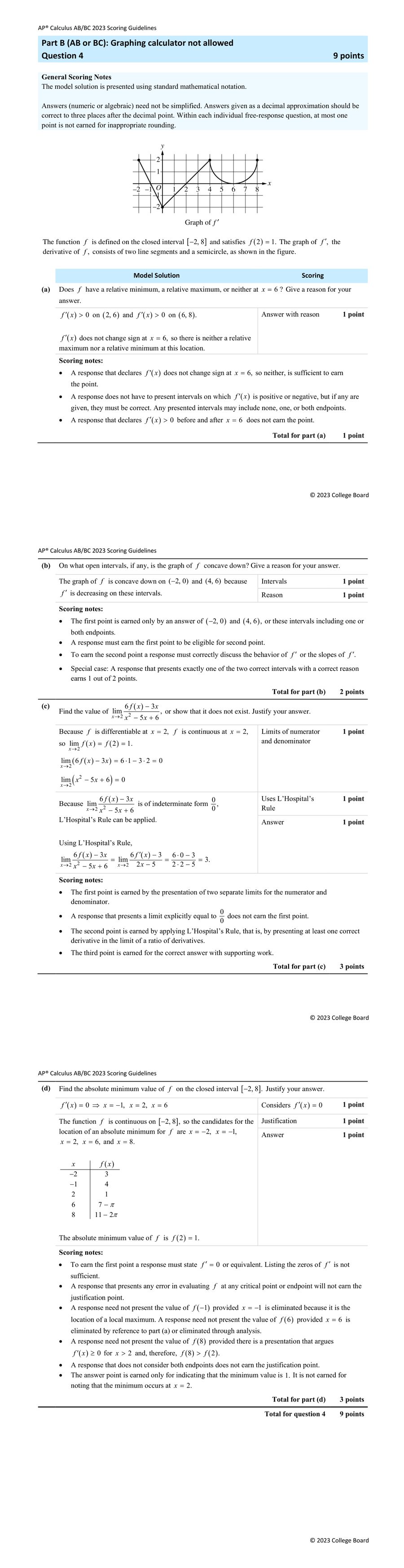
2024 FRQ4 · 🆕 f 水平切线 + 线性段 + 区域 R 面积🆕 f horizontal tangent + linear segments + region R area No Calculator
The graph of the differentiable function \(f\), shown for \(-6 \le x \le 7\), has a horizontal tangent at \(x = -2\) and is linear for \(0 \le x \le 7\). Let \(R\) be the region in the second quadrant bounded by the graph of \(f\), the vertical line \(x = -6\), and the \(x\)- and \(y\)-axes. Region \(R\) has area 12.
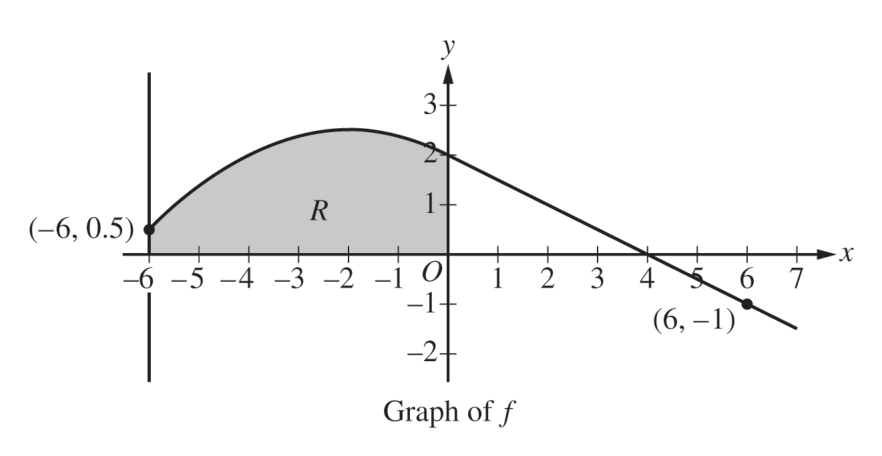
- (A) The function \(g\) is defined by \(g(x) = \displaystyle\int_0^{x} f(t)\,dt\). Find the values of \(g(-6)\), \(g(4)\), and \(g(6)\).
- (B) For the function \(g\) defined in part (a), find all values of \(x\) in the interval \(0 \le x \le 6\) at which the graph of \(g\) has a critical point. Give a reason for your answer.
- (C) The function \(h\) is defined by \(h(x) = \displaystyle\int_{-6}^{x} f'(t)\,dt\). Find the values of \(h(6)\), \(h'(6)\), and \(h''(6)\). Show the work that leads to your answers.
📝 点击展开评分标准(Scoring Guideline)📝 Expand Scoring Guideline
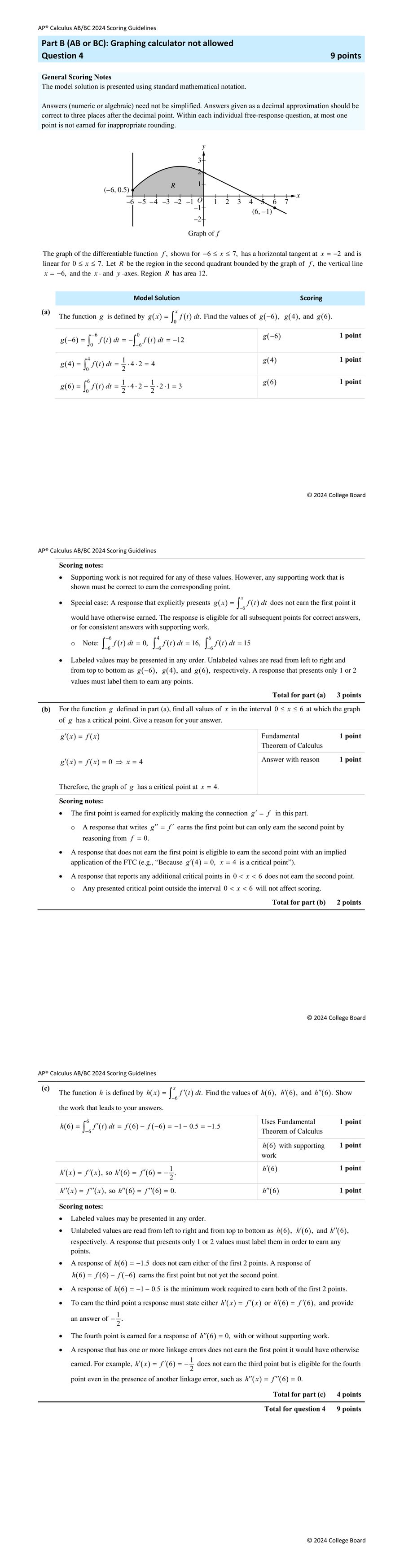
2025 FRQ4 · 🆕 f 两半圆 + 线段 → g(x) = ∫f, inflection🆕 f two semicircles + line segment → g(x) = ∫f, inflection No Calculator
The continuous function \(f\) is defined on the closed interval \(-6 \le x \le 12\). The graph of \(f\), consisting of two semicircles and one line segment, is shown in the figure. Let \(g\) be the function defined by \(g(x) = \displaystyle\int_6^{x} f(t)\,dt\).
- (A) Find \(g'(8)\). Give a reason for your answer.
- (B) Find all values of \(x\) in the open interval \(-6 < x < 12\) at which the graph of \(g\) has a point of inflection. Give a reason for your answer.
- (C) Find \(g(12)\) and \(g(0)\). Label your answers.
- (D) Find the value of \(x\) at which \(g\) attains an absolute minimum on the closed interval \(-6 \le x \le 12\). Justify your answer.
📝 点击展开评分标准(Scoring Guideline)📝 Expand Scoring Guideline

FRQ4 · 表格 / MVT / 数值近似FRQ4 · Table / MVT / Numerical Approximation
Unit 4/5/6。给表格数据 + 离散值,让你用 MVT、Riemann sum、linear approx。No calc。Unit 4/5/6. Given tabular data + discrete values, use MVT, Riemann sum, and linear approximation. No calculator.
🔍 怎么一眼认出🔍 How to Identify
- 题目有一张表格(x, f(x), f'(x) 等)
- 问 MVT、Trapezoidal/Riemann、linear approximation
- 可能结合 L'Hôpital(0/0 型)
- Problem has a table (x, f(x), f'(x), etc.)
- Asks for MVT, Trapezoidal/Riemann, linear approximation
- May combine with L'Hôpital (0/0 form)
📐 解题模板📐 Solution Template
- MVT:f 在 [a,b] 连续可导 ⇒ ∃c 使 \(f'(c) = \frac{f(b)-f(a)}{b-a}\)。判断题要写三条:连续性、可导性、结论。
- Trapezoidal:用 4 个子区间近似 \(\int_a^b f\,dx \approx \sum \frac{x_{i+1}-x_i}{2}(f(x_i)+f(x_{i+1}))\)。区间不等长也要逐段算!
- Riemann(左/右/中):Left \(= \sum f(x_i)\Delta x\),Right \(= \sum f(x_{i+1})\Delta x\)。题目说「four subintervals」就分四段。
- Linear approx:\(f(x) \approx f(a) + f'(a)(x-a)\)。
- L'Hôpital:\(\lim_{x\to a} \frac{f(x)}{g(x)} = \frac{f'(a)}{g'(a)}\)(0/0 或 ∞/∞ 时)。
- MVT: If f is continuous and differentiable on [a,b] ⇒ ∃c such that \(f'(c) = \frac{f(b)-f(a)}{b-a}\). For justification problems, write all three: continuity, differentiability, conclusion.
- Trapezoidal: With 4 subintervals, approximate \(\int_a^b f\,dx \approx \sum \frac{x_{i+1}-x_i}{2}(f(x_i)+f(x_{i+1}))\). For unequal intervals, compute segment by segment!
- Riemann (left/right/midpoint): Left \(= \sum f(x_i)\Delta x\), Right \(= \sum f(x_{i+1})\Delta x\). When asked for 'four subintervals', divide into four parts.
- Linear approx: \(f(x) \approx f(a) + f'(a)(x-a)\).
- L'Hôpital: \(\lim_{x\to a} \frac{f(x)}{g(x)} = \frac{f'(a)}{g'(a)}\) (when 0/0 or ∞/∞).
⚠️ 踩分点与易错⚠️ Pitfalls & Common Errors
- ⚠️ MVT 条件没写全(少写 continuity / differentiability 失分)
- ⚠️ Trapezoidal 把系数 1/2 漏掉
- ⚠️ 子区间不等长时按固定 \(\Delta x\) 处理
- ⚠️ L'Hôpital 没检查是否为 0/0 就直接用
- ⚠️ Missing MVT conditions (losing points for omitting continuity / differentiability)
- ⚠️ Dropping the 1/2 coefficient in trapezoidal
- ⚠️ Treating unequal subintervals as if \(\Delta x\) were constant
- ⚠️ Applying L'Hôpital without confirming 0/0 form
历年真题(10 道 · 点击展开)Past FRQs (10 · Click to Expand)
2014 FRQ4 · Train A v(t) + Train B, 距离、加速度Train A v(t) + Train B, distance, acceleration No Calculator
Train A runs back and forth on an east-west section of railroad track. Train A's velocity, measured in meters per minute, is given by a differentiable function \(v_A(t)\), where time \(t\) is measured in minutes. Selected values for \(v_A(t)\) are given in the table above.
| t (minutes) | v_A(t) (meters per minute) |
|---|---|
| 0 | 0 |
| 2 | 100 |
| 5 | 40 |
| 8 | -120 |
| 12 | -150 |
- (A) Find the average acceleration of train A over the interval \(2 \le t \le 8\).
- (B) Do the data in the table support the conclusion that train A's velocity is \(-100\) meters per minute at some time \(t\) with \(5 < t < 8\)? Give a reason for your answer.
- (C) At time \(t = 2\), train A's position is 300 meters east of the Origin Station, and the train is moving to the east. Write an expression involving an integral that gives the position of train A, in meters from the Origin Station, at time \(t = 12\). Use a trapezoidal sum with three subintervals indicated by the table to approximate the position of the train at time \(t = 12\).
- (D) A second train, train B, travels north from the Origin Station. At time \(t\) the velocity of train B is given by \(v_B(t) = -5t^2 + 60t + 25\), and at time \(t = 2\) the train is 400 meters north of the station. Find the rate, in meters per minute, at which the distance between train A and train B is changing at time \(t = 2\).
📝 点击展开评分标准(Scoring Guideline)📝 Expand Scoring Guideline
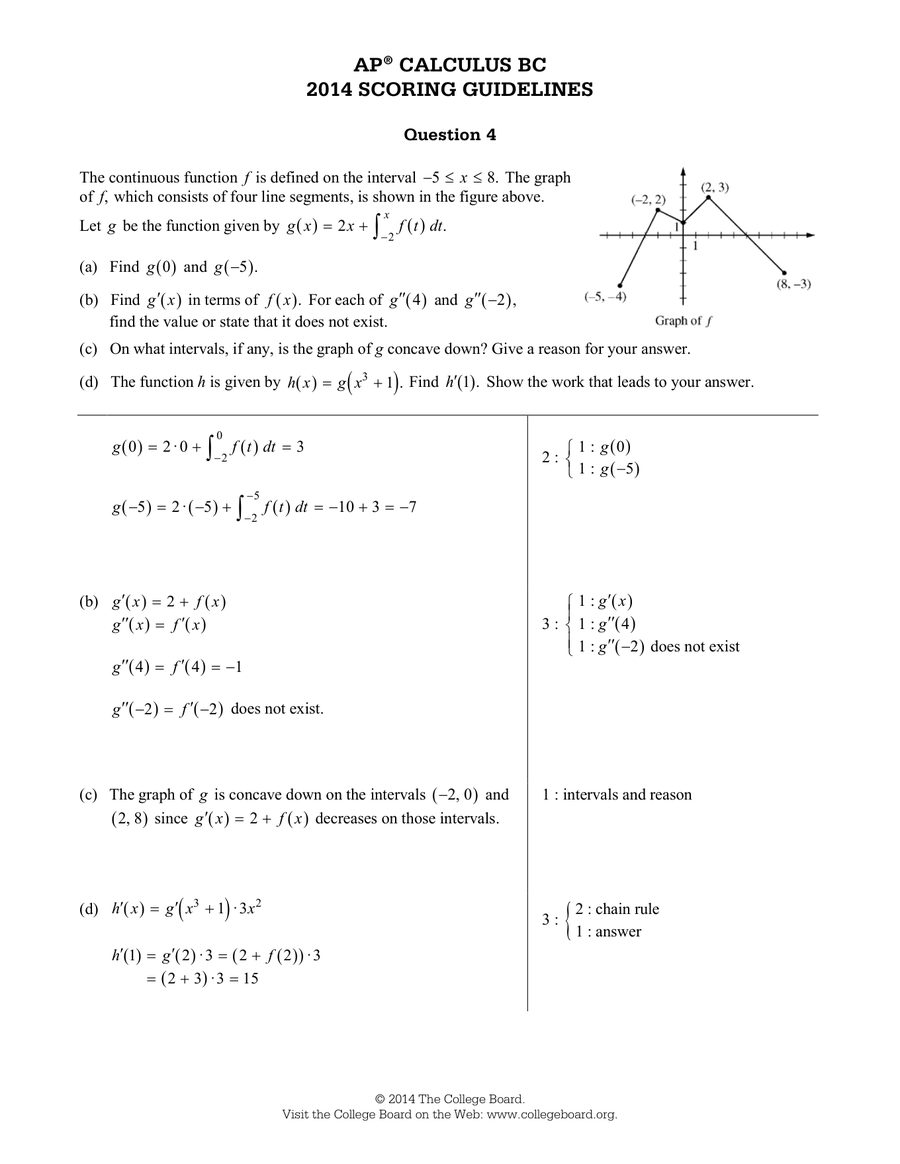
2015 FRQ3 · Kathleen skates v(t) 表格 → trap + MVTKathleen skates v(t) table → trap + MVT No Calculator
Johanna jogs along a straight path. For \(0 \le t \le 40\), Johanna's velocity is given by a differentiable function \(v\). Selected values of \(v(t)\), where \(t\) is measured in minutes and \(v(t)\) is measured in meters per minute, are given in the table above.
| t (minutes) | v(t) (meters per minute) |
|---|
- (A) Use the data in the table to estimate the value of \(v'(16)\).
- (B) Using correct units, explain the meaning of the definite integral \(\int_{0}^{40} |v(t)|\,dt\) in the context of the problem. Approximate the value of \(\int_{0}^{40} |v(t)|\,dt\) using a right Riemann sum with the four subintervals indicated in the table.
- (C) Bob is riding his bicycle along the same path. For \(0 \le t \le 10\), Bob's velocity is modeled by \(B(t) = t^3 - 6t^2 + 300\), where \(t\) is measured in minutes and \(B(t)\) is measured in meters per minute. Find Bob's acceleration at time \(t = 5\).
- (D) Based on the model \(B\) from part (c), find Bob's average velocity during the interval \(0 \le t \le 10\).
📝 点击展开评分标准(Scoring Guideline)📝 Expand Scoring Guideline
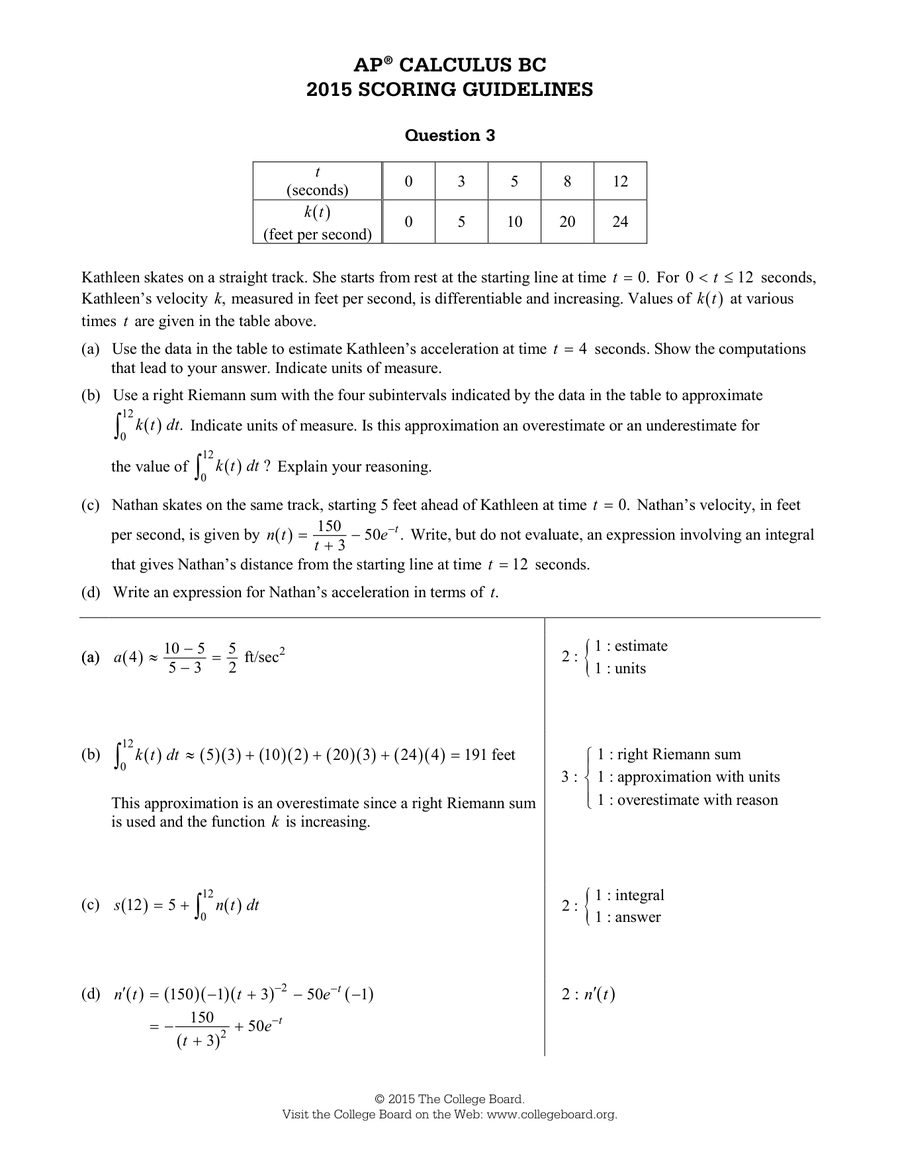
2018 FRQ4 · Tree height H(t) 表格 + MVT + RiemannTree height H(t) table + MVT + Riemann No Calculator
The height of a tree at time \(t\) is given by a twice-differentiable function \(H\), where \(H(t)\) is measured in meters and \(t\) is measured in years. Selected values of \(H(t)\) are given in the table above.
| t (years) | H(t) (meters) |
|---|---|
| 2 | 1.5 |
| 3 | 2 |
| 5 | 6 |
| 7 | 11 |
| 10 | 15 |
- (A) Use the data in the table to estimate \(H'(6)\). Using correct units, interpret the meaning of \(H'(6)\) in the context of the problem.
- (B) Explain why there must be at least one time \(t\), for \(2 < t < 10\), such that \(H'(t) = 2\).
- (C) Use a trapezoidal sum with the four subintervals indicated by the data in the table to approximate the average height of the tree over the time interval \(2 \le t \le 10\).
- (D) The height of the tree, in meters, can also be modeled by the function \(G\), given by \(G(x) = \dfrac{100x}{1 + x}\), where \(x\) is the diameter of the base of the tree, in meters. When the tree is 50 meters tall, the diameter of the base of the tree is increasing at a rate of 0.03 meter per year. According to this model, what is the rate of change of the height of the tree with respect to time, in meters per year, at the time when the tree is 50 meters tall?
📝 点击展开评分标准(Scoring Guideline)📝 Expand Scoring Guideline
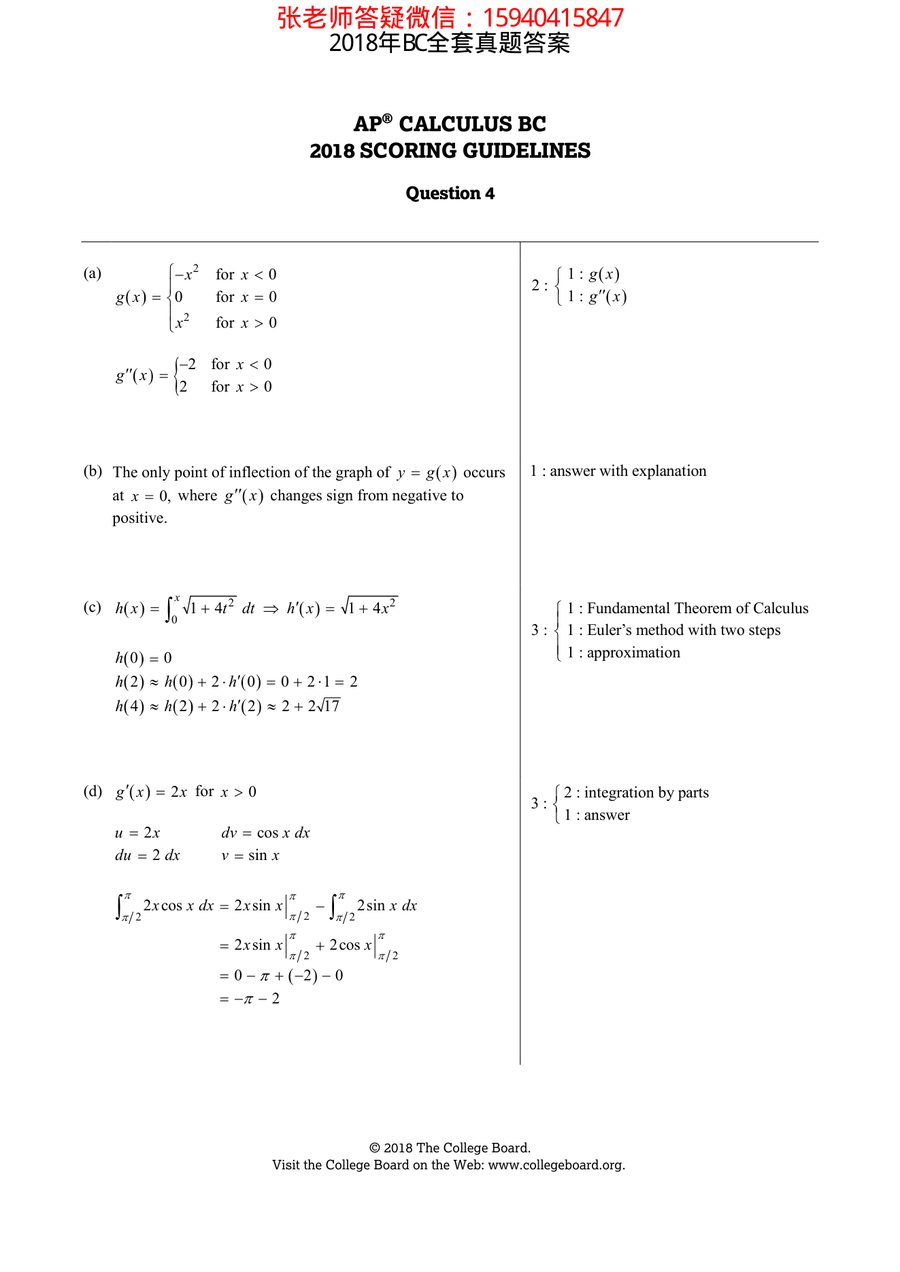
2019 FRQ4 · Cylindrical barrel 雨水, 相关变化率 dh/dtCylindrical barrel rainwater, related rate dh/dt No Calculator
A cylindrical barrel with a diameter of 2 feet contains collected rainwater, as shown in the figure above. The water drains out through a valve (not shown) at the bottom of the barrel. The rate of change of the height \(h\) of the water in the barrel with respect to time \(t\) is modeled by \(\dfrac{dh}{dt} = -\dfrac{1}{10}\sqrt{h}\), where \(h\) is measured in feet and \(t\) is measured in seconds. (The volume \(V\) of a cylinder with radius \(r\) and height \(h\) is \(V = \pi r^2 h\).)
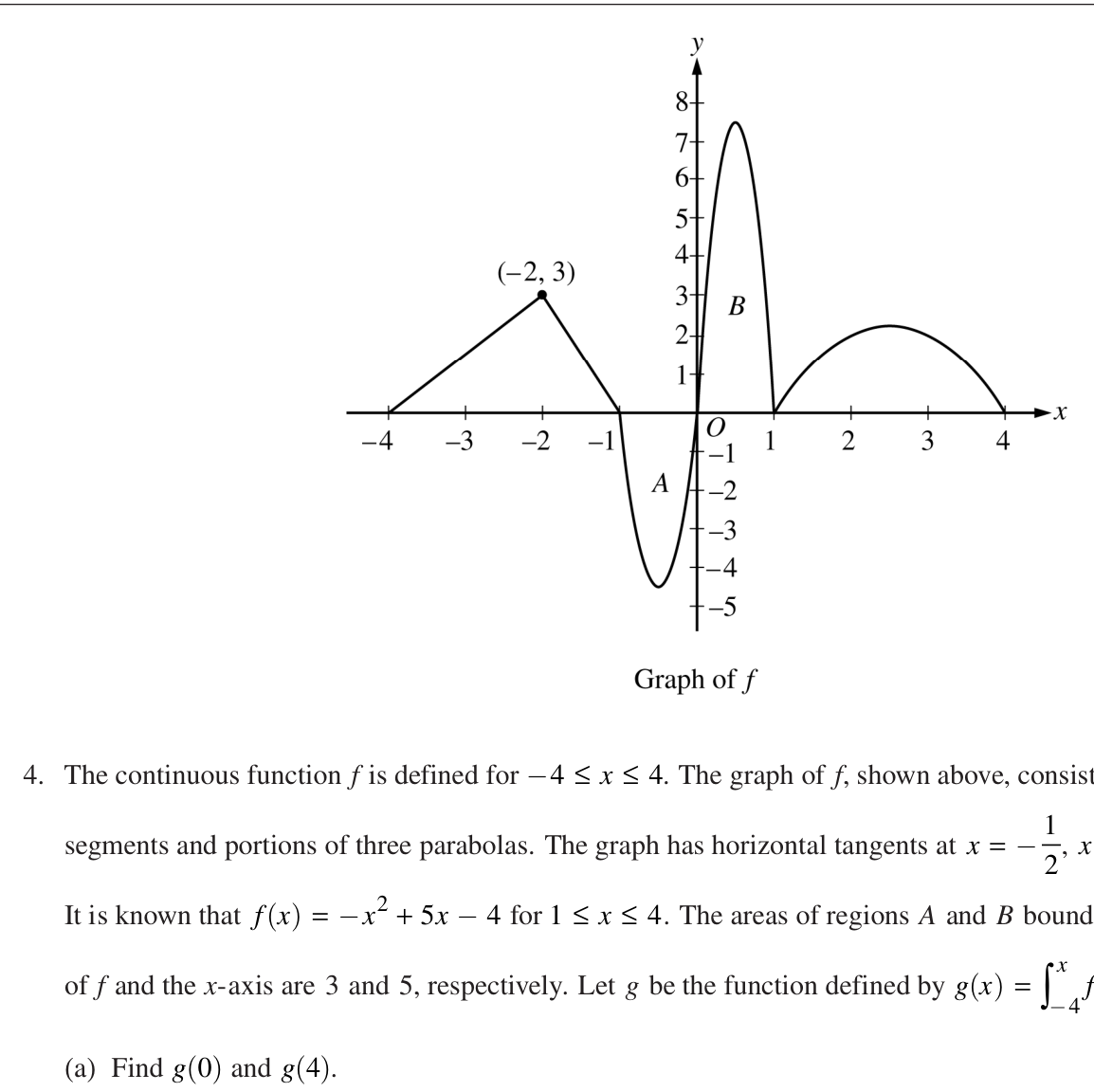
- (A) Find the rate of change of the volume of water in the barrel with respect to time when the height of the water is 4 feet. Indicate units of measure.
- (B) When the height of the water is 3 feet, is the rate of change of the height of the water with respect to time increasing or decreasing? Explain your reasoning.
- (C) At time \(t = 0\) seconds, the height of the water is 5 feet. Use separation of variables to find an expression for \(h\) in terms of \(t\).
2021 FRQ1 · 细菌密度 f(r) 表格(径向积分)(AB/BC 同题)Bacterial density f(r) table (radial integration) (AB/BC shared) Calculator Allowed
The density of a bacteria population in a circular petri dish at a distance \(r\) centimeters from the center of the dish is given by an increasing, differentiable function \(f\), where \(f(r)\) is measured in milligrams per square centimeter. Values of \(f(r)\) for selected values of \(r\) are given in the table above.
| \(r\) (centimeters) | 0 | 1 | 2 | 2.5 | 4 |
|---|---|---|---|---|---|
| \(f(r)\) (milligrams per square centimeter) | 1 | 2 | 6 | 10 | 18 |
- (A) Use the data in the table to estimate \(f'(2.25)\). Using correct units, interpret the meaning of your answer in the context of this problem.
- (B) The total mass, in milligrams, of bacteria in the petri dish is given by the integral expression \(2\pi\displaystyle\int_0^4 r\,f(r)\,dr\). Approximate the value of \(2\pi\displaystyle\int_0^4 r\,f(r)\,dr\) using a right Riemann sum with the four subintervals indicated by the data in the table.
- (C) Is the approximation found in part (b) an overestimate or underestimate of the total mass of bacteria in the petri dish? Explain your reasoning.
- (D) The density of bacteria in the petri dish, for \(1 \le r \le 4\), is modeled by the function \(g\) defined by \(g(r) = 2 - 16\bigl(\cos(1.57\sqrt{r})\bigr)^3\). For what value of \(k\), \(1 < k < 4\), is \(g(k)\) equal to the average value of \(g(r)\) on the interval \(1 \le r \le 4\)?
📝 点击展开评分标准(Scoring Guideline)📝 Expand Scoring Guideline

2022 FRQ4 · 冰雕圆锥 r'(t) 表格 + dV/dt (AB/BC 同题)Ice sculpture cone r'(t) table + dV/dt (AB/BC shared) No Calculator
An ice sculpture melts in such a way that it can be modeled as a cone that maintains a conical shape as it decreases in size. The radius of the base of the cone is given by a twice-differentiable function \(r\), where \(r(t)\) is measured in centimeters and \(t\) is measured in days. The table above gives selected values of \(r'(t)\), the rate of change of the radius, over the time interval \(0 \le t \le 12\).
| \(t\) (days) | 0 | 3 | 7 | 10 | 12 |
|---|---|---|---|---|---|
| \(r'(t)\) (centimeters per day) | \(-6.1\) | \(-5.0\) | \(-4.4\) | \(-3.8\) | \(-3.5\) |
- (A) Approximate \(r''(8.5)\) using the average rate of change of \(r'\) over the interval \(7 \le t \le 10\). Show the computations that lead to your answer, and indicate units of measure.
- (B) Is there a time \(t\), \(0 \le t \le 3\), for which \(r'(t) = -6\)? Justify your answer.
- (C) Use a right Riemann sum with the four subintervals indicated in the table to approximate the value of \(\displaystyle\int_0^{12} r'(t)\,dt\).
- (D) The height of the cone decreases at a rate of 2 centimeters per day. At time \(t = 3\) days, the radius is 100 centimeters and the height is 50 centimeters. Find the rate of change of the volume of the cone with respect to time, in cubic centimeters per day, at time \(t = 3\) days. (The volume \(V\) of a cone with radius \(r\) and height \(h\) is \(V = \tfrac{1}{3}\pi r^2 h\).)
📝 点击展开评分标准(Scoring Guideline)📝 Expand Scoring Guideline

2023 FRQ1 · Gasoline pumping f(t) 表格 + 累积 (AB/BC 同题)Gasoline pumping f(t) table + accumulation (AB/BC shared) Calculator Allowed
A customer at a gas station is pumping gasoline into a gas tank. The rate of flow of gasoline is modeled by a differentiable function \(f\), where \(f(t)\) is measured in gallons per second and \(t\) is measured in seconds since pumping began. Selected values of \(f(t)\) are given in the table.
| \(t\) (seconds) | 0 | 60 | 90 | 120 | 135 | 150 |
|---|---|---|---|---|---|---|
| \(f(t)\) (gallons per second) | 0 | 0.1 | 0.15 | 0.1 | 0.05 | 0 |
- (A) Using correct units, interpret the meaning of \(\displaystyle\int_{60}^{135} f(t)\,dt\) in the context of the problem. Use a right Riemann sum with the three subintervals \([60, 90]\), \([90, 120]\), and \([120, 135]\) to approximate the value of \(\displaystyle\int_{60}^{135} f(t)\,dt\).
- (B) Must there exist a value of \(c\), for \(60 < c < 120\), such that \(f'(c) = 0\)? Justify your answer.
- (C) The rate of flow of gasoline, in gallons per second, can also be modeled by \(g(t) = \left(\dfrac{t}{500}\right)\cos\!\left(\left(\dfrac{t}{120}\right)^2\right)\) for \(0 \le t \le 150\). Using this model, find the average rate of flow of gasoline over the time interval \(0 \le t \le 150\). Show the setup for your calculations.
- (D) Using the model \(g\) defined in part (c), find the value of \(g'(140)\). Interpret the meaning of your answer in the context of the problem.
📝 点击展开评分标准(Scoring Guideline)📝 Expand Scoring Guideline
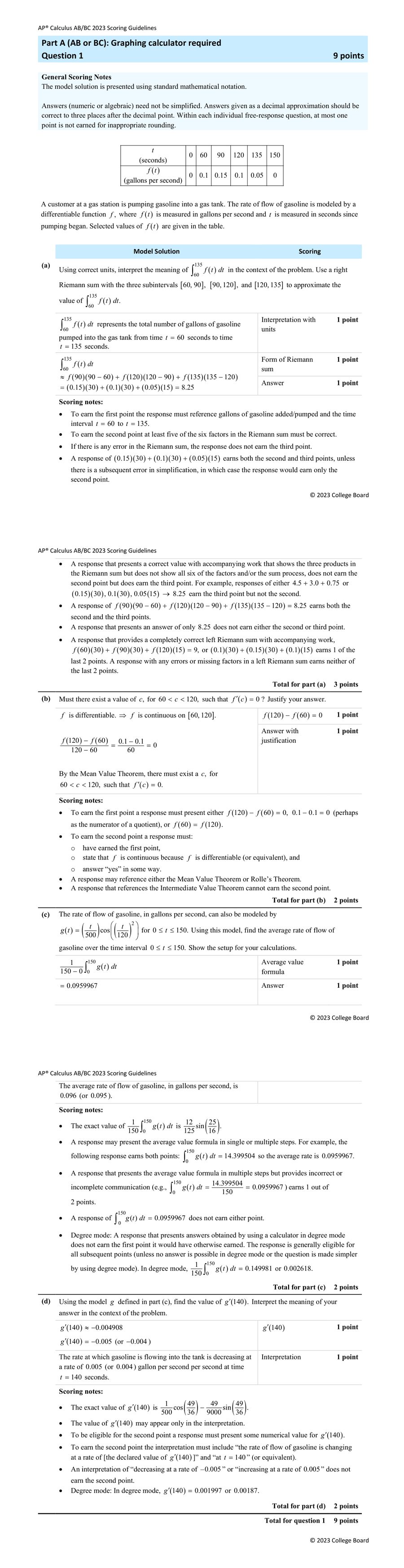
2024 FRQ1 · 🆕 Coffee cooling C(t) 表格 + 平均变化率🆕 Coffee cooling C(t) table + avg rate of change Calculator Allowed
The temperature of coffee in a cup at time \(t\) minutes is modeled by a decreasing differentiable function \(C\), where \(C(t)\) is measured in degrees Celsius. For \(0 \le t \le 12\), selected values of \(C(t)\) are given in the table shown.
| \(t\) (minutes) | 0 | 3 | 7 | 12 |
|---|---|---|---|---|
| \(C(t)\) (degrees Celsius) | 100 | 85 | 69 | 55 |
- (A) Approximate \(C'(5)\) using the average rate of change of \(C\) over the interval \(3 \le t \le 7\). Show the work that leads to your answer and include units of measure.
- (B) Use a left Riemann sum with the three subintervals indicated by the data in the table to approximate the value of \(\displaystyle\int_0^{12} C(t)\,dt\). Interpret the meaning of \(\dfrac{1}{12}\displaystyle\int_0^{12} C(t)\,dt\) in the context of the problem.
- (C) For \(12 \le t \le 20\), the rate of change of the temperature of the coffee is modeled by \(C'(t) = \dfrac{-24.55\,e^{0.01t}}{t}\), where \(C'(t)\) is measured in degrees Celsius per minute. Find the temperature of the coffee at time \(t = 20\). Show the setup for your calculations.
- (D) For the model defined in part (c), it can be shown that \(C''(t) = \dfrac{0.2455\,e^{0.01t}(100 - t)}{t^2}\). For \(12 < t < 20\), determine whether the temperature of the coffee is changing at a decreasing rate or at an increasing rate. Give a reason for your answer.
📝 点击展开评分标准(Scoring Guideline)📝 Expand Scoring Guideline
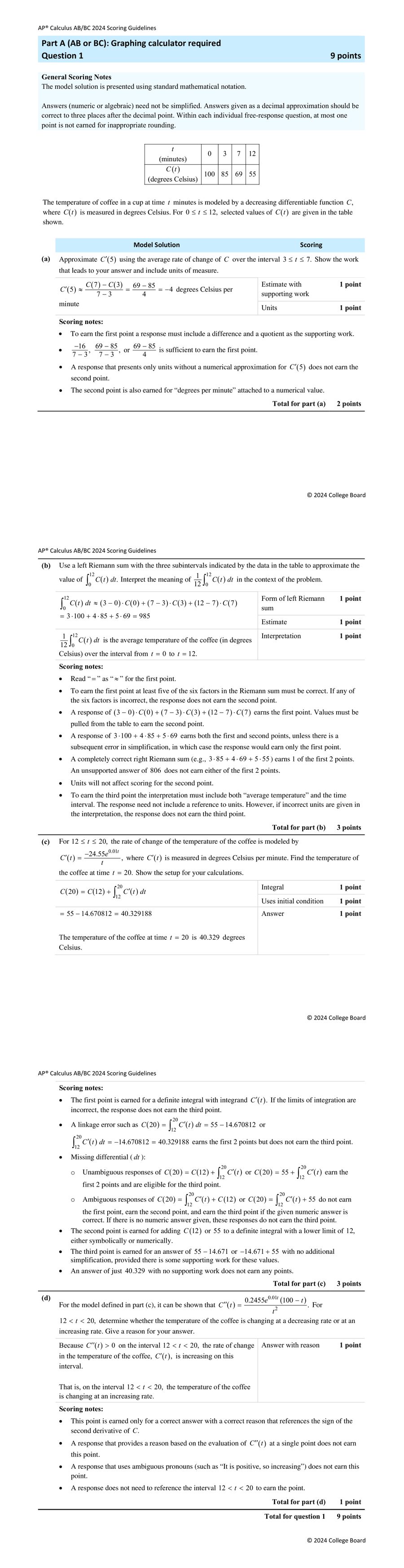
2024 FRQ5 · 🆕 f' 表格 + h(x)=∫√(1+(f')²) 积分🆕 f' table + h(x)=∫√(1+(f')²) integral No Calculator
The function \(f\) is twice differentiable for all \(x\) with \(f(0) = 0\). Values of \(f'\), the derivative of \(f\), are given in the table for selected values of \(x\).
| \(x\) | 0 | \(\pi\) | \(2\pi\) |
|---|---|---|---|
| \(f'(x)\) | 5 | 6 | 0 |
- (A) For \(x \ge 0\), the function \(h\) is defined by \(h(x) = \displaystyle\int_0^{x} \sqrt{1 + (f'(t))^2}\,dt\). Find the value of \(h'(\pi)\). Show the work that leads to your answer.
- (B) What information does \(\displaystyle\int_0^{\pi} \sqrt{1 + (f'(x))^2}\,dx\) provide about the graph of \(f\)?
- (C) Use Euler's method, starting at \(x = 0\) with two steps of equal size, to approximate \(f(2\pi)\). Show the computations that lead to your answer.
- (D) Find \(\displaystyle\int (t + 5)\cos\!\left(\dfrac{t}{4}\right) dt\). Show the work that leads to your answer.
📝 点击展开评分标准(Scoring Guideline)📝 Expand Scoring Guideline

2025 FRQ3 · 🆕 Reading rate R(t) 表格 + avg rate + trap🆕 Reading rate R(t) table + avg rate + trap Calculator Allowed
A student starts reading a book at time \(t = 0\) minutes and continues reading for the next 10 minutes. The rate at which the student reads is modeled by the differentiable function \(R\), where \(R(t)\) is measured in words per minute. Selected values of \(R(t)\) are given in the table shown.
| \(t\) (minutes) | 0 | 2 | 8 | 10 |
|---|---|---|---|---|
| \(R(t)\) (words per minute) | 90 | 100 | 150 | 162 |
- (A) Approximate \(R'(1)\) using the average rate of change of \(R\) over the interval \(0 \le t \le 2\). Show the work that leads to your answer. Indicate units of measure.
- (B) Must there be a value \(c\), for \(0 < c < 10\), such that \(R(c) = 155\)? Justify your answer.
- (C) Use a trapezoidal sum with the three subintervals indicated by the data in the table to approximate the value of \(\displaystyle\int_0^{10} R(t)\,dt\). Show the work that leads to your answer.
- (D) A teacher also starts reading at time \(t = 0\) minutes and continues reading for the next 10 minutes. The rate at which the teacher reads is modeled by the function \(W\) defined by \(W(t) = -\tfrac{3}{10}t^2 + 8t + 100\), where \(W(t)\) is measured in words per minute. Based on the model, how many words has the teacher read by the end of the 10 minutes? Show the work that leads to your answer.
📝 点击展开评分标准(Scoring Guideline)📝 Expand Scoring Guideline

FRQ5 · 微分方程(近年 53%)⭐⭐⭐FRQ5 · Differential Equations (53% recently) ⭐⭐⭐
Unit 7。近 6 年 7/11 年考 DE。斜率场 + 可分离 DE + Euler + Logistic + Taylor 近似解。2023-2025 连续 3 年考。Unit 7. 7 out of last 11 years tested DE. Slope field + separable DE + Euler + Logistic + Taylor approximation. Tested 3 years in a row (2023-2025).
🔍 怎么一眼认出🔍 How to Identify
- 题目给 dy/dx = f(x, y) 形式
- 问画 slope field、solve separable DE、Euler approx、second-degree Taylor approx
- 常有初始值 f(a) = b
- Problem gives dy/dx = f(x, y) form
- Asks to draw slope field, solve separable DE, Euler approx, second-degree Taylor approx
- Usually has initial value f(a) = b
📐 解题模板📐 Solution Template
- Slope Field:在指定点 \((x, y)\) 代入 \(dy/dx\),画短线段。分母为 0 时无定义。
- 可分离 DE 5 步:
- ① 分离:\(g(y)\,dy = h(x)\,dx\)
- ② 积分:\(\int g(y)\,dy = \int h(x)\,dx + C\)
- ③ 代入初始值求 C
- ④ 解出 y(显式)
- ⑤ 检查定义域
- Euler's Method:步长 h,递推 \(y_{n+1} = y_n + h \cdot f(x_n, y_n)\)。
- Logistic DE:\(dP/dt = kP(1-P/L)\)。拐点在 \(P = L/2\),极限 \(\lim_{t\to\infty} P = L\)。
- Taylor Approx of Solution:\(P_2(x) = y_0 + y'(a)(x-a) + \frac{y''(a)}{2}(x-a)^2\)。\(y''(a)\) 由 \(y'' = f_x + f_y \cdot y'\) 求。
- Slope Field: At specified points \((x, y)\), plug into \(dy/dx\) and draw short segments. Undefined where denominator = 0.
- Separable DE · 5 Steps:
- ① Separate: \(g(y)\,dy = h(x)\,dx\)
- ② Integrate: \(\int g(y)\,dy = \int h(x)\,dx + C\)
- ③ Use initial value to find C
- ④ Solve for y (explicit)
- ⑤ Check domain
- Euler's Method: Step size h, iteration \(y_{n+1} = y_n + h \cdot f(x_n, y_n)\).
- Logistic DE: \(dP/dt = kP(1-P/L)\). Inflection point at \(P = L/2\), limit \(\lim_{t\to\infty} P = L\).
- Taylor Approx of Solution: \(P_2(x) = y_0 + y'(a)(x-a) + \frac{y''(a)}{2}(x-a)^2\). Get \(y''(a)\) from \(y'' = f_x + f_y \cdot y'\).
⚠️ 踩分点与易错⚠️ Pitfalls & Common Errors
- ⚠️ 分离时 y, dy 和 x, dx 对调
- ⚠️ 积分常数 C 忘了代初始值求
- ⚠️ Euler 步数算错
- ⚠️ Logistic 和标准可分离 DE 混着用
- ⚠️ 解出 y 后忘记定义域限制
- ⚠️ Swapping y, dy and x, dx when separating
- ⚠️ Forgetting to apply initial value to find constant C
- ⚠️ Miscounting Euler steps
- ⚠️ Confusing Logistic with standard separable DE
- ⚠️ Forgetting domain restrictions after solving for y
历年真题(8 道 · 点击展开)Past FRQs (8 · Click to Expand)
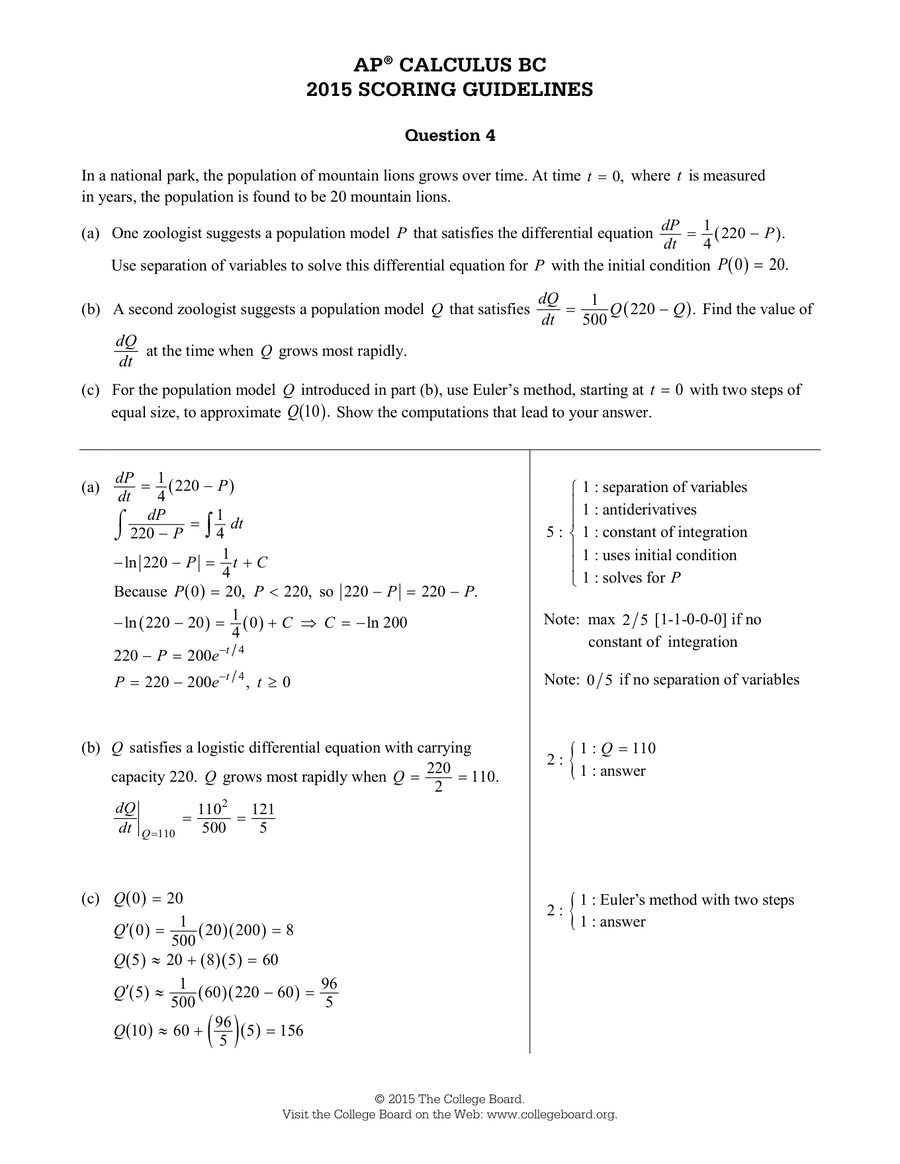
2015 FRQ4 · Mountain lions 种群 logistic 式增长Mountain lions population logistic growth No Calculator
In a national park, the population of mountain lions grows over time. At time \(t = 0\), where \(t\) is measured in years, the population is found to be 20 mountain lions.
- (A) One zoologist suggests a population model \(P\) that satisfies the differential equation \(\dfrac{dP}{dt} = \dfrac{1}{4}(220 - P)\). Use separation of variables to solve this differential equation for \(P\) with the initial condition \(P(0) = 20\).
- (B) A second zoologist suggests a population model \(Q\) that satisfies \(\dfrac{dQ}{dt} = \dfrac{1}{500}Q(220 - Q)\). Find the value of \(\dfrac{dQ}{dt}\) at the time when \(Q\) grows most rapidly.
- (C) For the population model \(Q\) introduced in part (b), use Euler's method, starting at \(t = 0\) with two steps of equal size, to approximate \(Q(10)\). Show the computations that lead to your answer.
📝 点击展开评分标准(Scoring Guideline)📝 Expand Scoring Guideline
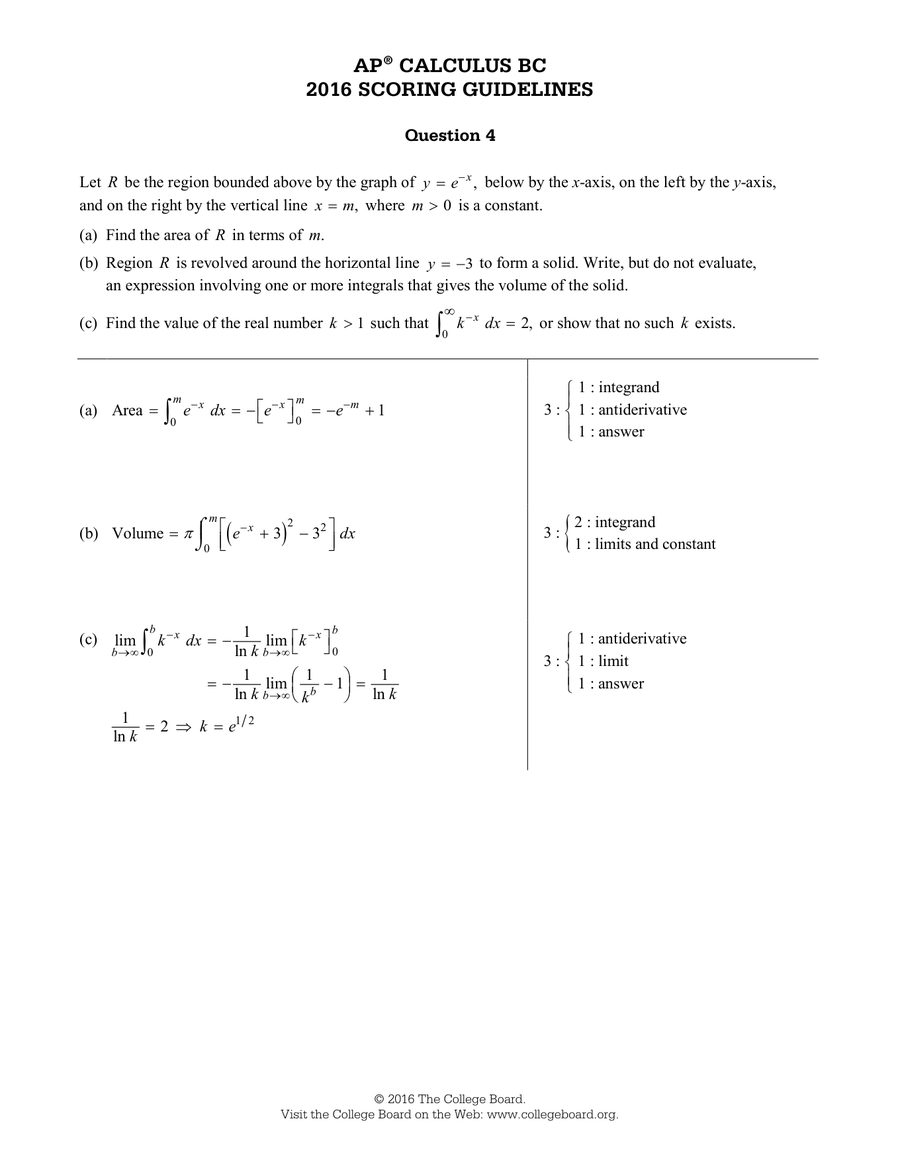
2016 FRQ4 · dy/dx = x² - y/2; d²y/dx², particular solution No Calculator
Consider the differential equation \(\dfrac{dy}{dx} = x^{2} - \dfrac{1}{2}y\).
- (A) Find \(\dfrac{d^{2}y}{dx^{2}}\) in terms of \(x\) and \(y\).
- (B) Let \(y = f(x)\) be the particular solution to the given differential equation whose graph passes through the point \((-2, 8)\). Does the graph of \(f\) have a relative minimum, a relative maximum, or neither at the point \((-2, 8)\)? Justify your answer.
- (C) Let \(y = g(x)\) be the particular solution to the given differential equation with \(g(-1) = 2\). Find \(\displaystyle\lim_{x \to -1} \dfrac{g(x) - 2}{3(x + 1)^{2}}\). Show the work that leads to your answer.
- (D) Let \(y = h(x)\) be the particular solution to the given differential equation with \(h(0) = 2\). Use Euler's method, starting at \(x = 0\) with two steps of equal size, to approximate \(h(1)\).
📝 点击展开评分标准(Scoring Guideline)📝 Expand Scoring Guideline
2017 FRQ4 · Boiled potato 冷却 dH/dt = -(1/4)(H-27); Newton coolingBoiled potato cooling dH/dt = -(1/4)(H-27); Newton cooling No Calculator
At time \(t = 0\), a boiled potato is taken from a pot on a stove and left to cool in a kitchen. The internal temperature of the potato is 91 degrees Celsius (\(^\circ\)C) at time \(t = 0\), and the internal temperature of the potato is greater than \(27^\circ\)C for all times \(t > 0\). The internal temperature of the potato at time \(t\) minutes can be modeled by the function \(H\) that satisfies the differential equation \(\dfrac{dH}{dt} = -\dfrac{1}{4}(H - 27)\), where \(H(t)\) is measured in degrees Celsius and \(H(0) = 91\).
- (A) Write an equation for the line tangent to the graph of \(H\) at \(t = 0\). Use this equation to approximate the internal temperature of the potato at time \(t = 3\).
- (B) Use \(\dfrac{d^2 H}{dt^2}\) to determine whether your answer in part (a) is an underestimate or an overestimate of the internal temperature of the potato at time \(t = 3\).
- (C) For \(t < 10\), an alternate model for the internal temperature of the potato at time \(t\) minutes is the function \(G\) that satisfies the differential equation \(\dfrac{dG}{dt} = -(G - 27)^{2/3}\), where \(G(t)\) is measured in degrees Celsius and \(G(0) = 91\). Find an expression for \(G(t)\). Based on this model, what is the internal temperature of the potato at time \(t = 3\)?
📝 点击展开评分标准(Scoring Guideline)📝 Expand Scoring Guideline
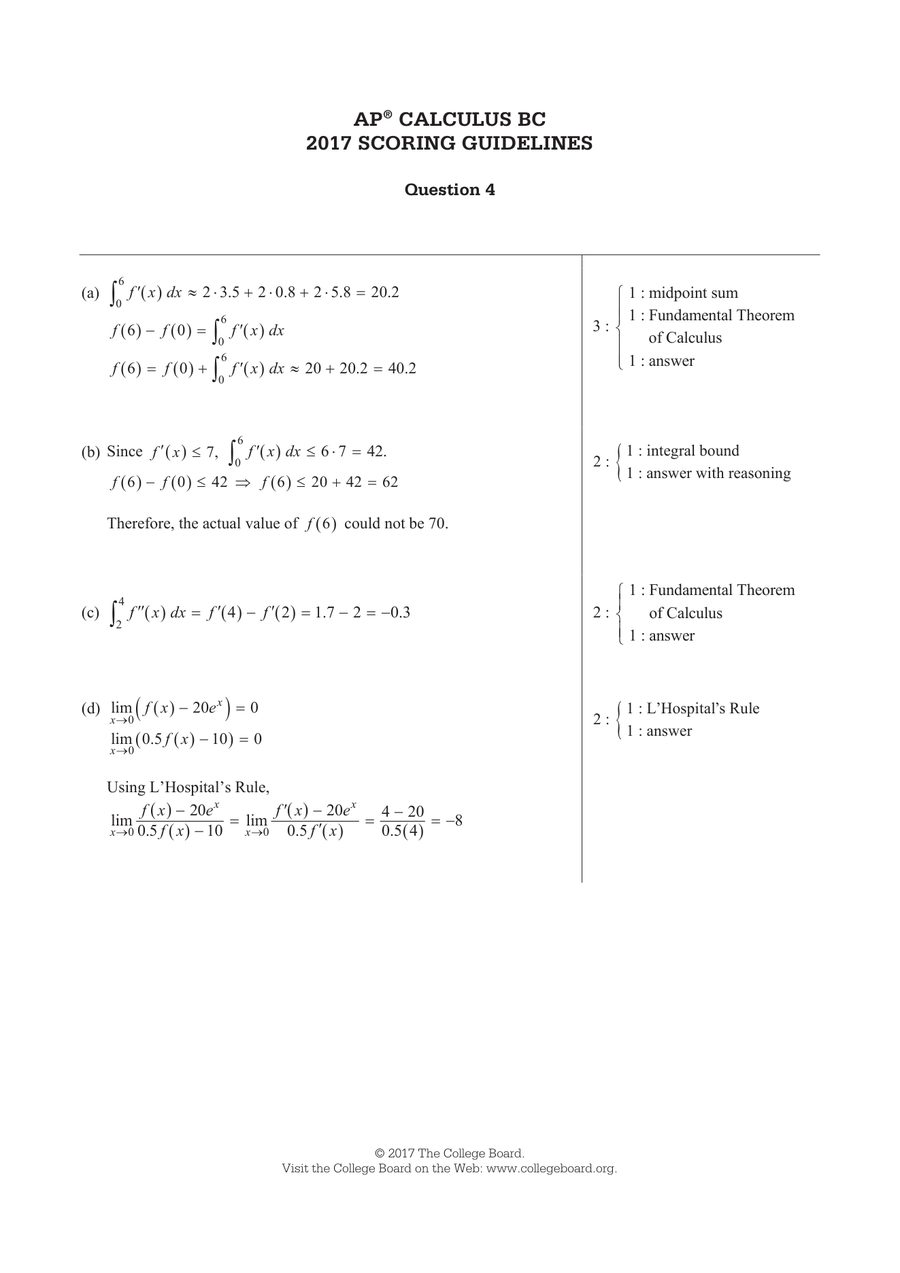
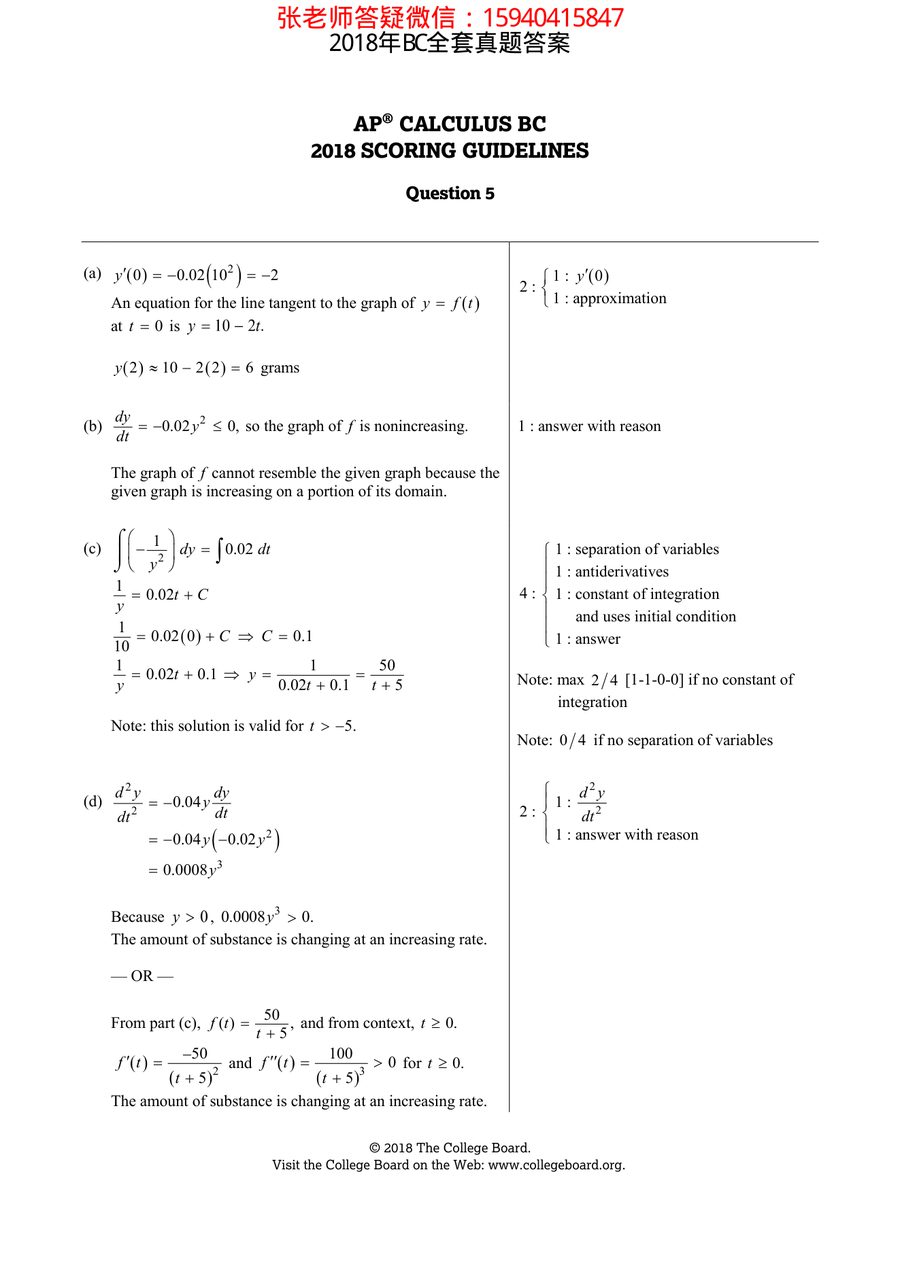
2018 FRQ5 · Chemical reaction y=f(t), 10g 起; dy/dtChemical reaction y=f(t), starting at 10g; dy/dt No Calculator
During a chemical reaction, the function \(y = f(t)\) models the amount of a substance present, in grams, at time \(t\) seconds. At the start of the reaction (\(t = 0\)), there are 10 grams of the substance present. The function \(y = f(t)\) satisfies the differential equation \(\dfrac{dy}{dt} = -0.02 y^2\).
- (A) Use the line tangent to the graph of \(y = f(t)\) at \(t = 0\) to approximate the amount of the substance remaining at time \(t = 2\) seconds.
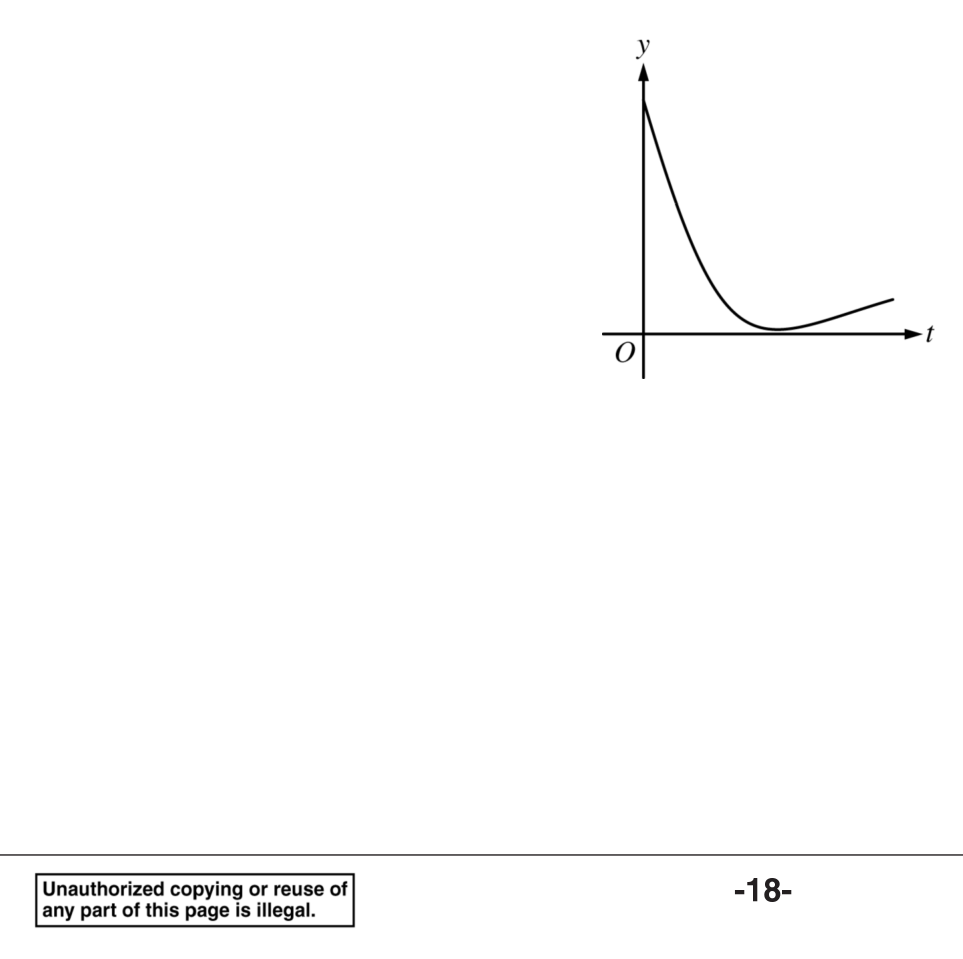
- (B) Using the given differential equation, determine whether the graph of \(f\) could resemble the following graph. Give a reason for your answer.
- (C) Find an expression for \(y = f(t)\) by solving the differential equation \(\dfrac{dy}{dt} = -0.02 y^2\) with the initial condition \(f(0) = 10\).
- (D) Determine whether the amount of the substance is changing at an increasing or a decreasing rate. Explain your reasoning.
📝 点击展开评分标准(Scoring Guideline)📝 Expand Scoring Guideline
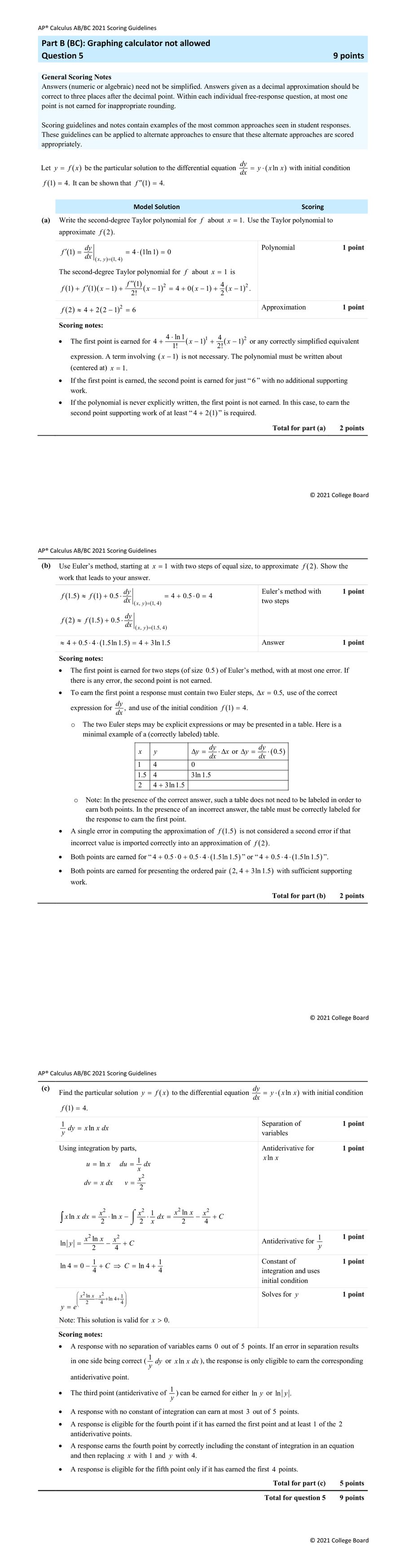
2021 FRQ5 · dy/dx = y·(x·ln x), f(1)=4; Taylor 2 次dy/dx = y·(x·ln x), f(1)=4; 2nd-order Taylor No Calculator
Let \(y = f(x)\) be the particular solution to the differential equation \(\dfrac{dy}{dx} = y\cdot(x\ln x)\) with initial condition \(f(1) = 4\). It can be shown that \(f''(1) = 4\).
- (A) Write the second-degree Taylor polynomial for \(f\) about \(x = 1\). Use the Taylor polynomial to approximate \(f(2)\).
- (B) Use Euler's method, starting at \(x = 1\) with two steps of equal size, to approximate \(f(2)\). Show the work that leads to your answer.
- (C) Find the particular solution \(y = f(x)\) to the differential equation \(\dfrac{dy}{dx} = y\cdot(x\ln x)\) with initial condition \(f(1) = 4\).
📝 点击展开评分标准(Scoring Guideline)📝 Expand Scoring Guideline
2023 FRQ3 · 🆕 牛奶温度 dM/dt = (1/4)(40-M); 斜率场 + 可分离 (AB/BC 同题)🆕 Milk temperature dM/dt = (1/4)(40-M); slope field + separable (AB/BC shared) No Calculator
A bottle of milk is taken out of a refrigerator and placed in a pan of hot water to be warmed. The increasing function \(M\) models the temperature of the milk at time \(t\), where \(M(t)\) is measured in degrees Celsius (\(^\circ\)C) and \(t\) is the number of minutes since the bottle was placed in the pan. \(M\) satisfies the differential equation \(\dfrac{dM}{dt} = \tfrac{1}{4}(40 - M)\). At time \(t = 0\), the temperature of the milk is \(5^\circ\)C. It can be shown that \(M(t) < 40\) for all values of \(t\).
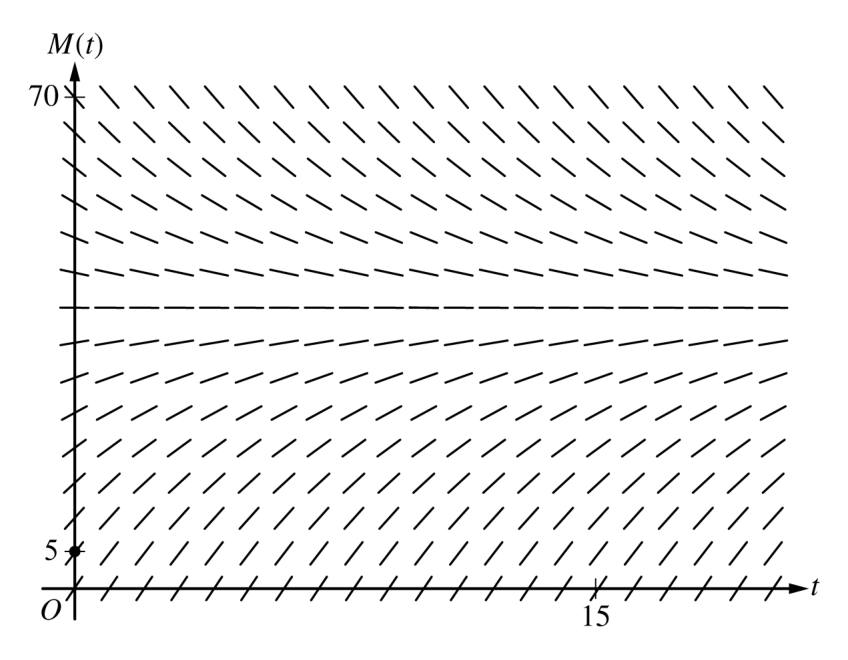
- (A) A slope field for the differential equation \(\dfrac{dM}{dt} = \tfrac{1}{4}(40 - M)\) is shown. Sketch the solution curve through the point \((0, 5)\).
- (B) Use the line tangent to the graph of \(M\) at \(t = 0\) to approximate \(M(2)\), the temperature of the milk at time \(t = 2\) minutes.
- (C) Write an expression for \(\dfrac{d^2 M}{dt^2}\) in terms of \(M\). Use \(\dfrac{d^2 M}{dt^2}\) to determine whether the approximation from part (b) is an underestimate or an overestimate for the actual value of \(M(2)\). Give a reason for your answer.
- (D) Use separation of variables to find an expression for \(M(t)\), the particular solution to the differential equation \(\dfrac{dM}{dt} = \tfrac{1}{4}(40 - M)\) with initial condition \(M(0) = 5\).
📝 点击展开评分标准(Scoring Guideline)📝 Expand Scoring Guideline

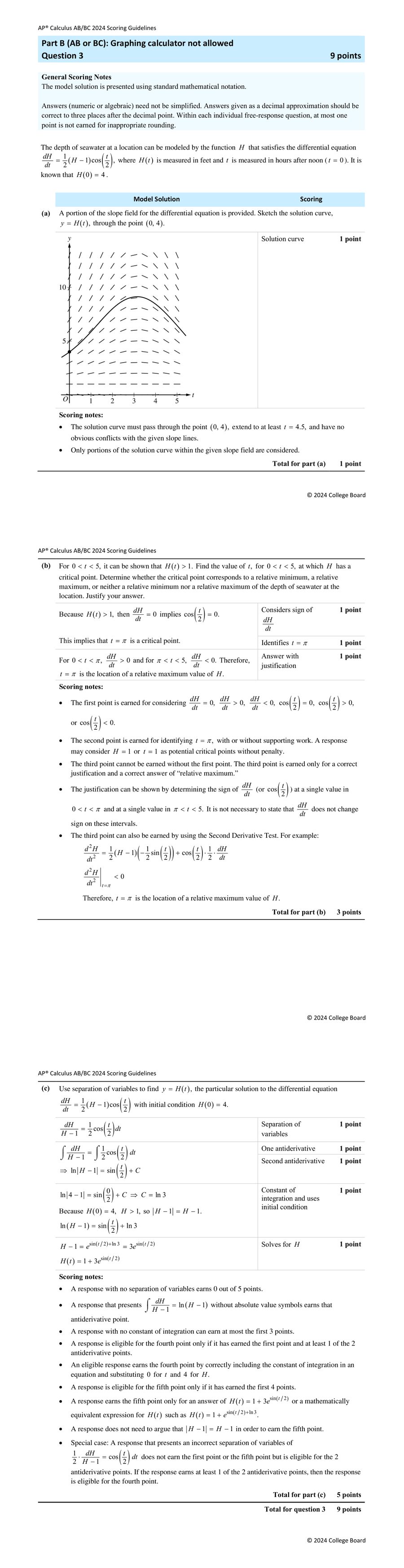
2024 FRQ3 · 🆕 海水深度 dH/dt = (1/2)(H-1)cos(t/2); 斜率场 + 可分离🆕 Seawater depth dH/dt = (1/2)(H-1)cos(t/2); slope field + separable No Calculator
The depth of seawater at a location can be modeled by the function \(H\) that satisfies the differential equation \(\dfrac{dH}{dt} = \dfrac{1}{2}(H - 1)\cos\!\left(\dfrac{t}{2}\right)\), where \(H(t)\) is measured in feet and \(t\) is measured in hours after noon (\(t = 0\)). It is known that \(H(0) = 4\).
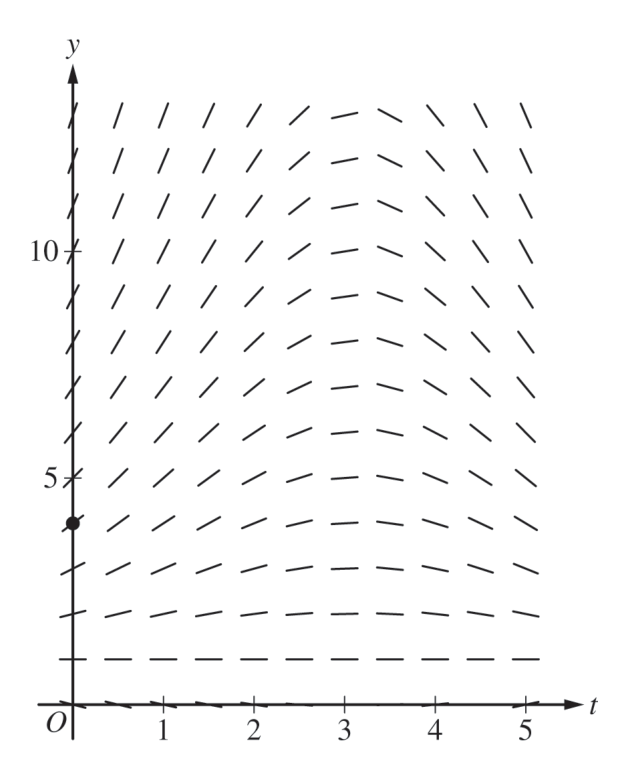
- (A) A portion of the slope field for the differential equation is provided. Sketch the solution curve, \(y = H(t)\), through the point \((0, 4)\).
- (B) For \(0 < t < 5\), it can be shown that \(H(t) > 1\). Find the value of \(t\), for \(0 < t < 5\), at which \(H\) has a critical point. Determine whether the critical point corresponds to a relative minimum, a relative maximum, or neither a relative minimum nor a relative maximum of the depth of seawater at the location. Justify your answer.
- (C) Use separation of variables to find \(y = H(t)\), the particular solution to the differential equation \(\dfrac{dH}{dt} = \dfrac{1}{2}(H - 1)\cos\!\left(\dfrac{t}{2}\right)\) with initial condition \(H(0) = 4\).
📝 点击展开评分标准(Scoring Guideline)📝 Expand Scoring Guideline
2025 FRQ5 · 🆕 dy/dx=(3-x)y², f(1)=-1; Taylor 2次 + Lagrange + Euler 2 步🆕 dy/dx=(3-x)y², f(1)=-1; 2nd-order Taylor + Lagrange + Euler 2 steps No Calculator
Let \(y = f(x)\) be the particular solution to the differential equation \(\dfrac{dy}{dx} = (3 - x)y^2\) with initial condition \(f(1) = -1\).
- (A) Find \(f''(1)\), the value of \(\dfrac{d^2 y}{dx^2}\) at the point \((1, -1)\). Show the work that leads to your answer.
- (B) Write the second-degree Taylor polynomial for \(f\) about \(x = 1\).
- (C) The second-degree Taylor polynomial for \(f\) about \(x = 1\) is used to approximate \(f(1.1)\). Given that \(|f'''(x)| \le 60\) for all \(x\) in the interval \(1 \le x \le 1.1\), use the Lagrange error bound to show that this approximation differs from \(f(1.1)\) by at most \(0.01\).
- (D) Use Euler's method, starting at \(x = 1\) with two steps of equal size, to approximate \(f(1.4)\). Show the work that leads to your answer.
📝 点击展开评分标准(Scoring Guideline)📝 Expand Scoring Guideline

FRQ6 · 级数(100% 必考)⭐⭐⭐⭐⭐FRQ6 · Series (100% Must-Know) ⭐⭐⭐⭐⭐ BC 专属BC Only
Unit 10。9/9 年都考。Taylor/Maclaurin 级数 56% + 幂级数收敛区间 44%。必须吃透。Unit 10. Tested 9/9 years. Taylor/Maclaurin series 56% + power series interval of convergence 44%. Must master completely.
🔍 怎么一眼认出🔍 How to Identify
- 题目提到 Taylor series / Maclaurin / power series / radius of convergence
- 常见 3 类:已知 f(x) 求级数;已知级数求 f;判断收敛性
- Problem mentions Taylor series / Maclaurin / power series / radius of convergence
- Three common types: given f(x) find series; given series find f; determine convergence
📐 解题模板📐 Solution Template
- 写级数(Maclaurin):
- \(e^x = \sum \frac{x^n}{n!}\)
- \(\sin x = \sum \frac{(-1)^n x^{2n+1}}{(2n+1)!}\)
- \(\cos x = \sum \frac{(-1)^n x^{2n}}{(2n)!}\)
- \(\frac{1}{1-x} = \sum x^n\)(\(|x|<1\))
- \(\ln(1+x) = \sum \frac{(-1)^{n+1} x^n}{n}\)(\(|x|<1\))
- \(\arctan x = \sum \frac{(-1)^n x^{2n+1}}{2n+1}\)(\(|x|<1\))
- Ratio Test:\(L = \lim_{n\to\infty} |a_{n+1}/a_n|\)。\(L<1\) 收敛,\(L>1\) 发散。
- 端点检验:
- • 交替级数:\(b_n \to 0\) 且 \(b_n\) 单减 → 收敛
- • p-series \(\sum 1/n^p\):\(p > 1\) 收敛
- • 绝对 vs 条件:检查 \(\sum |a_n|\)
- Lagrange Error Bound:\(|f(x) - T_n(x)| \le \frac{M}{(n+1)!}|x-a|^{n+1}\),M = \(|f^{(n+1)}|\) 在区间上最大。
- Term-by-term 微分/积分:幂级数在收敛半径内可逐项求导/积分。
- Writing Series (Maclaurin):
- \(e^x = \sum \frac{x^n}{n!}\)
- \(\sin x = \sum \frac{(-1)^n x^{2n+1}}{(2n+1)!}\)
- \(\cos x = \sum \frac{(-1)^n x^{2n}}{(2n)!}\)
- \(\frac{1}{1-x} = \sum x^n\) (\(|x|<1\))
- \(\ln(1+x) = \sum \frac{(-1)^{n+1} x^n}{n}\) (\(|x|<1\))
- \(\arctan x = \sum \frac{(-1)^n x^{2n+1}}{2n+1}\) (\(|x|<1\))
- Ratio Test: \(L = \lim_{n\to\infty} |a_{n+1}/a_n|\). \(L<1\) converges, \(L>1\) diverges.
- Endpoint Testing:
- • Alternating series: \(b_n \to 0\) and \(b_n\) monotonically decreasing → converges
- • p-series \(\sum 1/n^p\): converges when \(p > 1\)
- • Absolute vs conditional: check \(\sum |a_n|\)
- Lagrange Error Bound: \(|f(x) - T_n(x)| \le \frac{M}{(n+1)!}|x-a|^{n+1}\), M = max of \(|f^{(n+1)}|\) on the interval.
- Term-by-term differentiation/integration: Power series can be differentiated/integrated term-by-term within radius of convergence.
⚠️ 踩分点与易错⚠️ Pitfalls & Common Errors
- ⚠️ Ratio test 算 \(|a_{n+1}/a_n|\) 忘取绝对值
- ⚠️ 端点只查一个
- ⚠️ Lagrange M 算错(取了 \(f^{(n)}\) 而非 \(f^{(n+1)}\))
- ⚠️ 误用几何级数公式
- ⚠️ Taylor 多项式次数数错
- ⚠️ Forgetting absolute value in ratio test \(|a_{n+1}/a_n|\)
- ⚠️ Only testing one endpoint
- ⚠️ Wrong Lagrange M (used \(f^{(n)}\) instead of \(f^{(n+1)}\))
- ⚠️ Misapplying geometric series formula
- ⚠️ Miscounting Taylor polynomial degree
历年真题(11 道 · 点击展开)Past FRQs (11 · Click to Expand)
2014 FRQ6 · Taylor 级数 about x=1: ∑(-1)^(n+1)·(2^n/n)(x-1)^nTaylor series about x=1: ∑(-1)^(n+1)·(2^n/n)(x-1)^n No Calculator
The Taylor series for a function \(f\) about \(x = 1\) is given by \[\sum_{n=1}^{\infty} (-1)^{n+1} \dfrac{2^{n}}{n} (x - 1)^{n}\] and converges to \(f(x)\) for \(|x - 1| < R\), where \(R\) is the radius of convergence of the Taylor series.
- (A) Find the value of \(R\).
- (B) Find the first three nonzero terms and the general term of the Taylor series for \(f'\), the derivative of \(f\), about \(x = 1\).
- (C) The Taylor series for \(f'\) about \(x = 1\), found in part (b), is a geometric series. Find the function \(f'\) to which the series converges for \(|x - 1| < R\). Use this function to determine \(f\) for \(|x - 1| < R\).
📝 点击展开评分标准(Scoring Guideline)📝 Expand Scoring Guideline

2015 FRQ6 · Maclaurin x/3 + x²/4 + x³/5 + ...; ratio test No Calculator
The Maclaurin series for a function \(f\) is given by \(\dfrac{x}{3} + \dfrac{x^2}{4} + \dfrac{x^3}{5} + \cdots + \dfrac{x^n}{n + 2} + \cdots\).
- (A) Use the ratio test to find the interval of convergence of the Maclaurin series for \(f\).
- (B) Let \(g\) be the function given by \(g(x) = f(-2x)\). Find the first three terms and the general term of the Maclaurin series for \(g\).
- (C) The first two terms of the Maclaurin series for \(f\) are used to approximate \(f(0.1)\). Given that \(|f'''(x)| \le 2\) for \(0 \le x \le 0.1\), use the Lagrange error bound to show that this approximation differs from \(f(0.1)\) by at most \(\dfrac{1}{3000}\).
📝 点击展开评分标准(Scoring Guideline)📝 Expand Scoring Guideline

2016 FRQ6 · Taylor about x=1: 3 - 6(x-1)² + 5(x-1)³ - 2(x-1)⁴ No Calculator
The function \(f\) has a Taylor series about \(x = 1\) that converges to \(f(x)\) for all \(x\) in the interval of convergence. It is known that \(f(1) = 1\), \(f'(1) = -\dfrac{1}{2}\), and the \(n\)th derivative of \(f\) at \(x = 1\) is given by \[f^{(n)}(1) = (-1)^{n} \dfrac{(n-1)!}{2^{n}}\] for \(n \ge 2\).
- (A) Write the first four nonzero terms and the general term of the Taylor series for \(f\) about \(x = 1\).
- (B) The Taylor series for \(f\) about \(x = 1\) has a radius of convergence of 2. Find the interval of convergence. Show the work that leads to your answer.
- (C) The Taylor series for \(f\) about \(x = 1\) can be used to represent \(f(1.2)\) as an alternating series. Use the first three nonzero terms of the alternating series to approximate \(f(1.2)\).
- (D) Show that the approximation found in part (c) is within 0.001 of the exact value of \(f(1.2)\).
📝 点击展开评分标准(Scoring Guideline)📝 Expand Scoring Guideline

2017 FRQ6 · f(0)=0, f'(0)=1, 递推 f^(n+1)(0) = -n·f^(n)(0); Maclaurinf(0)=0, f'(0)=1, recurrence f^(n+1)(0) = -n·f^(n)(0); Maclaurin No Calculator
A function \(f\) has derivatives of all orders for \(-1 < x < 1\). The derivatives of \(f\) satisfy the conditions \[f(0) = 0, \quad f'(0) = 1, \quad f^{(n+1)}(0) = -n \cdot f^{(n)}(0)\text{ for all }n \ge 1.\] The Maclaurin series for \(f\) converges to \(f(x)\) for \(|x| < 1\).
- (A) Show that the first four nonzero terms of the Maclaurin series for \(f\) are \(x - \dfrac{x^2}{2} + \dfrac{x^3}{3} - \dfrac{x^4}{4}\), and write the general term of the Maclaurin series for \(f\).
- (B) Determine whether the Maclaurin series described in part (a) converges absolutely, converges conditionally, or diverges at \(x = 1\). Explain your reasoning.
- (C) Write the first four nonzero terms and the general term of the Maclaurin series for \(g(x) = \displaystyle\int_0^{x} f(t)\,dt\).
- (D) Let \(P_n\!\left(\dfrac{1}{2}\right)\) represent the \(n\)th-degree Taylor polynomial for \(g\) about \(x = 0\) evaluated at \(x = \dfrac{1}{2}\), where \(g\) is the function defined in part (c). Use the alternating series error bound to show that \(\left|P_4\!\left(\dfrac{1}{2}\right) - g\!\left(\dfrac{1}{2}\right)\right| < \dfrac{1}{500}\).
📝 点击展开评分标准(Scoring Guideline)📝 Expand Scoring Guideline

2018 FRQ6 · f 及前四阶导数选值, Taylor 2 阶 + Lagrange errorSelected values of f and first four derivatives, 2nd-order Taylor + Lagrange error No Calculator
Let \(f\) be a function having derivatives of all orders for all real numbers. Selected values of \(f\) and its first four derivatives are shown in the table above.
| \(x\) | \(f(x)\) | \(f'(x)\) | \(f''(x)\) | \(f'''(x)\) | \(f^{(4)}(x)\) |
|---|---|---|---|---|---|
| 0 | 4 | 5 | \(-1\) | \(-\dfrac{15}{2}\) | 23 |
| 1 | 8 | 3 | \(-2\) | \(\dfrac{3}{2}\) | \(\dfrac{2}{5}\) |
- (A) Write the second-degree Taylor polynomial for \(f\) about \(x = 0\) and use it to approximate \(f(0.2)\).
- (B) Let \(g\) be a function such that \(g(x) = f(x^3)\). Write the fifth-degree Taylor polynomial for \(g'\), the derivative of \(g\), about \(x = 0\).
- (C) Write the third-degree Taylor polynomial for \(f\) about \(x = 1\).
- (D) It is known that \(\left|f^{(4)}(x)\right| \le 300\) for \(0 \le x \le 1.125\). The third-degree Taylor polynomial for \(f\) about \(x = 1\), found in part (c), is used to approximate \(f(1.1)\). Use the Lagrange error bound along with the information about \(f^{(4)}(x)\) to find an upper bound on the error of the approximation.
📝 点击展开评分标准(Scoring Guideline)📝 Expand Scoring Guideline

2019 FRQ6 · 幂级数 ∑(-1)^(n+1)(x-3)^n/(5^n·n^p) 收敛Power series ∑(-1)^(n+1)(x-3)^n/(5^n·n^p) convergence No Calculator
Consider the series \(\displaystyle\sum_{n=1}^{\infty} \dfrac{(-1)^{n+1}(x - 3)^n}{5^n \cdot n^p}\), where \(p\) is a constant and \(p > 0\).
- (A) For \(p = 3\) and \(x = 8\), does the series converge absolutely, converge conditionally, or diverge? Explain your reasoning.
- (B) For \(p = 1\) and \(x = 8\), does the series converge absolutely, converge conditionally, or diverge? Explain your reasoning.
- (C) When \(x = -2\), for what values of \(p\) does the series converge? Explain your reasoning.
- (D) When \(p = 1\) and \(x = 3.1\), the series converges to a value \(S\). Use the first two terms of the series to approximate \(S\). Use the alternating series error bound to show that this approximation differs from \(S\) by less than \(\dfrac{1}{300{,}000}\).
2021 FRQ6 · g 的 Maclaurin 级数; 收敛区间 + 逐项Maclaurin series of g; interval of convergence + term-by-term No Calculator
The function \(g\) has derivatives of all orders for all real numbers. The Maclaurin series for \(g\) is given by \[g(x) = \sum_{n=0}^{\infty} \dfrac{(-1)^n x^n}{2e^n + 3}\] on its interval of convergence.
- (A) State the conditions necessary to use the integral test to determine convergence of the series \(\displaystyle\sum_{n=0}^{\infty} \dfrac{1}{e^n}\). Use the integral test to show that \(\displaystyle\sum_{n=0}^{\infty} \dfrac{1}{e^n}\) converges.
- (B) Use the limit comparison test with the series \(\displaystyle\sum_{n=0}^{\infty} \dfrac{1}{e^n}\) to show that the series \(g(1) = \displaystyle\sum_{n=0}^{\infty} \dfrac{(-1)^n}{2e^n + 3}\) converges absolutely.
- (C) Determine the radius of convergence of the Maclaurin series for \(g\).
- (D) The first two terms of the series \(g(1) = \displaystyle\sum_{n=0}^{\infty} \dfrac{(-1)^n}{2e^n + 3}\) are used to approximate \(g(1)\). Use the alternating series error bound to determine an upper bound on the error of the approximation.
📝 点击展开评分标准(Scoring Guideline)📝 Expand Scoring Guideline

2022 FRQ6 · 幂级数 f(x) = x - x³/3 + x⁵/5 - ...Power series f(x) = x - x³/3 + x⁵/5 - ... No Calculator
The function \(f\) is defined by the power series \[f(x) = x - \dfrac{x^3}{3} + \dfrac{x^5}{5} - \dfrac{x^7}{7} + \cdots + \dfrac{(-1)^n x^{2n+1}}{2n+1} + \cdots\] for all real numbers \(x\) for which the series converges.
- (A) Using the ratio test, find the interval of convergence of the power series for \(f\). Justify your answer.
- (B) Show that \(\left| f\!\left(\tfrac{1}{2}\right) - \tfrac{1}{2} \right| < \tfrac{1}{10}\). Justify your answer.
- (C) Write the first four nonzero terms and the general term for an infinite series that represents \(f'(x)\).
- (D) Use the result from part (c) to find the value of \(f'\!\left(\tfrac{1}{6}\right)\).
📝 点击展开评分标准(Scoring Guideline)📝 Expand Scoring Guideline
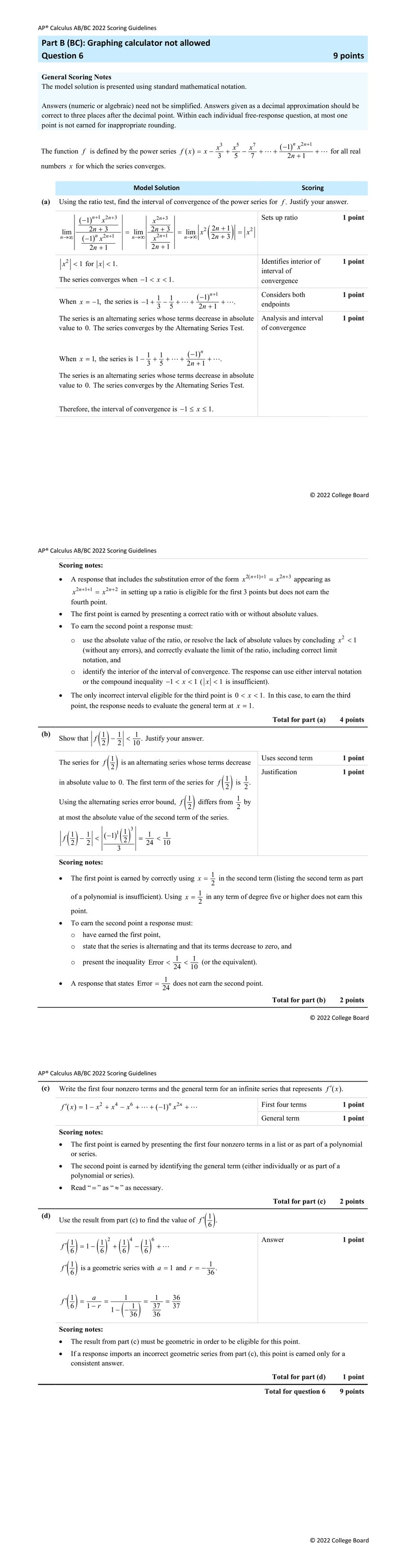
2023 FRQ6 · f''=-2f 递推; Taylor 多项式 + error boundf''=-2f recurrence; Taylor polynomial + error bound No Calculator
The function \(f\) has derivatives of all orders for all real numbers. It is known that \(f(0) = 2\), \(f'(0) = 3\), \(f''(x) = -f(x^2)\), and \(f'''(x) = -2x\cdot f'(x^2)\).
- (A) Find \(f^{(4)}(x)\), the fourth derivative of \(f\) with respect to \(x\). Write the fourth-degree Taylor polynomial for \(f\) about \(x = 0\). Show the work that leads to your answer.
- (B) The fourth-degree Taylor polynomial for \(f\) about \(x = 0\) is used to approximate \(f(0.1)\). Given that \(\left|f^{(5)}(x)\right| \le 15\) for \(0 \le x \le 0.5\), use the Lagrange error bound to show that this approximation is within \(\dfrac{1}{10^5}\) of the exact value of \(f(0.1)\).
- (C) Let \(g\) be the function such that \(g(0) = 4\) and \(g'(x) = e^x f(x)\). Write the second-degree Taylor polynomial for \(g\) about \(x = 0\).
📝 点击展开评分标准(Scoring Guideline)📝 Expand Scoring Guideline
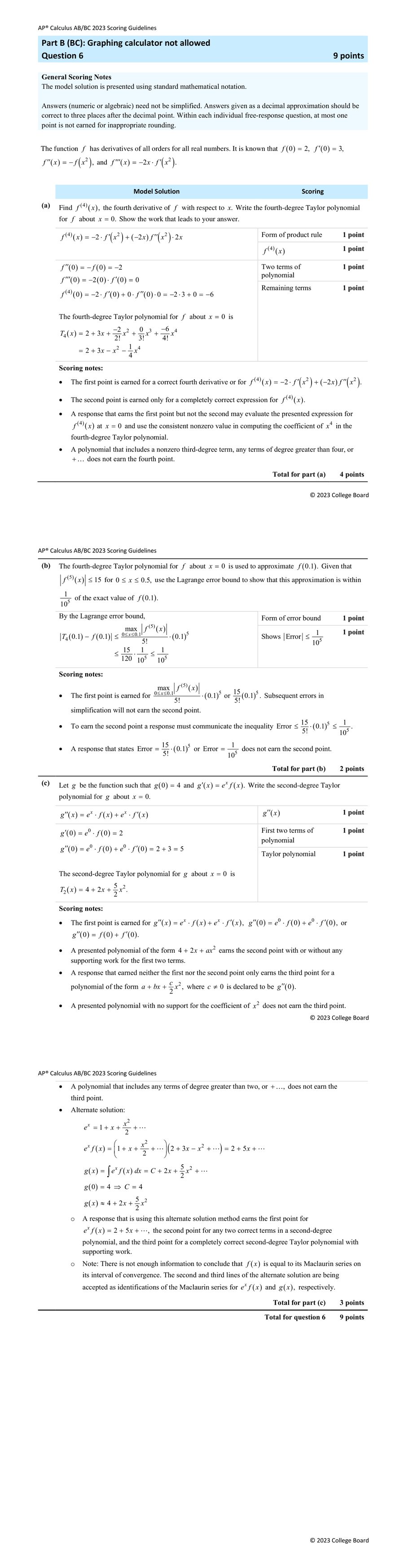
2024 FRQ6 · 🆕 Maclaurin ∑x^n/(n·6^n); R=6, endpoints No Calculator
The Maclaurin series for a function \(f\) is given by \(\displaystyle\sum_{n=1}^{\infty} \dfrac{(n+1)x^n}{n^2\,6^n}\) and converges to \(f(x)\) for all \(x\) in the interval of convergence. It can be shown that the Maclaurin series for \(f\) has a radius of convergence of \(6\).
- (A) Determine whether the Maclaurin series for \(f\) converges or diverges at \(x = 6\). Give a reason for your answer.
- (B) It can be shown that \(f(-3) = \displaystyle\sum_{n=1}^{\infty} \dfrac{(n+1)(-3)^n}{n^2\,6^n} = \displaystyle\sum_{n=1}^{\infty} \dfrac{n+1}{n^2}\left(-\dfrac{1}{2}\right)^n\) and that the first three terms of this series sum to \(S_3 = -\dfrac{125}{144}\). Show that \(|f(-3) - S_3| < \dfrac{1}{50}\).
- (C) Find the general term of the Maclaurin series for \(f'\), the derivative of \(f\). Find the radius of convergence of the Maclaurin series for \(f'\).
- (D) Let \(g(x) = \displaystyle\sum_{n=1}^{\infty} \dfrac{(n+1)x^{2n}}{n^2\,3^n}\). Use the ratio test to determine the radius of convergence of the Maclaurin series for \(g\).
📝 点击展开评分标准(Scoring Guideline)📝 Expand Scoring Guideline

2025 FRQ6 · 🆕 Taylor about x=4; ratio test + 求导级数🆕 Taylor about x=4; ratio test + differentiated series No Calculator
The Taylor series for a function \(f\) about \(x = 4\) is given by \[\sum_{n=1}^{\infty} \frac{(x-4)^{n+1}}{(n+1)\,3^n} = \frac{(x-4)^2}{2 \cdot 3} + \frac{(x-4)^3}{3 \cdot 3^2} + \frac{(x-4)^4}{4 \cdot 3^3} + \cdots + \frac{(x-4)^{n+1}}{(n+1)\,3^n} + \cdots\] and converges to \(f(x)\) on its interval of convergence.
- (A) Using the ratio test, find the interval of convergence of the Taylor series for \(f\) about \(x = 4\). Justify your answer.
- (B) Find the first three nonzero terms and the general term of the Taylor series for \(f'\), the derivative of \(f\), about \(x = 4\).
- (C) The Taylor series for \(f'\) described in part B is a geometric series. For all \(x\) in the interval of convergence of the Taylor series for \(f'\), show that \(f'(x) = \dfrac{x - 4}{7 - x}\).
- (D) It is known that the radius of convergence of the Taylor series for \(f\) about \(x = 4\) is the same as the radius of convergence of the Taylor series for \(f'\) about \(x = 4\). Does the Taylor series for \(f'\) described in part B converge to \(f'(x) = \dfrac{x - 4}{7 - x}\) at \(x = 8\)? Give a reason for your answer.
📝 点击展开评分标准(Scoring Guideline)📝 Expand Scoring Guideline

Part III · 2026 AI 押题模拟卷Part III · 2026 AI Mock Exam
基于 2014–2025 押题概率设计的 6 道原创 FRQ。每题都附完整解答 + 评分细则(严格按 CB 标准 9 分制)。建议卡表做完再看答案。6 original FRQs designed to match 2014-2025 prediction probabilities. Each includes a full solution + 9-point AP rubric. Time yourself before revealing the answer.
Mock FRQ1 · Museum Visitor Flow
A museum is open from 9:00 a.m. (\(t=0\)) to 6:00 p.m. (\(t=9\)). Visitors enter the museum at a rate given by the differentiable function \(A(t) = 200 + 80\sin\!\left(\dfrac{\pi t}{6}\right)\) (people per hour). Visitors leave at a rate modeled by the differentiable function \(L(t) = 30\sqrt{t}\,(10 - t)\) people per hour, for \(0 \le t \le 9\).
When the museum opens at 9:00 a.m. there are already 30 people inside. Let \(N(t)\) denote the number of people in the museum at time \(t\).
(a) Find the value of \(A(3) - L(3)\) and interpret its meaning (include units).
(b) Find the values of \(\displaystyle\int_0^9 A(t)\,dt\) and \(\displaystyle\int_0^9 L(t)\,dt\) (accurate to three decimal places).
(c) Write an integral expression for \(N(t)\) and find \(N(9)\) (round to the nearest integer).
(d) Does \(N(t)\) attain a maximum on \(0 \le t \le 9\)? If so, find the time \(t\) at which this maximum occurs and the corresponding value of \(N(t)\). Justify your answer.
⚠️ 真的做完了?再点开看答案(防手滑)⚠️ Already done? Click only after finishing (anti-slip gate)
你即将看到完整解答 + 评分细则。建议先:You are about to see the full solution + rubric. Recommend first:
- ✅ 用计时器卡完 15 分钟✅ Set a 15-min timer and finish
- ✅ 每问都写了过程,不是只看了答案✅ Write out each part, not just glance at answers
- ✅ 尝试自己写单位 / 符号分析✅ Try writing units + sign analysis yourself
✅ 我已做完,展开完整解答 + 评分标准✅ I am done — reveal full solution + scoring
(a) \(A(3) - L(3)\)
\(A(3) = 200 + 80\sin(\pi/2) = 200 + 80 = 280\); \(L(3) = 30\sqrt{3}(10-3) = 30 \cdot \sqrt{3} \cdot 7 \approx 363.731\).
\(A(3) - L(3) \approx -83.731\) people per hour.
Interpretation: At \(t=3\) (noon), the number of people in the museum is decreasing at a rate of about 83.731 people per hour (more are leaving than entering).
(b) The two definite integrals
\(\displaystyle\int_0^9 A(t)\,dt \approx \mathbf{1952.789}\) (calculator).
\(\displaystyle\int_0^9 L(t)\,dt \approx \mathbf{1574.640}\) (calculator).
(c) Integral expression for the number of people
\[ N(t) = 30 + \int_0^t \big[A(s) - L(s)\big]\,ds \]
\(N(9) = 30 + \int_0^9 A - \int_0^9 L \approx 30 + 1952.789 - 1574.640 \approx \mathbf{408}\) people.
(d) Maximum number of people
Critical points satisfy \(N'(t) = A(t) - L(t) = 0\). Solving \(A(t) = L(t)\) on \([0, 9]\) with a calculator gives two solutions \(t_1 \approx 1.066\) and \(t_2 \approx 8.273\).
Sign analysis:
- \(0 < t < t_1\): \(A > L\), so \(N\) is increasing
- \(t_1 < t < t_2\): \(A < L\), so \(N\) is decreasing
- \(t_2 < t < 9\): \(A > L\), so \(N\) is increasing
Therefore the maximum of \(N\) occurs either at \(t = t_1 \approx 1.066\) or at the endpoint \(t = 9\).
\(N(1.066) \approx 30 + \int_0^{1.066}[A(s) - L(s)]\,ds \approx 30 + 140.3 = 170.3\)
\(N(9) \approx 408\) (see part c)
Therefore the maximum occurs at \(t = 9\), with \(N(9) \approx \mathbf{408}\) people.
Scoring (9 points): (a) 2 pts (computation 1 + interpretation 1); (b) 2 pts (1 pt per integral); (c) 2 pts (expression 1 + numerical value 1); (d) 3 pts (critical points 1 + sign analysis 1 + endpoint comparison / justification 1).
Mock FRQ2 · Particle on a Parametric Curve
A particle moves along a curve in the \(xy\)-plane with position \((x(t), y(t))\), where
\[ \dfrac{dx}{dt} = t^2 - 2t, \qquad \dfrac{dy}{dt} = \ln(1+t^2). \]
At \(t = 0\) the particle is located at \((2, 0)\).
(a) Find the speed of the particle at \(t = 3\), and find the acceleration vector.
(b) Find all times in \(0 \le t \le 4\) at which the particle is at rest, and find all time intervals on which the particle is moving to the left (\(dx/dt < 0\)).
(c) Find the position of the particle \((x(4), y(4))\) at \(t = 4\) (accurate to three decimal places).
(d) Find the total distance traveled by the particle from \(t = 0\) to \(t = 4\).
⚠️ 真的做完了?再点开看答案(防手滑)⚠️ Already done? Click only after finishing (anti-slip gate)
你即将看到完整解答 + 评分细则。建议先:You are about to see the full solution + rubric. Recommend first:
- ✅ 用计时器卡完 15 分钟✅ Set a 15-min timer and finish
- ✅ 每问都写了过程,不是只看了答案✅ Write out each part, not just glance at answers
- ✅ 尝试自己写单位 / 符号分析✅ Try writing units + sign analysis yourself
✅ 我已做完,展开完整解答 + 评分标准✅ I am done — reveal full solution + scoring
(a) Velocity and acceleration at \(t=3\)
\(\dfrac{dx}{dt}\bigg|_{t=3} = 9-6=3,\quad \dfrac{dy}{dt}\bigg|_{t=3} = \ln 10 \approx 2.303\)
Speed \(\|v(3)\| = \sqrt{3^2 + (\ln 10)^2} \approx \mathbf{3.782}\).
Differentiating again with respect to time: \(\dfrac{d^2x}{dt^2} = 2t - 2,\quad \dfrac{d^2y}{dt^2} = \dfrac{2t}{1+t^2}\).
At \(t=3\), \(a = (4,\, 0.6)\).
(b) At rest + moving left
The particle is at rest \(\iff dx/dt = 0\) and \(dy/dt = 0\).
\(dy/dt = \ln(1+t^2) = 0 \Rightarrow t = 0\).
\(dx/dt = t^2 - 2t = t(t-2) = 0 \Rightarrow t = 0\) or \(t = 2\).
Both conditions are satisfied only at \(t = 0\). Therefore the particle is at rest at \(t = 0\).
\(dx/dt < 0 \iff t(t-2) < 0 \iff 0 < t < 2\). The particle moves to the left on \((0, 2)\).
(c) Position at \(t=4\)
\[ x(4) = 2 + \int_0^4 (s^2-2s)\,ds = 2 + \left[\tfrac{s^3}{3} - s^2\right]_0^4 = 2 + \tfrac{64}{3} - 16 = \tfrac{22}{3} \approx \mathbf{7.333} \]
\(y(4) = 0 + \int_0^4 \ln(1+s^2)\,ds \approx \mathbf{5.443}\) (calculator)
(d) Total distance
\[ L = \int_0^4 \sqrt{(t^2-2t)^2 + \left(\ln(1+t^2)\right)^2}\,dt \approx \mathbf{8.412} \]
Scoring (9 points): (a) 2 pts (speed 1 + acceleration 1); (b) 2 pts (at rest 1 + moving left 1); (c) 3 pts (\(x(4)\) 1 + integral setup 1 + \(y(4)\) 1); (d) 2 pts.
Mock FRQ3 · Analysis of the Graph of f' (Semicircle + Line Segments)
Let \(f\) be a differentiable function on \([-4, 6]\) whose derivative \(f'\) has a graph consisting of three pieces:
- \([-4, -1]\): the line segment through \((-4, -3)\) and \((-1, 0)\)
- \([-1, 3]\): the upper semicircle centered at \((1, 0)\) with radius 2 (above the \(x\)-axis)
- \([3, 6]\): the line segment through \((3, 0)\) and \((6, 2)\)
Given that \(f(-4) = 2\). Note: the two line segments meet the semicircle tangentially at the endpoints \(x = -1\) and \(x = 3\) (so the slopes at these two points are 0, with horizontal tangents).
(a) Compute \(f(6)\).
(b) Determine all relative extrema of \(f\) on \([-4, 6]\) and classify each as a max or a min.
(c) Determine all points of inflection of \(f\) on \([-4, 6]\) (i.e., where \(f''\) changes sign).
(d) On \([-4, 6]\), at which \(x\) does \(f\) attain its absolute maximum and absolute minimum? Justify your answer.
⚠️ 真的做完了?再点开看答案(防手滑)⚠️ Already done? Click only after finishing (anti-slip gate)
你即将看到完整解答 + 评分细则。建议先:You are about to see the full solution + rubric. Recommend first:
- ✅ 用计时器卡完 15 分钟✅ Set a 15-min timer and finish
- ✅ 每问都写了过程,不是只看了答案✅ Write out each part, not just glance at answers
- ✅ 尝试自己写单位 / 符号分析✅ Try writing units + sign analysis yourself
✅ 我已做完,展开完整解答 + 评分标准✅ I am done — reveal full solution + scoring
(a) \(f(6)\) via FTC
\(f(6) = f(-4) + \int_{-4}^{6} f'(t)\,dt\)
- \([-4, -1]\) triangle (\(f' < 0\)): area \(-\frac{1}{2} \cdot 3 \cdot 3 = -4.5\)
- \([-1, 3]\) semicircle (\(f' > 0\)): area \(\frac{1}{2}\pi(2)^2 = 2\pi\)
- \([3, 6]\) triangle (\(f' > 0\)): area \(\frac{1}{2} \cdot 3 \cdot 2 = 3\)
\(f(6) = 2 + (-4.5) + 2\pi + 3 = \mathbf{0.5 + 2\pi}\)
(b) Relative extrema
Critical points occur where \(f'(x) = 0\). From the graph: \(f'(-1) = 0, f'(3) = 0\), and \(f'(-4), f'(6)\) are endpoints.
At \(x = -1\): \(f'\) changes from negative (line segment) to positive (semicircle), so \(f\) has a local min.
At \(x = 3\): \(f'\) goes from positive (semicircle) to positive (line segment); no sign change. Although \(f'(3) = 0\), the tangent is horizontal here but this is not a relative extremum.
Conclusion: the only relative extremum is the local min at \(x = -1\).
(c) Points of inflection
Points of inflection \(\iff f''\) changes sign \(\iff f'\) switches from increasing to decreasing (or vice versa).
\([-4, -1]\): \(f'\) is a line segment of slope 1 (rising from -3 to 0), so \(f' \nearrow \Rightarrow f'' > 0\)
\([-1, 1]\): left half of the semicircle (\(f'\) rises from 0 to 2), \(f'\) still increasing \(\Rightarrow f'' > 0\)
\([1, 3]\): right half of the semicircle (\(f'\) falls from 2 to 0), \(f' \searrow \Rightarrow f'' < 0\)
\([3, 6]\): \(f'\) is a line segment of slope 2/3 > 0 (rising from 0 to 2), \(f' \nearrow \Rightarrow f'' > 0\)
Because the line segments meet the semicircle tangentially at \(x = -1\) and \(x = 3\) (smooth transition), \(f''\) is positive on both sides of \(x = -1\) (no sign change), while at \(x = 3\) it is negative on the left and positive on the right (sign change).
Points of inflection: \(x = 1\) (\(f''\) changes from + to -) and \(x = 3\) (\(f''\) changes from - to +). \(x = -1\) is not a point of inflection.
(d) Absolute extrema
Candidates: endpoints \(x = -4, 6\) and the interior critical point \(x = -1\) (local min).
\(f(-4) = 2\)
\(f(-1) = 2 + \int_{-4}^{-1} f' = 2 + (-4.5) = -2.5\)
\(f(6) = 0.5 + 2\pi \approx 6.78\)
Absolute maximum: \(f(6) = 0.5 + 2\pi\), attained at \(x = 6\)
Absolute minimum: \(f(-1) = -2.5\), attained at \(x = -1\)
Scoring (9 points): (a) 3 pts (FTC setup 1 + area decomposition 1 + answer 1); (b) 2 pts; (c) 2 pts; (d) 2 pts.
Mock FRQ4 · Table + MVT + Numerical Approximation
The velocity function \(v(t)\) describes an object moving along a straight line (in meters per second), and is continuously differentiable on \([0, 12]\). Selected values of \(v(t)\) are given below:
| \(t\) (sec) | 0 | 2 | 5 | 8 | 12 |
|---|---|---|---|---|---|
| \(v(t)\) (m/s) | 10 | 6 | -2 | 3 | 7 |
The object is at the origin at \(t = 0\). Let \(x(t)\) be the position function.
(a) Use a trapezoidal sum with 4 subintervals to approximate \(\displaystyle\int_0^{12} v(t)\,dt\), and interpret its physical meaning.
(b) On \([2, 5]\), must there exist a time \(c\) such that \(v'(c) = -\dfrac{8}{3}\)? State the theorem you use.
(c) What does \(\displaystyle\int_0^{12} |v(t)|\,dt\) represent physically? How is it different from \(\displaystyle\int_0^{12} v(t)\,dt\)?
(d) Based on the data in the table, list all candidate \(t\) values in \([0, 12]\) at which \(|x(t)|\) could attain its maximum (give reasons), and determine whether the final position \(x(12)\) is on the positive or negative side of the origin.
⚠️ 真的做完了?再点开看答案(防手滑)⚠️ Already done? Click only after finishing (anti-slip gate)
你即将看到完整解答 + 评分细则。建议先:You are about to see the full solution + rubric. Recommend first:
- ✅ 用计时器卡完 15 分钟✅ Set a 15-min timer and finish
- ✅ 每问都写了过程,不是只看了答案✅ Write out each part, not just glance at answers
- ✅ 尝试自己写单位 / 符号分析✅ Try writing units + sign analysis yourself
✅ 我已做完,展开完整解答 + 评分标准✅ I am done — reveal full solution + scoring
(a) Trapezoidal Sum
Subinterval widths: 2, 3, 3, 4.
\[ \int_0^{12} v\,dt \approx \tfrac{1}{2}(10+6)(2) + \tfrac{1}{2}(6-2)(3) + \tfrac{1}{2}(-2+3)(3) + \tfrac{1}{2}(3+7)(4) \]
\(= 16 + 6 + 1.5 + 20 = \mathbf{43.5}\) meters.
Physical meaning: \(\int_0^{12} v\,dt\) is the net displacement. The trapezoidal sum estimates the net displacement to be about 43.5 meters.
(b) MVT
\(v\) is continuously differentiable on \([2, 5]\) (by hypothesis), so by the Mean Value Theorem there exists \(c \in (2, 5)\) such that
\[ v'(c) = \frac{v(5) - v(2)}{5 - 2} = \frac{-2 - 6}{3} = -\frac{8}{3}. \]
So the answer is yes, guaranteed by the MVT.
(c) Distinguishing the two integrals
\(\int_0^{12} |v(t)|\,dt\) is the total distance traveled—independent of direction.
\(\int_0^{12} v(t)\,dt\) is the net displacement—signed, with positive and negative contributions cancelling.
Since \(v\) changes sign on \([2, 5]\) (\(v(2) = 6 > 0, v(5) = -2 < 0\)) and changes sign again on \([5, 8]\) (\(v(8) = 3 > 0\)), the two values must differ: total distance > net displacement.
(d) Candidates for maximum of |x(t)|
The position satisfies \(x(t) = \int_0^t v(s)\,ds\). Candidates for a local extremum of \(|x(t)|\) are the extrema of \(x\) or the endpoints. Since \(x'(t) = v(t)\), the extrema of \(|x|\) occur at times where \(v(t) = 0\) (direction reversals) together with the endpoints \(t = 0, 12\).
From the table:
- \(v(2) = 6 > 0\) and \(v(5) = -2 < 0\) \(\Rightarrow\) by IVT there exists \(t_1 \in (2, 5)\) with \(v(t_1) = 0\) (the object decelerates to rest and reverses direction)
- \(v(5) = -2 < 0\) and \(v(8) = 3 > 0\) \(\Rightarrow\) there exists \(t_2 \in (5, 8)\) with \(v(t_2) = 0\)
Candidate \(t\) values: \(t = 0,\ t_1 \in (2,5),\ t_2 \in (5,8),\ t = 12\).
Using the trapezoidal sum to estimate \(x\) at each node (by summing the trapezoidal integral of \(v\) piece by piece): \(x(0) = 0,\ x(2) \approx 16,\ x(5) \approx 16 + 6 = 22,\ x(8) \approx 23.5,\ x(12) \approx 43.5\). All values are positive, and \(x(12)\) is the largest.
Conclusion: \(x(12) \approx 43.5 > 0\), so the object ends on the positive side of the origin. Based on this estimate, the object is farthest from the origin at \(t = 12\); however, since the trapezoidal sum is only an approximation and the exact values of \(x(t_1), x(t_2)\) are unknown, we cannot strictly rule out that \(|x|\) is larger at \(t_1\) or \(t_2\) without additional data.
Scoring (9 points): (a) 2 pts (trapezoidal sum 1 + interpretation 1); (b) 2 pts; (c) 2 pts; (d) 3 pts (identifying candidates 2 + conclusion with justification 1).
Mock FRQ5 · Separable Differential Equation
Consider the differential equation \(\displaystyle\frac{dy}{dx} = x(y - 1)^2\) with the initial condition \(y(0) = 3\).
(a) On the given \(xy\)-grid, sketch the slope field for the differential equation at the 9 sample points (\(x = -2, 0, 2\); \(y = 0, 1, 3\)).
(b) Use Euler's Method with step size \(h = 0.25\), starting from \(y(0) = 3\), to take 2 steps and obtain an approximation of \(y(0.5)\).
(c) Use separation of variables to find the explicit solution \(y = f(x)\) of the initial value problem \(\dfrac{dy}{dx} = x(y-1)^2,\ y(0) = 3\) (include its domain).
(d) Use the solution from (c) to compute the exact value of \(y(0.5)\) and compare it with the Euler approximation from (b). State whether Euler's method overestimates or underestimates, and explain using the concavity of \(y\) on \([0, 0.5]\).
⚠️ 真的做完了?再点开看答案(防手滑)⚠️ Already done? Click only after finishing (anti-slip gate)
你即将看到完整解答 + 评分细则。建议先:You are about to see the full solution + rubric. Recommend first:
- ✅ 用计时器卡完 15 分钟✅ Set a 15-min timer and finish
- ✅ 每问都写了过程,不是只看了答案✅ Write out each part, not just glance at answers
- ✅ 尝试自己写单位 / 符号分析✅ Try writing units + sign analysis yourself
✅ 我已做完,展开完整解答 + 评分标准✅ I am done — reveal full solution + scoring
(a) Slope field
Slope at sample points \(m = x(y-1)^2\):
| \(y=0\) | \(y=1\) | \(y=3\) | |
|---|---|---|---|
| \(x=-2\) | -2 | 0 | -8 |
| \(x=0\) | 0 | 0 | 0 |
| \(x=2\) | 2 | 0 | 8 |
Along the entire row \(y = 1\) the slope is identically 0. Along the entire column \(x = 0\) the slope is also identically 0.
(b) Euler's Method, \(h=0.25\)
Step 1: \(x_0 = 0, y_0 = 3\). Slope \(= 0 \cdot (3-1)^2 = 0\). \(y_1 = 3 + 0.25 \cdot 0 = 3\), \(x_1 = 0.25\).
Step 2: \(x_1 = 0.25, y_1 = 3\). Slope \(= 0.25 \cdot (3-1)^2 = 1\). \(y_2 = 3 + 0.25 \cdot 1 = \mathbf{3.25}\), \(x_2 = 0.5\).
Euler approximation: \(y(0.5) \approx \mathbf{3.25}\).
(c) Analytic solution
Separate variables: \(\dfrac{dy}{(y-1)^2} = x\,dx\).
Integrate: \(-\dfrac{1}{y-1} = \dfrac{x^2}{2} + C\).
Substitute \(x = 0, y = 3\): \(-\dfrac{1}{2} = C\), so \(C = -\dfrac{1}{2}\).
\(-\dfrac{1}{y-1} = \dfrac{x^2 - 1}{2}\) \(\Rightarrow y - 1 = \dfrac{2}{1 - x^2}\),
\[ y = 1 + \frac{2}{1 - x^2}, \quad |x| < 1. \]
(d) Comparing \(y(0.5)\) + concavity
Exact: \(y(0.5) = 1 + \dfrac{2}{1 - 0.25} = 1 + \dfrac{2}{0.75} = 1 + \dfrac{8}{3} \approx \mathbf{3.667}\).
The Euler value \(3.25 < 3.667\), so Euler underestimates.
Concavity explanation: On \([0, 0.5]\), examine the sign of \(y''\).
\(y'' = \dfrac{d}{dx}[x(y-1)^2] = (y-1)^2 + x \cdot 2(y-1)y' = (y-1)^2 + 2x(y-1) \cdot x(y-1)^2\)
\(= (y-1)^2 [1 + 2x^2(y-1)]\).
On \([0, 0.5]\) we have \(y > 3 > 1\) and \(x \ge 0\), so \((y-1)^2 > 0\) and \(1 + 2x^2(y-1) > 0\), hence \(y'' > 0\): \(y\) is concave up.
Euler's method uses the tangent line (slope at the left endpoint) to step forward, and a concave-up curve lies above its tangent line, so approximating along the tangent below the curve \(\Rightarrow\) Euler underestimates.
Scoring (9 points): (a) 2 pts; (b) 2 pts; (c) 3 pts (separation 1 + integration 1 + explicit form + domain 1); (d) 2 pts (exact value + concavity justification).
Mock FRQ6 · Power Series Convergence and Taylor Approximation
Consider the power series \(\displaystyle f(x) = \sum_{n=1}^{\infty} \frac{(-1)^n (x - 2)^n}{n^2 \cdot 3^n}\).
(a) Use the Ratio Test to find the radius of convergence \(R\) of the series.
(b) Determine whether the endpoints \(x = -1\) and \(x = 5\) belong to the interval of convergence. Then give the interval of convergence of \(f\).
(c) Differentiate term-by-term to obtain the power series for \(f'(x)\). Write out the first 4 terms (starting at \(n = 1\)) and find the interval of convergence of \(f'(x)\) (include endpoint analysis).
(d) Let \(P_3(x)\) be the 3rd-degree Taylor polynomial of \(f\) centered at \(x = 2\). Show that \(|f(5) - P_3(5)| \le \dfrac{1}{16}\). State clearly which theorem is used and verify that its hypotheses are satisfied.
⚠️ 真的做完了?再点开看答案(防手滑)⚠️ Already done? Click only after finishing (anti-slip gate)
你即将看到完整解答 + 评分细则。建议先:You are about to see the full solution + rubric. Recommend first:
- ✅ 用计时器卡完 15 分钟✅ Set a 15-min timer and finish
- ✅ 每问都写了过程,不是只看了答案✅ Write out each part, not just glance at answers
- ✅ 尝试自己写单位 / 符号分析✅ Try writing units + sign analysis yourself
✅ 我已做完,展开完整解答 + 评分标准✅ I am done — reveal full solution + scoring
(a) Ratio Test
\(a_n = \dfrac{(-1)^n (x-2)^n}{n^2 \cdot 3^n}\).
\[\left|\dfrac{a_{n+1}}{a_n}\right| = \dfrac{|x-2|}{3} \cdot \dfrac{n^2}{(n+1)^2} \xrightarrow{n\to\infty} \dfrac{|x-2|}{3}.\]
The Ratio Test requires this to be \(< 1\): \(|x - 2| < 3\). \(R = 3\).
(b) Endpoints of \(f\)
\(x = -1\): \(\sum \dfrac{(-1)^n (-3)^n}{n^2 \cdot 3^n} = \sum \dfrac{(-1)^n (-1)^n 3^n}{n^2 \cdot 3^n} = \sum \dfrac{1}{n^2}\). This is a \(p\)-series with \(p = 2 > 1\), so it converges.
\(x = 5\): \(\sum \dfrac{(-1)^n 3^n}{n^2 \cdot 3^n} = \sum \dfrac{(-1)^n}{n^2}\). The series of absolute values \(\sum 1/n^2\) converges, so this series converges absolutely.
Interval of convergence of \(f\): \([-1, 5]\).
(c) First 4 terms of \(f'(x)\) + interval of convergence
Differentiating term-by-term: \(f'(x) = \sum_{n=1}^\infty \dfrac{(-1)^n (x-2)^{n-1}}{n \cdot 3^n}\).
First 4 terms (\(n = 1, 2, 3, 4\)):
\(-\dfrac{1}{3} + \dfrac{x-2}{18} - \dfrac{(x-2)^2}{81} + \dfrac{(x-2)^3}{324}\)
The open interval agrees with the original series: \((-1, 5)\). We need to check both endpoints.
\(x = -1\): substituting \((x-2) = -3\), \(\sum \dfrac{(-1)^n (-3)^{n-1}}{n \cdot 3^n} = \sum \dfrac{(-1)^n (-1)^{n-1} 3^{n-1}}{n \cdot 3^n} = -\dfrac{1}{3}\sum \dfrac{1}{n}\). This is the harmonic series times (-1/3), so it diverges.
\(x = 5\): substituting \((x-2) = 3\), \(\sum \dfrac{(-1)^n 3^{n-1}}{n \cdot 3^n} = \dfrac{1}{3}\sum \dfrac{(-1)^n}{n}\). This is the alternating harmonic series, which converges conditionally.
Therefore the interval of convergence of \(f'\) is \((-1, 5]\) (open on the left, closed on the right).
(d) Showing \(|f(5) - P_3(5)| \le \dfrac{1}{16}\)
At \(x = 5\), the series \(f(5) = \sum \dfrac{(-1)^n}{n^2}\) is an alternating series.
Verifying the conditions of the Alternating Series Estimation Theorem: let \(b_n = \dfrac{1}{n^2}\), then
- \(b_n > 0\): holds for all \(n \ge 1\) ✓
- \(b_n\) is decreasing: \(1/(n+1)^2 < 1/n^2\) ✓
- \(\lim b_n = 0\) ✓
The theorem applies. \(P_3(x)\) is the 3rd-degree Taylor polynomial = the sum of the first 3 terms of the series (\(n = 1, 2, 3\)). The error satisfies
\[ |f(5) - P_3(5)| \le |a_4| = \left|\dfrac{(-1)^4 \cdot 3^4}{4^2 \cdot 3^4}\right| = \dfrac{1}{16}. \]
Q.E.D.
Scoring (9 points): (a) 2 pts; (b) 2 pts (1 pt per endpoint); (c) 3 pts (series formula 1 + first 4 terms 1 + endpoint analysis 1); (d) 2 pts (theorem hypotheses 1 + bound 1).
▾Part IV · MCQ 真题库(381 题)Part IV · MCQ Past Question Bank (381 Qs)
MCQ 真题(2008 / 2012 / 2014 / 2015 / 2016 / 2018 / 2019 / 2021 / 2022)。用下面的筛选按年份 / 分卷 / 考点(Unit)组合。点「答案」查看答案。MCQ past questions (2008 / 2012 / 2014 / 2015 / 2016 / 2018 / 2019 / 2021 / 2022). Filter by year / section / unit; click 'Answer' to reveal.
AP Calculus BC 练习卷
答题卡
AP Calculus BC · FRQ 练习卷
Part V · 考前 24 小时 Cheat Sheet (BC)
必背公式卡
参数运动
速度 \(\|v\| = \sqrt{(dx/dt)^2 + (dy/dt)^2}\)
加速度 \(\vec a = (x''(t), y''(t))\)
切线 \(\frac{dy}{dx} = \frac{dy/dt}{dx/dt}\)
弧长 \(= \int \|v(t)\|\,dt\)
极坐标
面积 \(A = \frac{1}{2}\int_\alpha^\beta r^2(\theta)\,d\theta\)
\(x = r\cos\theta,\ y = r\sin\theta\)
两曲线间 \(\frac{1}{2}\int(r_{\text{out}}^2 - r_{\text{in}}^2)\,d\theta\)
微分方程
Euler: \(y_{n+1} = y_n + h \cdot f(x_n, y_n)\)
Logistic: \(dP/dt = kP(1-P/L)\),拐点 \(P = L/2\)
Taylor 近似: \(P_2(x) = y_0 + y'(a)(x-a) + \frac{y''(a)}{2}(x-a)^2\)
级数 · 6 大 Maclaurin
\(e^x = \sum \frac{x^n}{n!}\)
\(\sin x = \sum \frac{(-1)^n x^{2n+1}}{(2n+1)!}\)
\(\cos x = \sum \frac{(-1)^n x^{2n}}{(2n)!}\)
\(\frac{1}{1-x} = \sum x^n\)(\(|x|<1\))
\(\ln(1+x) = \sum \frac{(-1)^{n+1} x^n}{n}\)
\(\arctan x = \sum \frac{(-1)^n x^{2n+1}}{2n+1}\)
收敛判定
Ratio test: \(L = \lim |a_{n+1}/a_n|\)
Alt series: \(b_n \searrow 0\) ⇒ 收敛
p-series: \(\sum 1/n^p\) 收敛 ⇔ \(p>1\)
几何级数: \(\sum ar^n\) 收敛 ⇔ \(|r|<1\)
Lagrange Error Bound
\(|f(x) - T_n(x)| \le \frac{M}{(n+1)!}|x-a|^{n+1}\)
M = \(\max |f^{(n+1)}|\) 在区间上
积分技巧
u-sub: \(u = g(x),\ du = g'(x)\,dx\)
分部: \(\int u\,dv = uv - \int v\,du\)
部分分式: \(\frac{1}{x(x-a)} = \frac{A}{x} + \frac{B}{x-a}\)
三角替换: \(\sqrt{a^2-x^2} \Rightarrow x = a\sin\theta\)
导数复习
\((\sin x)' = \cos x,\ (\cos x)' = -\sin x\)
\((\tan x)' = \sec^2 x\)
\((\ln x)' = 1/x,\ (e^x)' = e^x\)
\((\arctan x)' = 1/(1+x^2)\)
链式: \((f(g(x)))' = f'(g(x)) \cdot g'(x)\)
考场 5 条纪律
- Calc 部分(FRQ1, 2)所有积分/方程求根都让计算器做,别手算。
- 每一问都写单位(cars, meters, seconds, dollars)。没单位 = 丢点。
- "Justify your answer" 必须写「因为 f' 从正变负,故是 local max」完整因果句。
- 不要提前翻后面 — Part B 封住的意思是到点才能打开。
- 留 10 分钟 buffer 给 FRQ6(级数),这是最容易拖时间的槽位。
最后 10 条高频陷阱
- 参数速度是 \(\sqrt{(dx/dt)^2 + (dy/dt)^2}\),不是 \(dx/dt + dy/dt\)
- 极坐标面积公式有 \(\frac{1}{2}\),不是 \(\int r\,d\theta\)
- MVT 三条件:连续、可导、结论(缺一条扣分)
- Trapezoidal 公式有 \(\frac{1}{2}\) 系数
- 可分离 DE 解完要验证定义域(\(\ln\) 的输入 > 0,\(\sqrt{\cdot}\) 取正支)
- Euler 2 步 = 2 次递推,不是 3 次
- Ratio test 取绝对值 \(\lim|a_{n+1}/a_n|\),忘取符号会错
- Power series 端点 2 个都要单独验
- Lagrange 用 \(f^{(n+1)}\) 不是 \(f^{(n)}\)
- f' 图上的面积 = f 值的变化,不是 f 本身
Part V · 24-Hour Pre-Exam Cheat Sheet (BC)
Must-Know Formula Cards
Parametric Motion
Speed \(\|v\| = \sqrt{(dx/dt)^2 + (dy/dt)^2}\)
Acceleration \(\vec a = (x''(t), y''(t))\)
Tangent \(\frac{dy}{dx} = \frac{dy/dt}{dx/dt}\)
Arc length \(= \int \|v(t)\|\,dt\)
Polar Coordinates
Area \(A = \frac{1}{2}\int_\alpha^\beta r^2(\theta)\,d\theta\)
\(x = r\cos\theta,\ y = r\sin\theta\)
Between two curves \(\frac{1}{2}\int(r_{\text{out}}^2 - r_{\text{in}}^2)\,d\theta\)
Differential Equations
Euler: \(y_{n+1} = y_n + h \cdot f(x_n, y_n)\)
Logistic: \(dP/dt = kP(1-P/L)\), inflection point \(P = L/2\)
Taylor approx: \(P_2(x) = y_0 + y'(a)(x-a) + \frac{y''(a)}{2}(x-a)^2\)
Series · 6 Key Maclaurin
\(e^x = \sum \frac{x^n}{n!}\)
\(\sin x = \sum \frac{(-1)^n x^{2n+1}}{(2n+1)!}\)
\(\cos x = \sum \frac{(-1)^n x^{2n}}{(2n)!}\)
\(\frac{1}{1-x} = \sum x^n\) (\(|x|<1\))
\(\ln(1+x) = \sum \frac{(-1)^{n+1} x^n}{n}\)
\(\arctan x = \sum \frac{(-1)^n x^{2n+1}}{2n+1}\)
Convergence Tests
Ratio test: \(L = \lim |a_{n+1}/a_n|\)
Alt series: \(b_n \searrow 0\) ⇒ converges
p-series: \(\sum 1/n^p\) converges ⇔ \(p>1\)
Geometric series: \(\sum ar^n\) converges ⇔ \(|r|<1\)
Lagrange Error Bound
\(|f(x) - T_n(x)| \le \frac{M}{(n+1)!}|x-a|^{n+1}\)
M = \(\max |f^{(n+1)}|\) on the interval
Integration Techniques
u-sub: \(u = g(x),\ du = g'(x)\,dx\)
By parts: \(\int u\,dv = uv - \int v\,du\)
Partial fractions: \(\frac{1}{x(x-a)} = \frac{A}{x} + \frac{B}{x-a}\)
Trig sub: \(\sqrt{a^2-x^2} \Rightarrow x = a\sin\theta\)
Derivative Review
\((\sin x)' = \cos x,\ (\cos x)' = -\sin x\)
\((\tan x)' = \sec^2 x\)
\((\ln x)' = 1/x,\ (e^x)' = e^x\)
\((\arctan x)' = 1/(1+x^2)\)
Chain rule: \((f(g(x)))' = f'(g(x)) \cdot g'(x)\)
5 Exam-Day Rules
- Calculator section (FRQ1, 2): let the calculator do all integrals and root-finding, don't compute by hand.
- Always write units (cars, meters, seconds, dollars). No units = lost points.
- "Justify your answer" must include full cause-effect: "because f' changes from positive to negative, this is a local max".
- Don't flip ahead — sealed Part B means don't open until instructed.
- Leave 10 min buffer for FRQ6 (series) — this slot drains the most time.
Top 10 High-Frequency Traps
- Parametric speed is \(\sqrt{(dx/dt)^2 + (dy/dt)^2}\), not \(dx/dt + dy/dt\)
- Polar area formula has \(\frac{1}{2}\), not \(\int r\,d\theta\)
- MVT three conditions: continuity, differentiability, conclusion (missing one loses points)
- Trapezoidal formula has \(\frac{1}{2}\) coefficient
- Separable DE solution must check domain (\(\ln\) input > 0, \(\sqrt{\cdot}\) take positive branch)
- Euler 2 steps = 2 iterations, not 3
- Ratio test takes absolute value \(\lim|a_{n+1}/a_n|\); forgetting the sign causes errors
- Power series both endpoints must be tested separately
- Lagrange uses \(f^{(n+1)}\), not \(f^{(n)}\)
- Area under f' graph = change in f values, not f itself